House subcommittee questions oil train safety after fiery crashes

Fiery and sometimes deadly derailments have drawn attention to the safety of train cars.

February 27, 2014 at 3:04PM
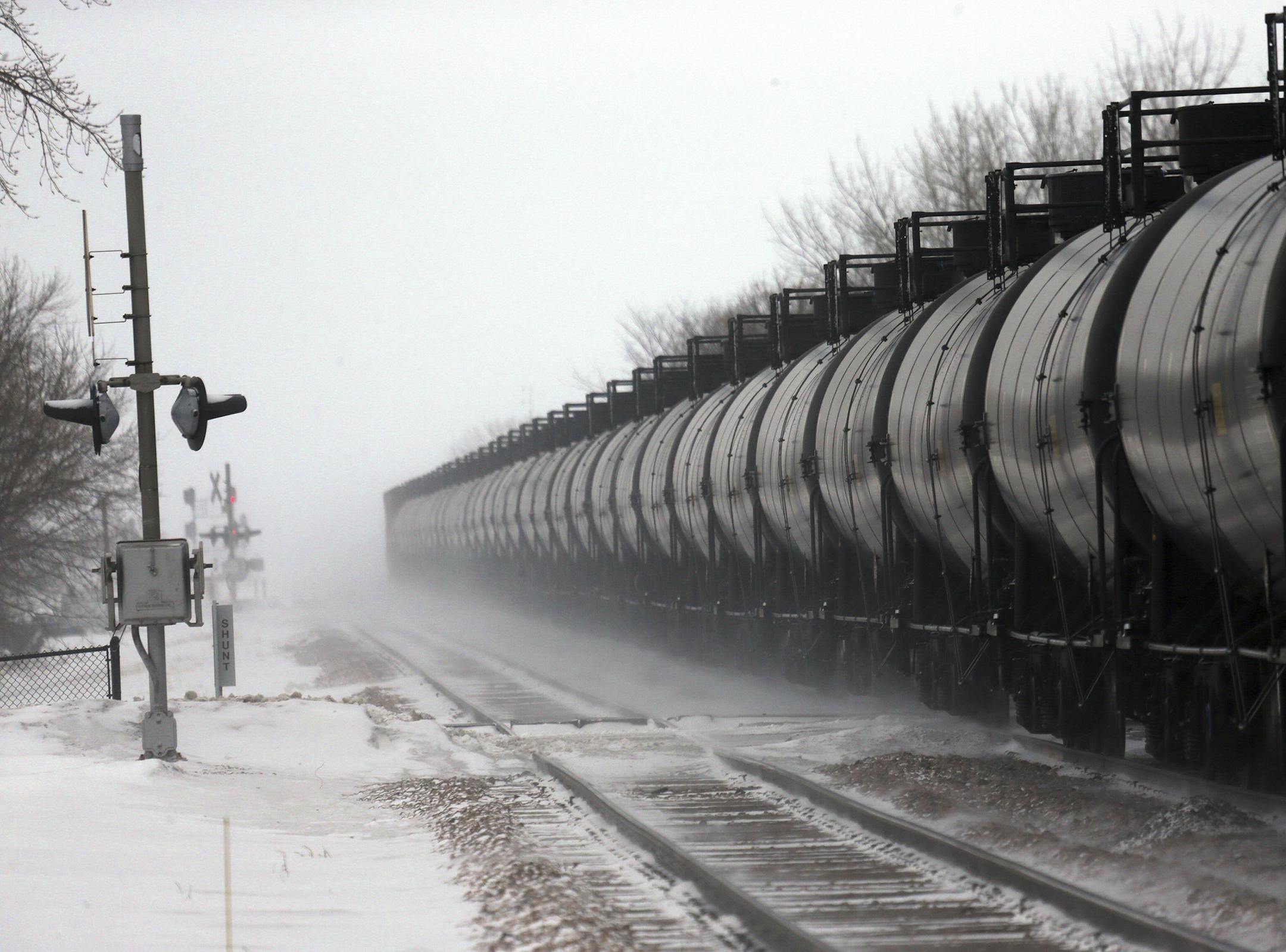
FILE -- Cars on an oil train roll through Casselton, N.D., where an explosive rail accident took place in December, Jan. 16, 2014. Responding to concerns about the safety of trains carrying oil around the country, federal regulators on Feb. 21 outlined voluntary measures for railroads to reduce the risk of rail shipments and bolster confidence in the fast-growing industry. (Jim Wilson/The New York Times)
Cars on an oil train roll through Casselton, N.D., where a mile-long train derailed and exploded. No one was killed in the December accident. (The Minnesota Star Tribune)

WASHINGTON – Tests of crude oil taken from North Dakota's Bakken Formation found that nearly one in five samples may have been improperly classified for shipment, a federal regulator said Wednesday.

Cynthia Quarterman, the leader of the Pipeline and Hazardous Materials Safety Administration (PHMSA), testified to a House subcommittee that 58 samples of Bakken crude inspected for proper classification uncovered 11 potential violations.

Improperly classified crude oil could increase the chances of fires or explosions if oil trains derail and tanker cars rupture. It also leaves local fire officials in the dark about the type of hazardous material they are dealing with when accidents occur.

Quarterman's presentation came as Congress focuses on recent fiery and sometimes deadly derailments of rail cars carrying crude oil across the United States and Canada. About eight of those oil trains pass through Minnesota daily, including six that travel through the Twin Cities metro area headed to refineries in the east and south.

The agency "has initiated enforcement actions on violators," Quarterman said in written testimony to the subcommittee. "In addition, as these violations could indicate further noncompliance issues, PHMSA continues to expand the scope of its investigations."

On Tuesday, the U.S. Department of Transportation issued an emergency order requiring better testing of Bakken crude, which some experts believe is more volatile than other types of crude oil because of its vapor pressure.

"If you intend to move crude oil by rail, then you must test and classify the material appropriately," Transportation Secretary Anthony Foxx said in a statement.

More frequent track inspections and better informed employees are also part of the plan for accident prevention, a series of government and private rail industry officials told the House Subcommittee on Railroads, Pipelines and Hazardous Materials.

The hearing placed heavy emphasis on proper labeling and better shipping containers for oil products, including building rail cars that can better withstand accidents without rupturing.

The National Transportation Safety Administration (NTSB) has "long-standing concerns" that the current standards for rail cars carrying crude oil pose "an unacceptable public risk," NTSB board member Robert Sumwalt told the subcommittee.

There is also a need to make sure that crude oil producers test their product sufficiently before they load it on rail cars, Quarterman said. "We don't know what we're getting." she said.

Details about flash points, boiling points and other measures of volatility help determine how crude oil should be shipped. Jack Gerard, president of the American Petroleum Institute, countered that oil companies test adequately and understand their products, but don't understand what additional testing the government wants. Gerard insisted that the vapor pressure in Bakken crude is similar to other forms of light crude oil.

Subcommittee member Tim Walz, a Democrat representing Minnesota's First District, stressed the need to prevent accidents and rail car ruptures.

The tank cars now in use "have done their time," Walz said. "We have better technology."

Bakken is 'new animal'

As for classification issues, Walz called Bakken crude "a new animal" for which testing protocols need to be worked out.

"One thing the public doesn't understand is that this is a collaboration by necessity," he said. "The railroads want to know what's in there, and my first responders want to know what's in there."

Even if they know, Walz said communities where oil trains routinely pass lack the training and resources to deal with spills and explosions like one that occurred Dec. 30 in Casselton, N.D. In that crash, a mile-long oil train derailed and exploded, forcing the evacuation of thousands of citizens.

Walz said fire chiefs in his district have told him "there are probably not three fire departments in America that could respond to a Casselton-type of incident."

Wednesday's hearing sparked some verbal explosions as subcommittee members pressed regulators on when they would issue new standards to improve the safety of tanker cars.

The rail industry needs to "stop using these crummy cars and killing people," Oregon Democrat Peter DeFazio said.

While the delivery of crude oil via trains has a very low accident rate, the accidents that occur tend to be high profile and destructive. And the risk of accidents will grow as oil shipments increase.

Roughly 70 percent of the oil coming out of North Dakota moves by train, and Rep. Kevin Cramer, R-N.D., said that trains will eventually carry 90 percent of the state's crude to refineries.

Meanwhile, oil production in the Bakken Formation, which was less than 200,000 barrels per day in 2007, now approaches 1 million barrels per day.

Cramer likened the oil boom in North Dakota to "watching a gold rush on a big-screen TV."

Jim Spencer • 202-383-6123


Rep. Jeff Denham (R-CA)
Rep. Jeff Denham (R-CA) (The Minnesota Star Tribune)
Cynthia Quarterman, of the Pipeline and Hazardous Materials Safety Administration, told the subcommittee that 11 potential classification violations were found among 58 samples of Bakken crude. Improperly classified crude could increase the chances of fire or explosion and would hinder proper response to a crisis.
Cynthia Quarterman, of the Pipeline and Hazardous Materials Safety Administration, told the subcommittee that 11 potential classification violations were found among 58 samples of Bakken crude. Improperly classified crude could increase the chances of fire or explosion and would hinder proper response to a crisis. (The Minnesota Star Tribune)
Robert Sumwalt, member, National Transportation Safety Board, testifies before the House Subcommittee on Railroads, Pipelines and Hazardous Materials, during a hearing on Capitol Hill on Wednesday, Feb. 26, 2014 in Washington, D.C. The hearing was to examine steps being taken by the industry and government to continue improving rail safety. (Pete Marovich/MCT) ORG XMIT: 1149722
Sumwalt (The Minnesota Star Tribune)
about the writer

about the writer

Jim Spencer

Washington Correspondent

Washington correspondent Jim Spencer examines the impact of federal politics and policy on Minnesota businesses, especially the medical technology, food distribution, farming, manufacturing, retail and health insurance industries.  

See Moreicon

More from Business

See More
Hennepin Healthcare Clinic and Specialty Center,l 8th Street between Park Av and Chicago Av.
The Minnesota Star Tribune

Minneapolis-based Hennepin Healthcare says it also will suspend contributions to some worker retirement plans while pausing $24 million in capital projects.

The newly renovated Parkway Theater is next door to the new restaurant El Burrito Mercado.
card image