

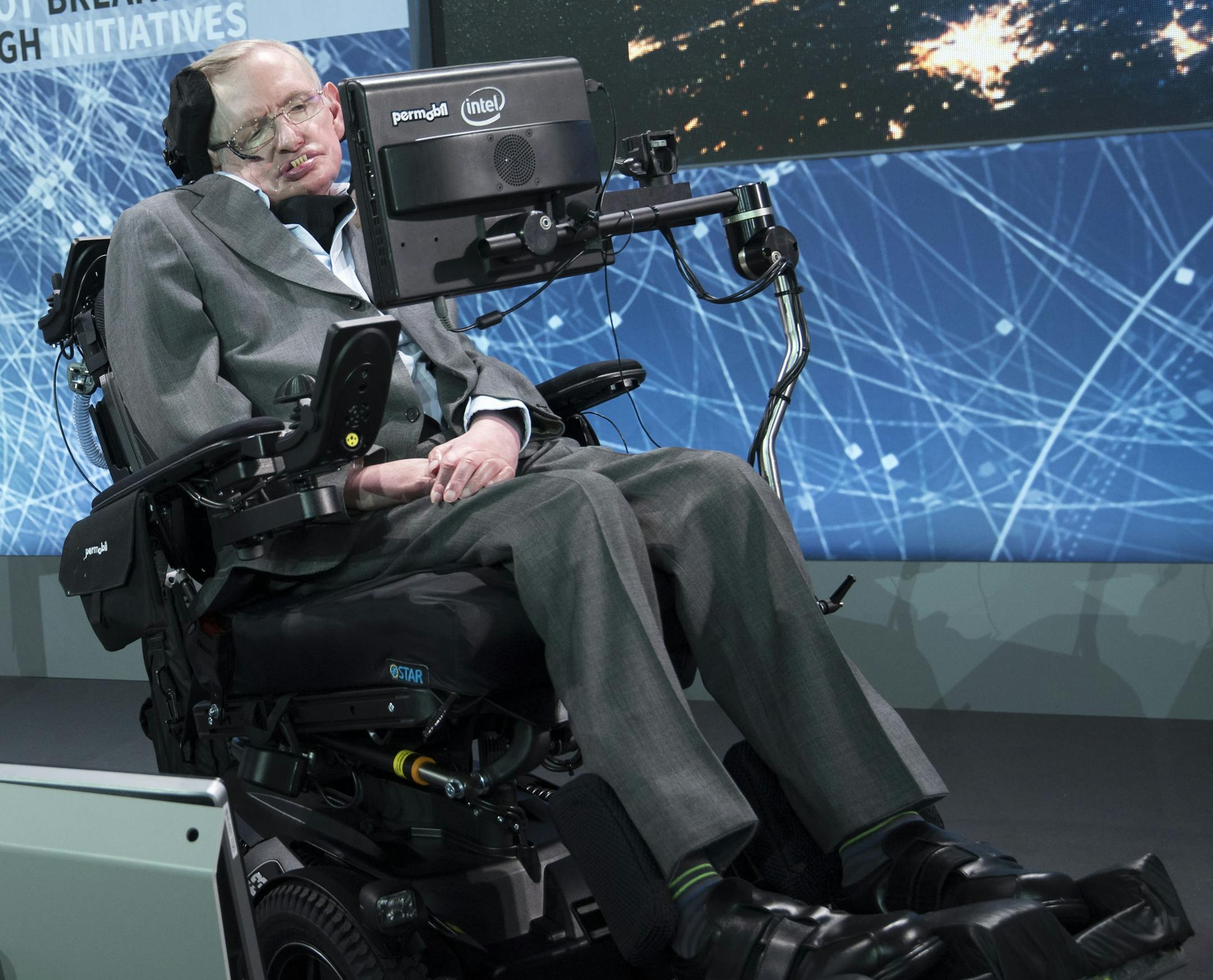
In 2002, the future Nobel Prize-winner Peter Higgs joined several fellow physicists at a dinner in Edinburgh, Scotland. Drinks flowed, and professional invective followed. The physicists were frustrated by, and perhaps a little jealous of, Stephen Hawking, the newspaper the Scotsman reported the next morning. "It is very difficult to engage him [Hawking] in discussion, and so he has got away with pronouncements in a way that other people would not," Higgs is quoted as saying. "His celebrity status gives him instant credibility that others do not have."
Higgs had reason to feel aggrieved. Two years earlier, Hawking had placed a very public $100 bet that the Higgs boson, a subatomic particle theorized in the 1960s, would never be found. In professional physics and cosmology, where being right is the surest route to professional rewards, it was tantamount to an insult. And Higgs, whose legacy was that particle, took it personally.
For Stephen Hawking, who died Wednesday at 76, it wasn't personal. It was just science. For years, he'd been making — and losing — public bets on fundamental questions of physics. He felt no shame in these repudiations but rather reveled in them, knowing that science advances when its participants are wrong as well as right.
His willingness to admit that reality at his own self-deprecating expense is an important part of his legacy as a public intellectual — and a lesson for our polarized times.
High-profile scientific bets date at least to the late 19th century. They've become more common in recent years as researchers leverage better communication technologies to raise awareness of basic scientific questions and disputes. Hawking, more than most of his peers, seemed to appreciate the possibilities.
In 1974, he bet Caltech physicist Kip Thorne that Cygnus X-1, a bright object in the constellation Cygnus, wasn't a black hole. In 1990, he announced that the accumulated evidence meant he'd lost the bet (which he paid off with a subscription to Penthouse). The subsequent publicity raised the profile of black holes, and Hawking, for years.
Hawking continued wagering. In 1997, he and Thorne bet another Caltech physicist, John Preskill, that information swallowed by a black hole could never be retrieved. If Hawking and Thorne were right, the finding would undermine the basic tenets of physics. Hawking worked on the problem until 2004, when he used the occasion of a major physics conference to announce he'd devised a calculation that proved he was wrong.
As the losing party, he presented to Preskill a baseball encyclopedia from which information could easily be retrieved. The bet was covered globally, as was the scientific question at the heart of it — and Hawking's embrace of his own error.


