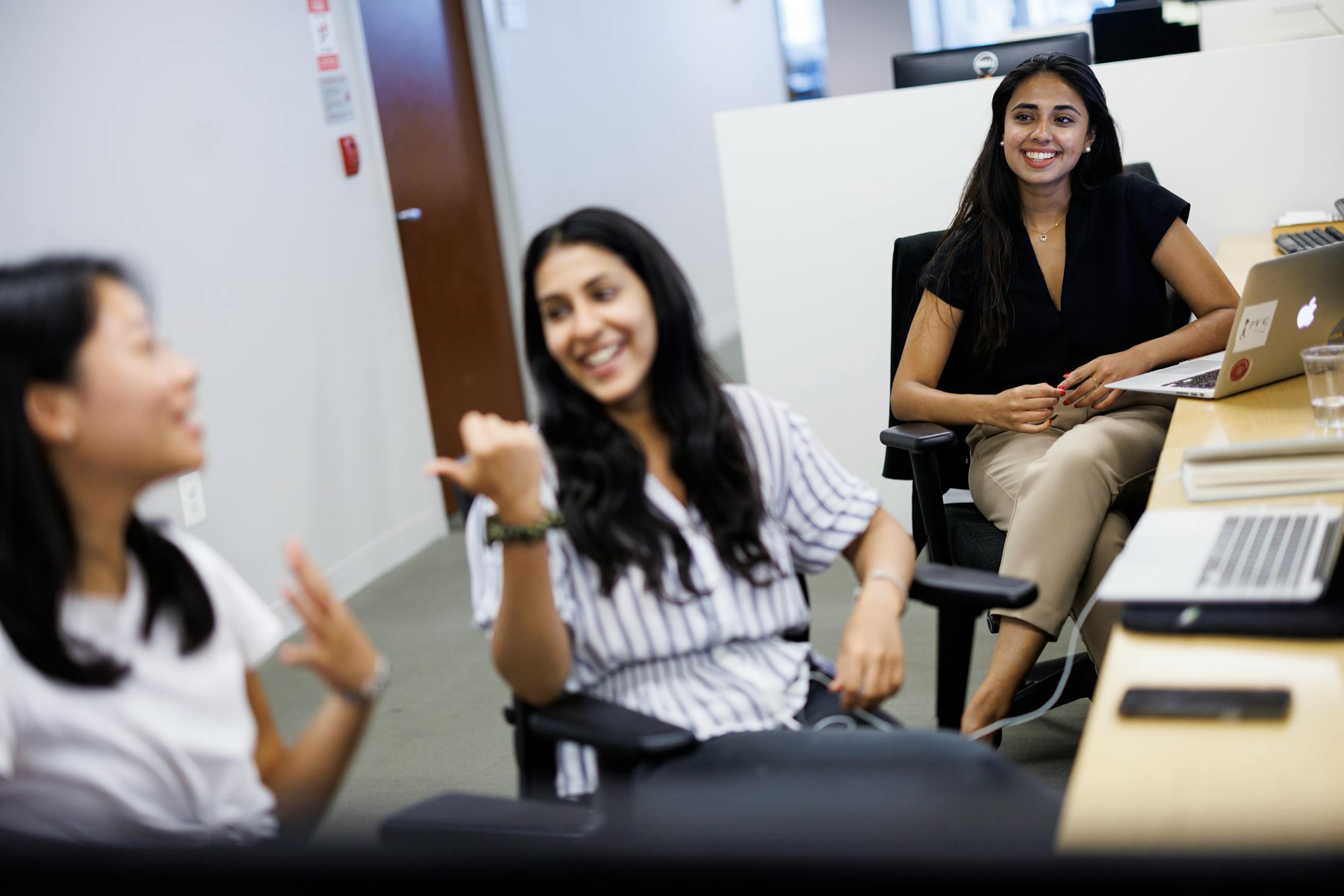
Alex Hyman pictured his summer internship as being one part "Entourage" and one part "The Office": people screaming into telephones Ari Gold superagent style, others menacing their desk mates as unnervingly as Dwight Schrute did at Dunder-Mifflin.
Instead, the office of his entertainment agency was mostly empty when Hyman, 20, arrived in early June, on the day he had been told to report to the Los Angeles location. He waited outside a locked door until a colleague found him and explained that his boss was working from home. Hyman was dropped off in a conference room with his fellow interns. They spent the day navigating Excel and joking about it. (What is an Excel joke? "How do you not know how to use Excel," Hyman said, insisting it was funny at the time.)
"I think everyone is a little nervous for the first day on a job," Hyman said with a laugh. "This definitely threw a curveball in what I was expecting."
Summer interns generally are aware of what awkward rites of passage await them. Most have to attend their share of stilted happy hours and softball games. They might have to nod their way through a brown bag lunch. Now, though, interns experience a strange new introduction to professional life. Working a summer job can mean commuting to an empty office, sitting unsupervised with other interns and trying desperately to impress managers over video calls. School is out for the summer — but in some cases, so are the bosses.
"The thing I've always been taught by my parents is to be the first one in and last one out," Hyman said. "But there's no one else there. My boss isn't going to see me put my best foot forward."
Office occupancy across the country has remained under 50% on average, according to the building security firm Kastle. Executives have often said they worry that the youngest generation of workers will have no interest in returning to — or in some cases, even entering — an office environment. But some research has found that young people are more eager to work in person than their senior counterparts.
A continuing survey of more than 5,000 Americans, started during the pandemic at Stanford, the University of Chicago and ITAM, found that the share of people ages 20-29 who want to work remotely full time is just 24%, while it is 41% among workers 50-64. Many recent college graduates are hungry for friendship. Others are fatigued from spending the past few years locked down in their dorms.
"They're people-starved," said Cyrus Beschloss, 25, founder of the Generation Lab, a firm that polls his own generation. "The last thing folks want is to do something that's meant to be in person on a Zoom. Even if there's a light dusting of people coming into the office every day, as much as young people can recreate some semblance of normal — dare I say 9 to 5 — that's comforting."