
Was Twin Cities woman a pawn to change Minnesota’s law on toplessness?

The woman at the center of the ruling deeming it legal for women to be topless in public has long struggled with mental illness and drug addiction, resulting in criminal charges.

The Minnesota Star Tribune
September 14, 2025 at 4:13PM
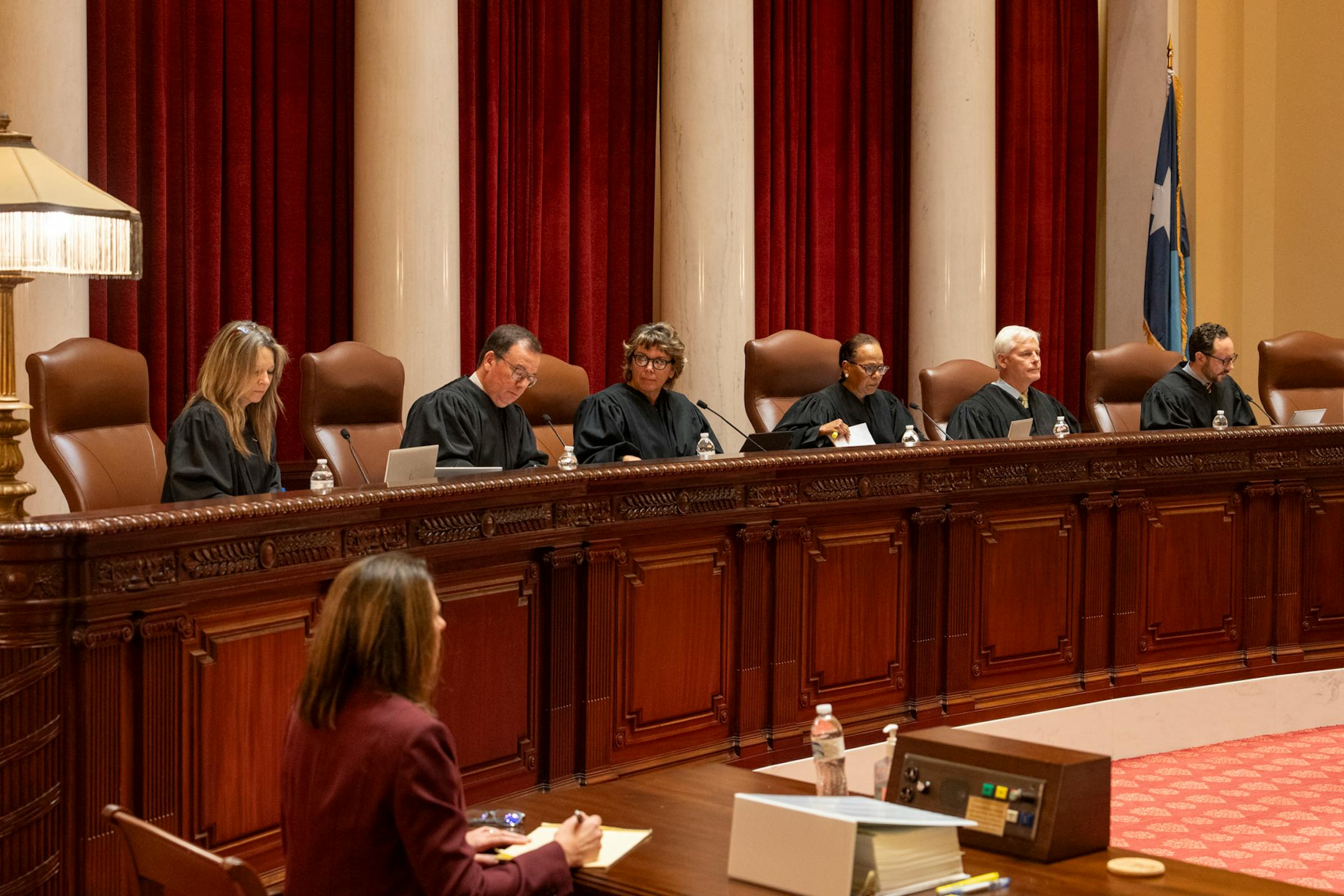
The justices of the Minnesota Supreme Court convened for oral arguments on Oct. 1. (Aaron Nesheim/Sahan Journal)

When the Minnesota Supreme Court ruled that women could not be criminally charged for being topless in public, civil liberties advocates declared a major victory for gender equity — they said the court had finally abolished dated and biased conventions about sexuality.

Whether the woman at the center of the case, Eloisa Plancarte, shared that view is unclear. Plancarte, 29, appears to have played no active role in her appeal — outside a general awareness that it was underway.

A Minnesota Star Tribune review of the court records and interviews with people familiar with Plancarte found no evidence that she knew the American Civil Liberties Union, Gender Justice, a private Minneapolis defense firm and the state Supreme Court used her case to make a public proclamation about women’s rights.

That’s because Plancarte has spent much of her life struggling with mental illness, drug addiction and criminal charges related to both afflictions.

There’s no evidence that her record of indecent exposure was meant as a political statement. Her troubled history has led some to question whether it was ethical for outside groups to use someone so vulnerable as the face of a high-profile cause.

A family member of Plancarte, who asked not to be identified to protect her family’s privacy, was incensed after learning about the Supreme Court opinion. “I can guarantee you she had no input or idea of anything they were doing,” the family member said. “Clearly, absolutely clearly, she was manipulated and used.”

Court records show Plancarte’s life has been filled with trauma and she often has no concept of the ethical nature of her behavior.

For almost the entirety of her adult life, she has been committed as mentally ill and chemically dependent. She resists medication, absconds from court-ordered treatment facilities, and then cycles back into treatment once she is detained again for criminal behavior.

In the four years it took to resolve her Supreme Court case, she was charged with 35 additional crimes related to her behavior in public. That behavior has continued.

Since the Supreme Court opinion was published in April, Plancarte has been charged with 17 more crimes, including eight counts of indecent exposure.

Last month, she was arrested for allegedly having sex in the Commons public park outside U.S. Bank Stadium in downtown Minneapolis at 11 a.m. Witnesses said she was completely naked. Police observed about 30 children in the park.

Richard Painter, the S. Walter Richey Professor of Corporate Law at the University of Minnesota and an expert on legal ethics, said there are clear issues around gender equity in society that have been fought for decades and remain to this day, but that doesn’t mean a case like Plancarte’s should be used in the fight.

He said the state Supreme Court using the case of a woman struggling with mental illness to “make a big point about gender and women’s body parts” holds the court up to ridicule.

“The lawyer who represents her should be focusing on her best interests, not fighting for a particular cause,” he continued. “And the lawyer who represents the state should be focusing on how best to address this type of problem consistent with the public interest, and the public interest here would be getting mentally ill people the help they need.”

Dispute over incompetency

Plancarte’s Supreme Court case originated after she was arrested for walking topless in a Kwik Trip parking lot in Rochester in 2021. She was charged with indecent exposure — her third such charge in a week — and when police searched her they found a vial of cocaine.

The case was tried in Olmsted County District Court. Transcripts of the proceedings show they were steeped in common struggles for the mentally ill and drug addicted in Minnesota: the difficulty of getting steady treatment, the freedom individuals have to leave treatment facilities or stop taking medication, and a history of criminal charges.

The judge, defense and prosecution knew Plancarte was under an active civil commitment for being mentally ill and chemically dependent at the time she was arrested. It appeared the only reason she was in Rochester was to get treatment after being sent there from the Twin Cities.

One doctor appointed by the court to evaluate Plancarte’s mental competency said she was unfit to stand trial. The judge in the case rejected that evaluation for lacking rigor. Plancarte’s public defender filed a motion that the case should be dismissed, arguing the search was illegal because Plancarte did not display her “private parts” and thus did not commit indecent exposure.

That legal argument had been at the center of gender equity arguments over indecent exposure for years, including by nationwide organizations such as Free the Nipple.

The District Court judge denied the motion to dismiss and Plancarte agreed to a stipulated evidence trial with the understanding that her conviction for indecent exposure would be appealed.

On Dec. 30, 2022, Plancarte’s drug charge was dismissed and she was sentenced to probation with no jail time. If she completed probation, the indecent exposure charge would be dismissed. She was cited for disorderly conduct and trespassing the next day.

The following month, Minnesota’s Appellate Public Defender’s Office took up her case.

Appeals of the indigent

Cathryn Middlebrook, the state’s chief appellate public defender, said her office is duty bound to represent anyone convicted of a crime who is indigent and files an appeal.

That work is divested from any civil commitment proceedings. Middlebrook said an appeal can come from a defendant or the defendant’s lawyer. She declined to speak about the specifics of Plancarte’s case.

In February 2024, the Court of Appeals upheld Plancarte’s conviction of indecent exposure in a split decision. Shortly before the opinion was released, Plancarte was staying at a treatment facility for her mental health but within a month she had left and stopped communicating with her caseworker.

A warrant was issued for her arrest on March 22, 2024. Two days before that, the ACLU, Gender Justice and the Minnesota Association of Criminal Defense Lawyers filed motions with the Supreme Court to write briefs on Plancarte’s behalf.

On May 14, 2024, Chief Justice Natalie Hudson signed an order that the Supreme Court would hear Plancarte’s appeal and the legal organizations could file their briefs. That same day, Plancarte was being held in an ICU at HCMC and the commitment division of the Minnesota Judicial Branch sent an email asking that Plancarte be placed on the waiting list for the Anoka Metro Regional Treatment Facility.

The ACLU brief asked the Supreme Court to “protect the rights of women, transgender, and gender nonconforming Minnesotans at a time when their rights under federal law are increasingly under attack.” A brief by Gender Justice focused on how the court’s decision could have a direct impact on sex-based stereotypes and harm committed against transgender and nonbinary Minnesotans.

Neither brief mentioned the mental health and drug addiction issues that precipitated Plancarte’s indecent exposure charge.

In a statement to the Star Tribune, the ACLU said it did not serve as legal counsel to Plancarte and arresting people for not wearing a top was based on “outdated ideas about gender and sexuality” and against Minnesotans’ rights to equal protection under the law. The ACLU also said those arrests are not effective or appropriate to help people struggling with mental illness or drug addiction.

Gender Justice said in a statement it became involved in the case because it disagreed with the Court of Appeals opinion.

‘Subjective mental state’

When oral arguments were heard in her Supreme Court case in October, Plancarte was being held at a community behavioral health hospital.

At the start of this year, Plancarte ran away from a group home in Oakdale and was picked up the same day by the Hennepin County Sheriff’s Department and brought to jail on outstanding warrants. In March, she was apprehended again and brought to Regions hospital. Her civil commitment expired on April 21.

The Supreme Court issued its opinion clarifying that women can be topless in public in Minnesota on April 30, siding with Plancarte. In the five days before the opinion was released, Plancarte interacted with police on four occasions and was cited with one count of disorderly conduct and three counts of trespassing.

The Supreme Court opinion was written by Justice Karl Procaccini. It made only passing reference to Plancarte’s mental health, noting that her statements to police about why she was topless did not amount to sexual conduct.

“At most, Plancarte’s statements speak to her subjective mental state when she was exposing her breasts,” Procaccini wrote. “Which is irrelevant to determining whether her conduct was lewd.”

Two days after the opinion was released, Plancarte was cited for exposing herself on the light rail.

Painter, the U law professor, said Plancarte’s case is an example of a legal theory known as the mask of law, which considers how courts can fail to center the individual when analyzing a case. The idea was advanced by John T. Noonan Jr., a former judge for the United States Circuit Court of Appeals.

“This will end up in law school case books and everyone will be talking about it,” Painter said about the Minnesota Supreme Court decision. “But it accomplishes absolutely nothing, because it doesn’t accomplish anything for her.”

A spokesperson for the Minnesota Judicial Branch said the state Supreme Court does not comment on specific cases and the opinion speaks for itself. Phone calls and messages seeking comment from the Olmsted County Public Defender’s Office were not returned.

Paula Chesley of Minneapolis has fought for equal rights for public toplessness in the state before. Time living in Europe opened her eyes to how Americans oversexualize women and police the body in general. She pointed out that American men used to also be subject to citations for indecent exposure if their tops were off in public.

She had followed Plancarte’s appeal closely and wrote about it, voicing her concerns about the rights of women and transgender people, but was unaware Plancarte also struggled with mental illness and drug addiction.

Chesley said it was tough because Plancarte had said yes to the appeal, but she wondered if being at the center of a case like this was fair.

“It can create hardships for her to have this case be advanced,” Chesley said. “Maybe she doesn’t want notoriety. Her picture plastered in the news. ... She wasn’t speaking about this, other people, including myself, were speaking out about her case.”

Concern for care

Last week, Hennepin County Public Defender Dana Lurie represented Plancarte on 11 cases during a pretrial hearing.

Lurie told Judge Matthew Wilcox that Plancarte is trying to get out of the legal system to see her two children and that Plancarte is “aware of the situation she is in.” Lurie asked Wilcox to release Plancarte without bail while she awaits a mental competency evaluation that could not be scheduled for several weeks.

Plancarte appeared cognizant in a glassed-off defendant’s booth during the hearing. She leaned forward and asked questions of her lawyer as white noise pumped through the room. The only words she spoke to the court were, “Good afternoon.”

City of Minneapolis attorney Riki Rodriguez said Plancarte was just found incompetent to stand trial in Scott County, in a separate case. Rodriguez argued Plancarte had exposed herself in front of children and people passing on the sidewalk. The city had concerns for “public safety, Ms. Plancarte’s safety and her ability to care for herself.”

Citing her high risk to reoffend, Wilcox ordered Plancarte kept in custody, but a general agreement was made that the finding of incompetency in Scott County might be adopted in Hennepin County.

If that happens, Plancarte would likely be placed in another treatment facility.

Attorney Jon Duckstad has represented Plancarte on several civil recommitment proceedings in Ramsey County as a patient advocate. He said his work often intersects with criminal proceedings.

“A health court is not a criminal court, even though criminal cases are sent over there when a person is deemed to be mentally incapable of participating in his or her own defense,” Duckstad said. “There is a determination made that they are incompetent and they are removed from the criminal system under a rule that it is inhumane to prosecute people who are insane because they have no ability to inform intent; they don’t know the difference between right and wrong.”

Duckstad said it’s not unusual for people to cycle in and out of civil commitments as they improve with medical treatment but are not forced to keep taking their medications. They can then decompensate and become psychotic.

He said the cycle can be difficult to overcome and people can die in the process.

Duckstad had been unaware his former client had a case reach the state Supreme Court.

Correction: A previous version of this story said Paula Chesley has fought for equal rights for public nudity in Minnesota; she has fought for equal rights for public toplessness.
about the writer

about the writer

Jeff Day

Reporter

Jeff Day is a Hennepin County courts reporter. He previously worked as a sports reporter and editor.

See Moreicon

More from Twin Cities

See More
card image