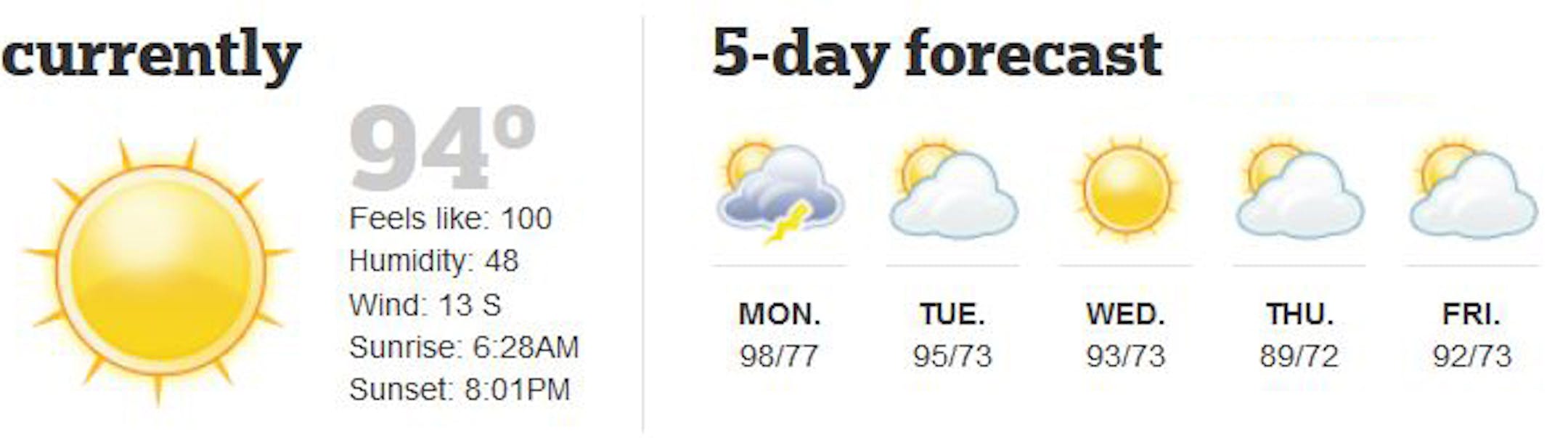
What looked like a bountiful harvest earlier this month is now shrinking in the sweltering sun.
Market watchers are divided about whether soaring late-August temperatures mean the upcoming corn and soybean harvests will experience a marginal reduction in yields or a bigger one. Either way, the potential to fall short of previous expectations drove prices for corn and soybeans sharply upward Monday.
The price for corn delivered in December rose 6 percent, or 30.5 cents, to $5.005 a bushel, and soybeans for November delivery jumped 4.6 percent, or 61.5 cents, to $13.895 a bushel. The corn spike was the biggest in 14 months and the soybean leap was the biggest since early 2011, Bloomberg News reported.
Skyrocketing temperatures —expected to continue through Sunday — are being closely monitored by farmers, commodity traders and food businesses.
"Out of nowhere we got this incredibly hot, dry pattern," said Mark Schultz, chief analyst for Northstar Commodity Investment Co., a Minneapolis firm that buys and sells grains and issues advisory reports for both sellers and buyers. He believes that the Midwest has already suffered a 7 percent shortfall in corn yield and a 20 percent decline in soybean yield compared to what markets were expecting earlier this month.
The U.S. Department of Agriculture on Aug. 12 forecast a record corn crop of 13.8 billion bushels this year and 3.255 billion bushels of soybeans, both down from its May forecast because of the late planting after a cold spring in much of the Midwest.
"There is still a pretty good potential for crops around the globe, so this is not a disaster in the making," Schultz said. "But it's disheartening for livestock guys, the ethanol people and the food businesses that had been expecting relief from high prices."
Michael Swanson, an agricultural economist at Wells Fargo & Co. in Minneapolis, said the markets are reacting to what might happen, and cautioned that it hasn't happened yet. Nationwide crop-yield estimates are in line with 25-year averages, he said.