

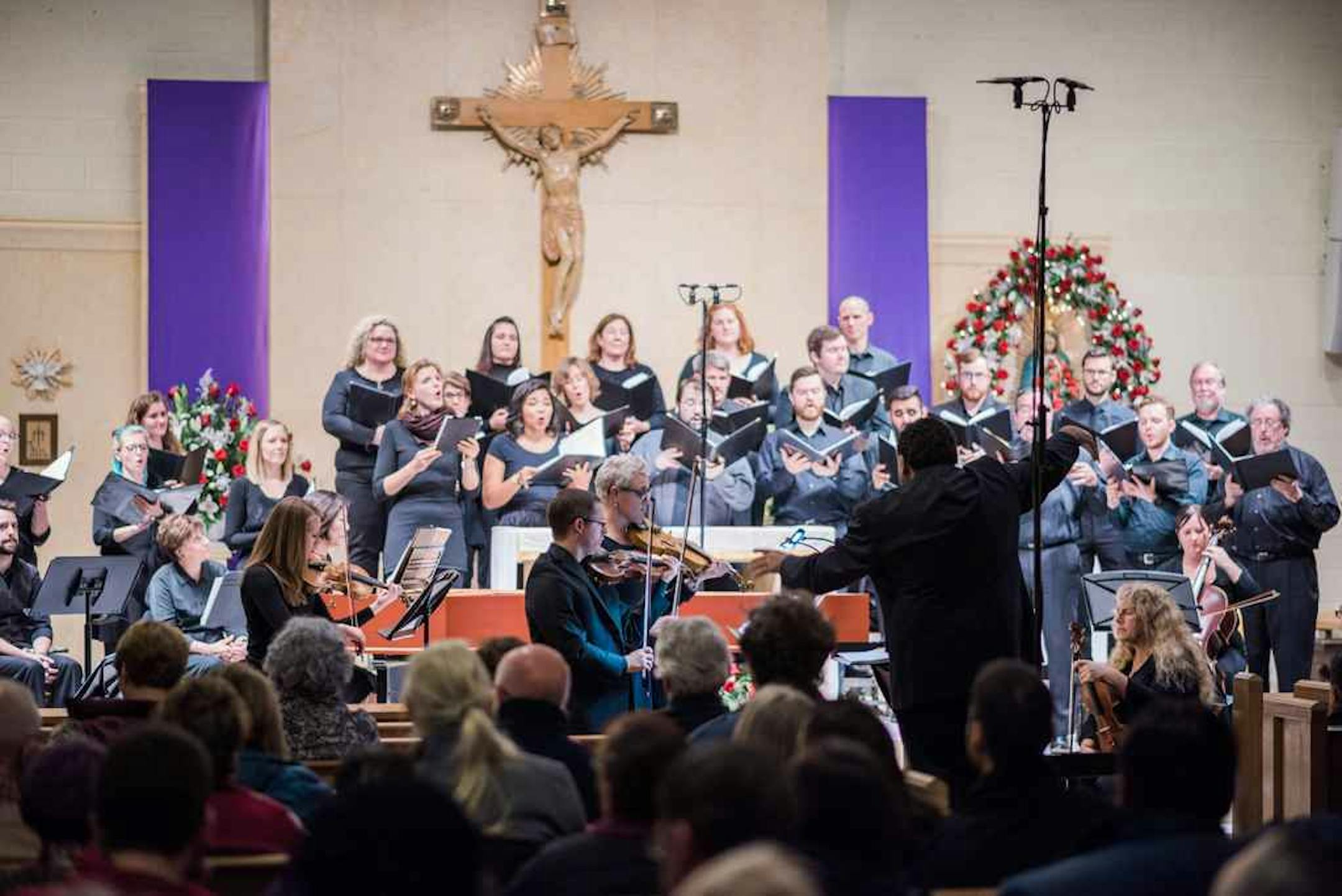
On paper it sounds a crazy idea. Take Part One of Handel’s “Messiah,” translate half of it into Spanish, then divide it up by inserting movements from another piece of music altogether.
That is what happened Friday evening at the Church of the Ascension in Minneapolis as Border CrosSing performed “El Mesías,” the choir’s cross-cultural take on Handel’s choral masterpiece.
That man behind the radical cut-and-paste exercise was Border CrosSing’s artistic director Ahmed Anzaldúa, and he led the team of 46 musicians in a performance which rattled preconceptions and had many uniquely affecting moments.
For Handel’s famous choruses — “For unto us a child is born” and “His yoke is easy” among them — Ahmed adopted a bilingual approach, his singers changing between Spanish and English as they made their entries.
It should have sounded gimmicky and confusing, but it didn’t.
Border CrosSing’s mission is to “truly reflect the cultural reality in which we live,” and the bilingualism did just that — emphasizing commonalities of belief and spirituality across national divisions, and how natural it is that they should come together.
The insertion of movements from Argentine composer Ariel Ramírez’s Christmas cantata “Navidad Nuestra,” which describes the same events as Part One of “Messiah,” had a similar effect.
In a tingling juxtaposition, its toe-tapping opening movement “La anunciación” followed on instantly from Handel’s jubilant “And the glory of the Lord,” the joy of one chorus brimming over to the other.


![Brandi Carlile performed "You And Me On The Rock" in concert Saturday, July 30, 2022 at Xcel Energy Center in St. Paul, Minn. ]](https://arc.stimg.co/startribunemedia/P4TW2YOFYDOM6HK7YPPI7CCG2U.jpg?&w=436&ar=3:2&fit=crop)

