
Half of Dayton's tax cuts help Minnesota businesses

After Dayton's proposal Thursday morning, the House voted to wipe out three business sales taxes.

March 7, 2014 at 4:35PM
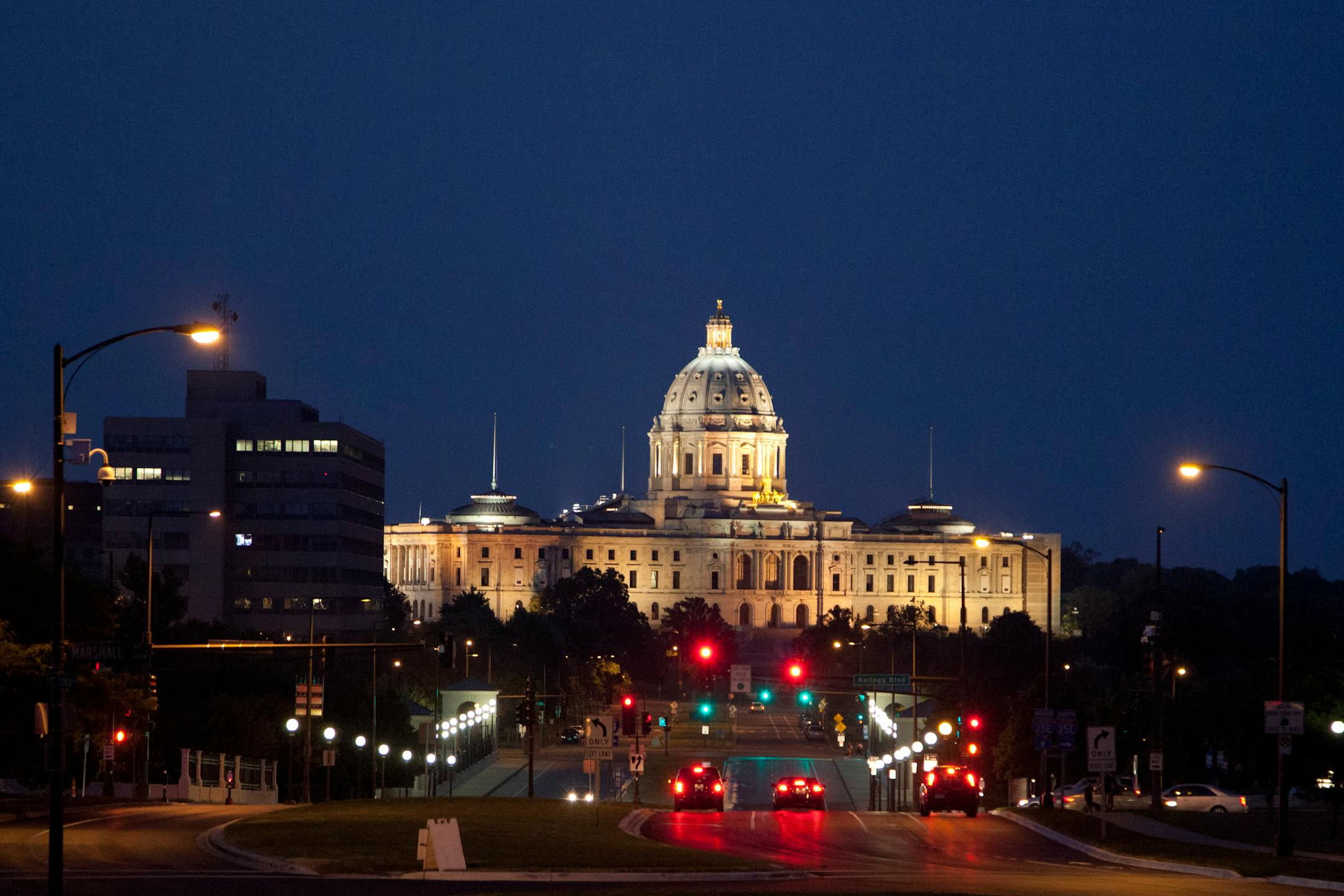
The Minnesota State Capitol stands at night in St. Paul, Minnesota, U.S., on Tuesday, Aug. 20, 2013. Minnesota's real GDP grew 3.5 percent in 2012 and was ranked fifth in growth after North Dakota, Texas, Oregon and Washington. Photographer: Ariana Lindquist/Bloomberg
About half of the $616 million in tax cuts Gov. Mark Dayton proposed Thursday are on levies that hit the state's businesses and affluent. (Evan Ramstad — Bloomberg/The Minnesota Star Tribune)

Nearly half of the tax cuts Gov. Mark Dayton proposed Thursday are for businesses and their owners, a move that may reduce the anti-business criticism that has dogged him.

Dayton proposed — and the House almost immediately passed — eliminating three business-sales taxes that accounted for $232 million in his overall $616 million in tax cuts.

He also asked lawmakers to simplify and raise the estate tax deduction to $2 million from $1 million and to eliminate the gift tax, a 10 percent levy on any personal gift above $1 million. Those moves would cut $43 million in taxes, bringing the combined cut on businesses and the wealthy to $275 million, or 44 percent of the total.

Minnesota Revenue Commissioner Myron Frans said in an interview that the gift tax, created just last year, was particularly seen as unfair.

"Only one other state, Connecticut, has a gift tax, and they are talking about eliminating it," Frans said. "We want taxes to be fair, whether on low-income or high-income people. And the gift tax didn't make sense, and it's complicated and caused consternation."

The estate tax and gift tax changes last year fueled discussion of avoidance strategies by affluent Minnesotans, estate lawyers and tax advisers. Some lawyers and accountants held seminars for clients that promoted establishing residency in other states.

Two prominent critics of those taxes — Hunt Greene, a Minneapolis businessman, and Bob Abdo, a Minneapolis business lawyer — said Thursday that Dayton's proposals were steps in the right direction.

"It sounds like the governor figured it out," Greene said. "I hope this is a shoo-in with the Legislature. I haven't done a survey, but this will make a big difference in people staying in Minnesota."

Dayton proposed lifting from $1 million to $2 million the amount of estates that can pass from generation to generation without taxation, plus other measures that would also eliminate a "bubble," partly owing to federal law, that effectively taxes the first $100,000 in an estate that is subject to taxes at up to 41 percent and a declining rate after that.

Some critics have urged Minnesota to conform with recent federal tax law that raised the exemption to about $5.25 million. But Frans said this is a "first step" toward federal conformity that eliminates the bubble tax for Minnesotans and it's what the state could afford at this point.

Meanwhile, the Minnesota Chamber of Commerce had made repeal of the three business-sales taxes a priority for the current legislative session. Bill Blazar, a chamber executive, said the state's largest business lobby was pleased to see the House's quick action.

"We ask Senate Majority Leader Tom Bakk and members of his caucus to join ranks and act quickly to repeal the three taxes by April 1 before they do any more damage to jobs and businesses," Blazar said in a statement.

The sales taxes, which were passed last year, include labor service charges for repair of business equipment, purchases of equipment by telecommunications providers and one on independent warehouse owners.

Neal St. Anthony • 612-673-7144

about the writer

about the writer

Neal St. Anthony

Columnist, reporter

Neal St. Anthony has been a Star Tribune business columnist/reporter since 1984. 

See Moreicon

More from Business

See More
card image
Fairview Health Services

The school is changing an elective course while still working with the Eden Prairie-based health care giant after students raised concerns.

This transmission electron microscope image shows SARS-CoV-2, the virus that causes COVID-19, isolated from a patient in the U.S., emerging from the surface of cells cultured in the lab. (NIAID/TNS) ORG XMIT: 1659810
card image