

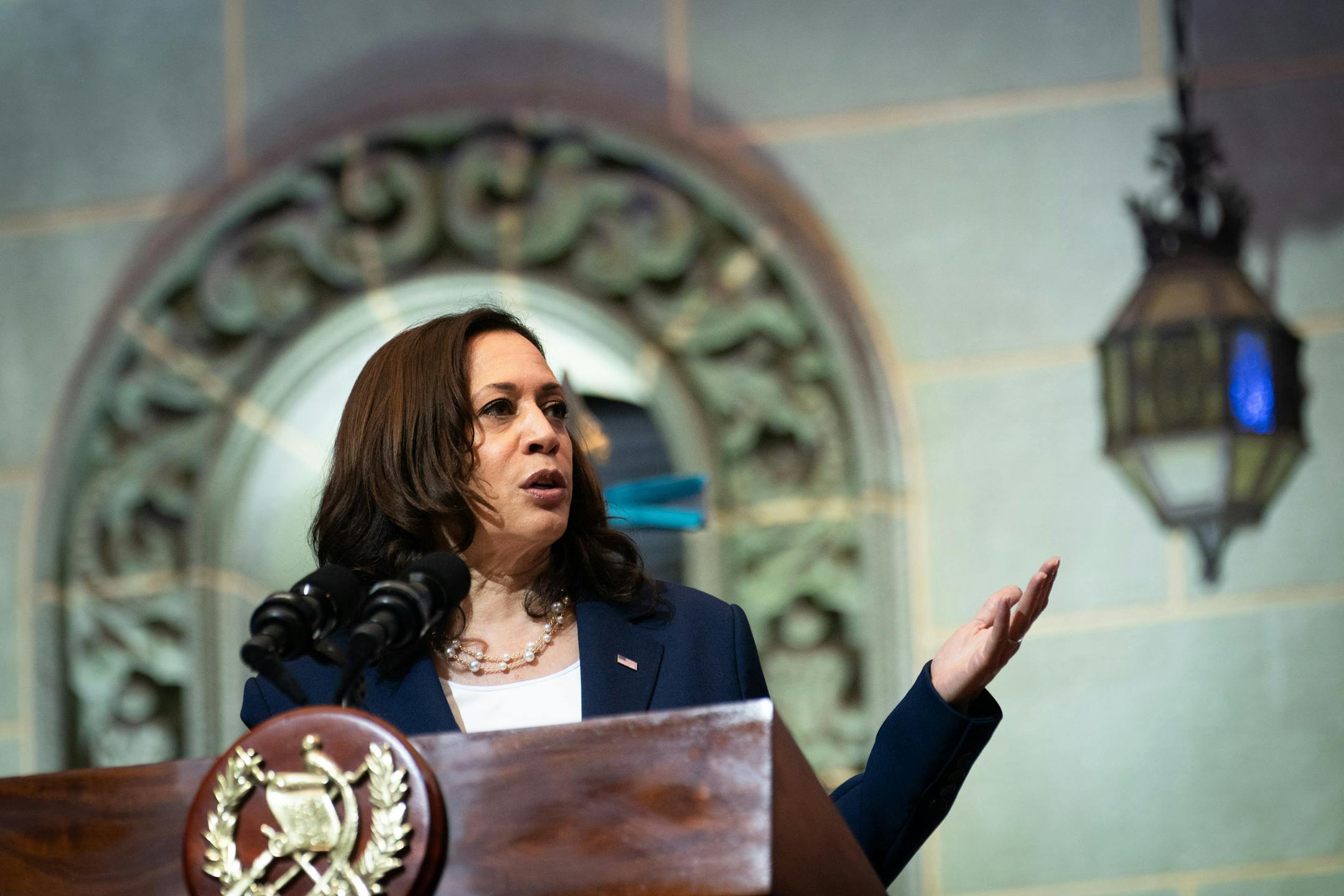
Vice President Kamala Harris arrived in Guatemala on Monday to kick off a two-day tour aimed at trying to strengthen ties with the country and tackle corruption, violence and poverty — the core issues behind the record number of migrants from Central America seeking entry into the United States. During a news conference in Guatemala City with President Alejandro Giammattei, Harris warned people not to come to the United States, adding that "the goal of our work is to help Guatemalans find hope at home."
Harris has her work cut out for her. While Guatemala's civil war officially ended with the signing of the Peace Accords on Dec. 29, 1996, the country is still sharply divided along racial and class lines. The COVID-19 pandemic has exacerbated an already dire economic situation. Over the past few months a growing number of Guatemalan migrants have left for the U.S., lured by smugglers' promises of safe passage and access to coronavirus vaccines.
But for all its enormous challenges, Guatemala also offers the Biden administration an opportunity to rethink its approach to migration from the region. For too long, U.S. policy has been guided by the assumption that everyone south of the border aspires to make a new life in the United States, and that tackling undocumented immigration requires a unified regional approach. But this approach has done little to stem the myriad drivers of migration from the region. The Biden administration would do well to take a closer look at why so many Guatemalans are leaving and determine what it would take for them to stay.
A 2018 survey of more than 1,800 immigrants from Guatemala, El Salvador and Honduras, carried out by the region's central development bank, tracked a steady growth in irregular migration from Central America since 1990. It highlighted the mix of push and pull factors, namely poverty, violence and family reunification, that drive people to leave. It also underscored the critical role remittances play in sustaining economies, communities and families.
But upon closer examination the survey illuminates striking differences that set Guatemalan immigrants apart from their counterparts in Central America. The Guatemalans surveyed, in contrast to their Northern Triangle neighbors, more often cited economic factors as their primary reason for migrating, while relatively fewer pointed to violence and insecurity as motivating factors.
Compared to two-thirds of all Salvadoran respondents and nearly half of Honduran respondents, only a quarter of Guatemalans said they intended to stay permanently in the United States. Consistent with their long-term intentions, many more Guatemalans are saving their earnings and investing them back home.
This data aligns with what is playing out on the ground. Over the past several decades, many Guatemalans have packed up and left for the United States. Their earnings cover their families' basic needs back home and are helping to finance the slow-motion construction of multistory homes. A growing fleet of cars and pickup trucks are parked in driveways and convenience stores are sprouting up in even the smallest rural hamlets.
Prospective migrants tell us that they aren't chasing an American dream. It's a Guatemalan dream they're after, but they need to go to the U.S. to attain it. They describe a mixture of despair and ambition that propel them to embark on an expensive and perilous journey knowing that backbreaking labor and the possibility of being caught and deported await them on the other side. They tell us that they are determined to make something of themselves for their own sake, as well as for that of their children and their communities. The goal is to pay back their debts, take care of their families and save what they need to make an economic go of it back home.


