

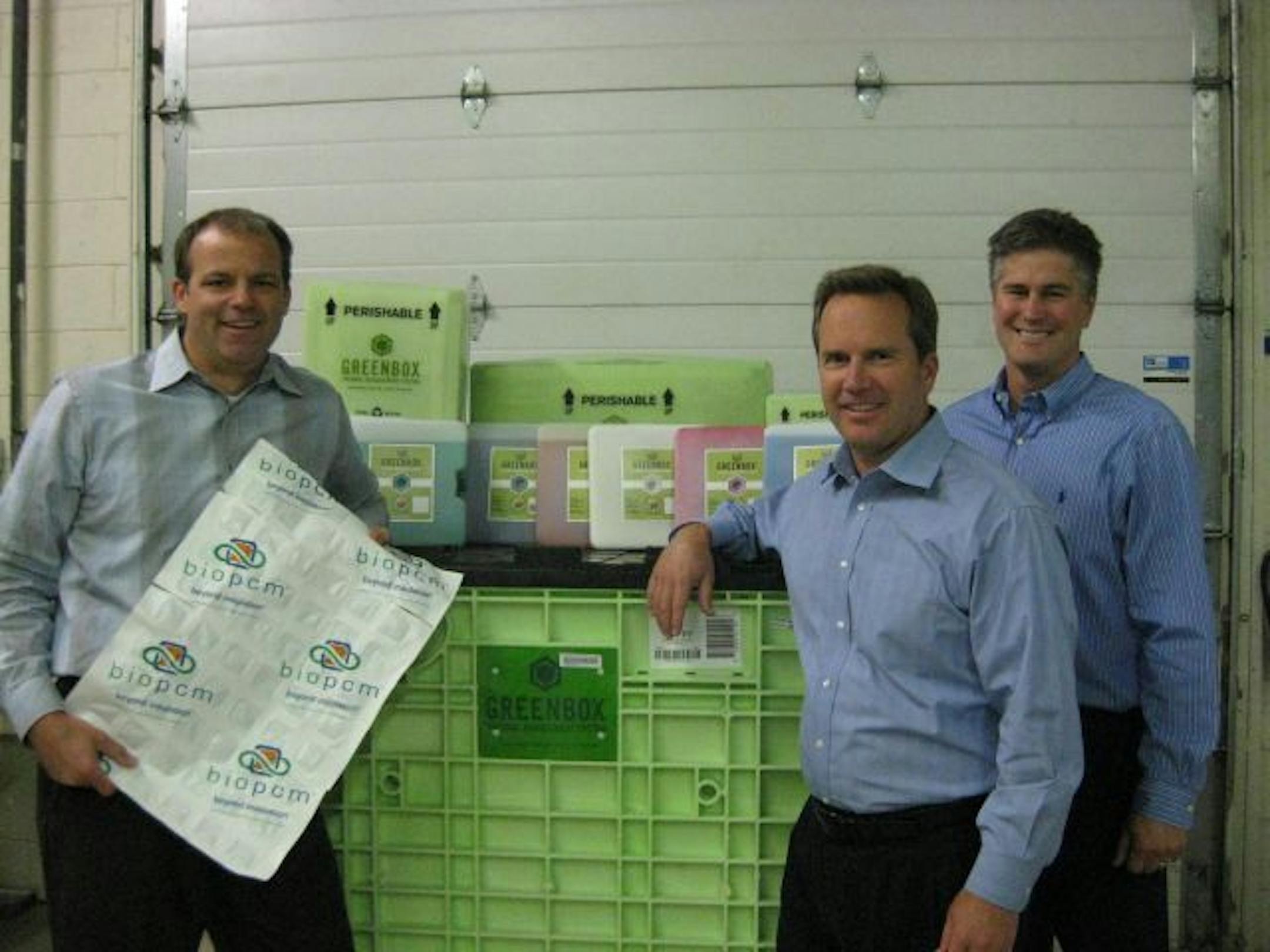
Entropy Solutions, which makes high-tech shipping containers with its "GreenBox," recyclable, thermal-management system, is expanding from boxes to buildings.
The Eden Prairie company, which expects to achieve profitability this year on revenue of $10 million after only two years of sales, uses plant oil formulations to manufacture containers that can keep temperature-sensitive cargo such as human organs and pharmaceuticals safe in transit for as long as 120 hours. Now the technology is being scaled up, proving that its plant-oil formulations also underscore what mom always knew: "Those vegetables are good for you."
"She just didn't know that vegetable byproducts can reduce residential and commercial energy usage by 30 percent," said Entropy President Eric Lindquist. "They are now being used in products that keep baby's car seat from scalding in the summer sun, protect and cool police and military officers and their dogs working in extreme heat, and keep pharmaceuticals at a consistent temperature during shipment."
In an interview this week, Lindquist projected an increase in revenue to $100 million in 2011, as Entropy's patented, "PureTemp" solution is adapted to retrofit restaurants, weatherize old buildings or new houses through its recently commercialized "BioPCM" materials. That stands for "phase-change materials" -- an active-ingredient, polyfilm-encased insulation produced at the Phase Change Energy Solutions plant in Ashboro, N.C., minority-owned by Entropy.
"We're replacing mechanical solutions with passive solutions," Lindquist said, adding that independent tests indicate the material works for 50-plus years. "The mechanical heating and cooling systems essentially become the backup. BioPCM reduces indoor temperature fluctuations, greenhouse gas emissions and overall energy use by up to 30 percent."
GreenBox was launched in late 2007 and incorporates a reusable, high-density polyethylene container that resists heat transfer, water and crushing. The liquid solution is contained in plastic-molded containers, sized for boxes that can carry a few pounds of biological supplies or hundreds of pounds of blood. The containers can be reused as many as 100 times, cutting distribution costs by as much as 65 percent over time, Entropy says.
"We chose temperature-sensitive packaging because it was our core, and we knew that we could have a big impact in a short period of time," Lindquist said. "We have the ability to do different temperature options, and you only have to do it once. Our patented process allows us to dial in the phase-change point by slightly altering the manufacturing process to lock in any temperature between minus-40 Fahrenheit and 300 Fahrenheit."
Entropy said it has pilot projects underway with three major fast-food chains, although the company declined to identify the customers. The restaurant industry is a prime target because of heavy energy costs, particularly in the kitchen areas that must be heated and cooled.



