
Greek vote rattles stocks, angers European leaders

The Associated Press
November 2, 2011 at 4:14AM
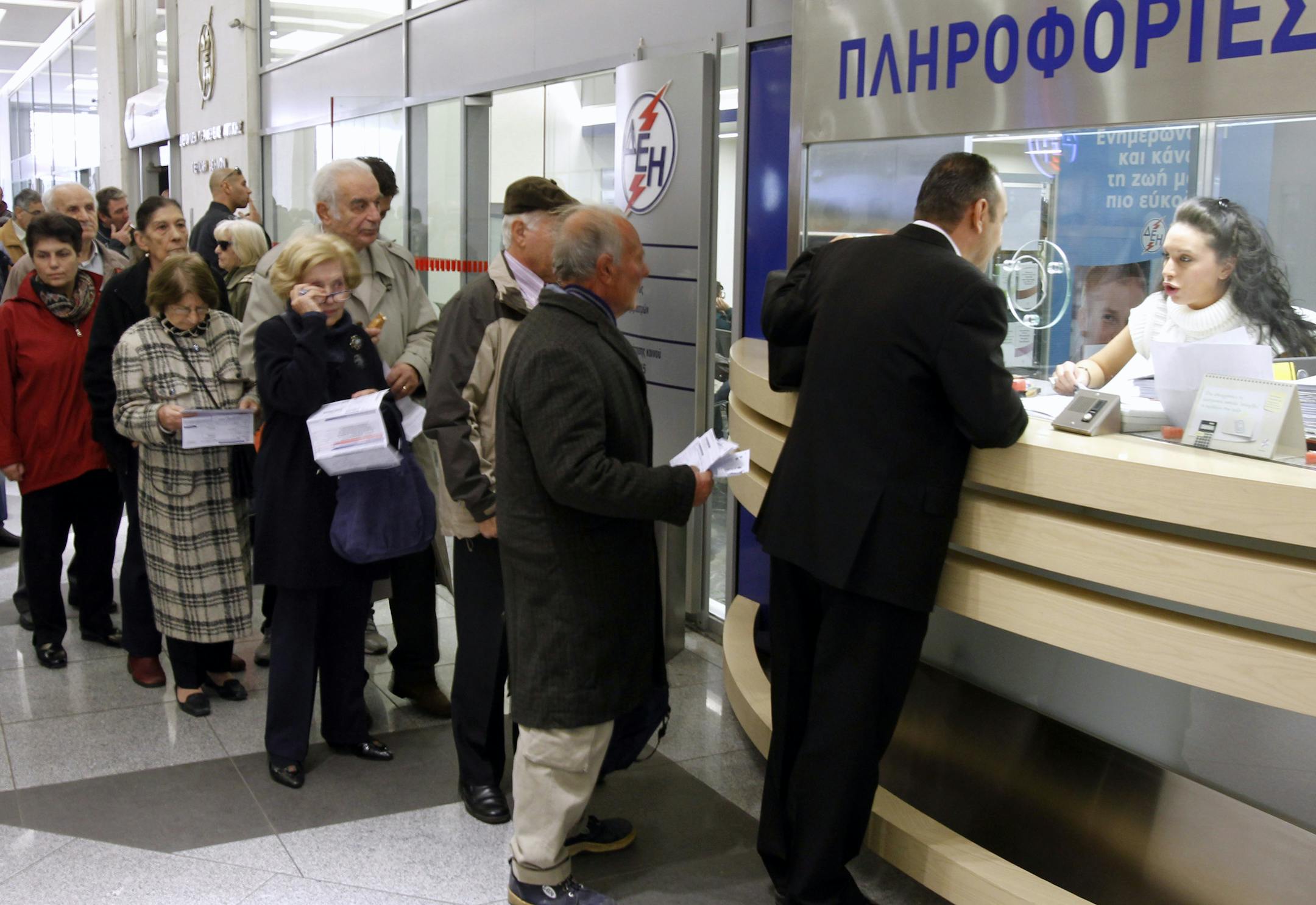
Consumers of Public Power Company, DEH, wait in a line to ask about the new property tax, which will be included in future energy bills in Athens, Oct. 31, 2011. Taking a huge political gamble, Greece's prime minister announced that his debt-strapped country will hold a referendum on the new European debt deal reached last week the first such vote in 37 years. The booth reads ''Information.'' (AP Photo/Thanassis Stavrakis)
Consumers of Public Power Company, DEH, wait in a line to ask about the new property tax, which will be included in future energy bills in Athens, Oct. 31, 2011. Taking a huge political gamble, Greece's prime minister announced that his debt-strapped country will hold a referendum on the new European debt deal reached last week the first such vote in 37 years. The booth reads ''Information.'' (AP Photo/Thanassis Stavrakis) (Colleen Kelly — Associated Press/The Minnesota Star Tribune)

ATHENS, GREECE - Greece's prime minister held firm early Wednesday to his shock decision to call for a referendum on a hard-fought European debt deal, despite anger from abroad, market turmoil across the world and dissent from within his own party.

George Papandreou's government still faced a battle for survival with a vote of confidence scheduled for Friday and a grilling from frustrated European leaders expected later in the day ahead of a Group of 20 summit on the French Riviera.

After a grueling seven-hour Cabinet meeting, government spokesman Ilias Mossialos said that Papandreou's ministers expressed "total support for the initiatives taken by the prime minister" and said the referendum would be held "as soon as possible."

However, government officials said two ministers still had strong reservations to the idea of a referendum.

Markets were hammered across the world after Papandreou's surprise Monday night announcement amid fears the vote could unravel a deal that took European leaders months of complex negotiations among themselves and with banks to reach.

The Dow Jones industrial average dropped nearly 300 points. Greece's general price index plunged to close down 6.92 percent, while in Germany the Dax index, the major stock market average, lost 5 percent -- the equivalent of about 600 points on the Dow. The French stock market closed down 5.4 percent, the Italian 6.7 percent and Britain's 2.2 percent.

European leaders made no secret of their displeasure. "This announcement surprised all of Europe," said a clearly annoyed French President Nicolas Sarkozy, who has been scrambling to save face for Europe before he hosts leaders of the G-20 major world economies later this week.

"Giving the people a say is always legitimate, but the solidarity of all countries of the eurozone cannot work unless each one consents to the necessary efforts," he said.

Sarkozy and German Chancellor Angela Merkel, who have been at the forefront of Europe's efforts to contain the debt crisis, talked by phone and agreed to convene emergency talks Wednesday in Cannes, France, to which Papandreou was also summoned to discuss implementation of the bailout.

French lawmaker Christian Estrosi was even more direct, saying on France-Info radio that the Greek move was "totally irresponsible ... I want to tell the Greek government that when you are in a situation of crisis and others want to help you, it is insulting to try to save your skin instead of assuming your responsibilities."

Dutch Prime Minister Mark Rutte, meanwhile, said he would try to prevent the referendum plan, saying he would "attempt to see that it doesn't happen." But he conceded it was up to Greece how it approves or rejects the European deal.

Papandreou's decision had left his government teetering on the verge of collapse Tuesday as his own deputies rebelled and his Socialist Party saw its parliamentary majority whittled down to just two seats in the 300-member legislature.

During the two-year financial crisis, the wealthier countries of northern Europe, led by Germany, have insisted that their heavily indebted brethren in the south radically cut spending in return for emergency loans. They have stuck to that prescription even though austerity has undermined growth and increased unemployment in Greece, Spain, Portugal and now Italy, betting that people in those countries would swallow the harsh medicine because their only alternative is to default and possibly leave the eurozone altogether.

Greece appears about to call that bet. Many Greek politicians appear to be calculating, at this late stage, that they have more to lose by sticking to Germany's terms than by risking a messy default, and even going it alone with their old currency, the drachma, outside the eurozone.

Austerity, in other words, is facing its first really big political test.

"This is clearly the return of politics," said Jean Pisani-Ferry, director of Bruegel, an economic research institution in Brussels. "The management of all this by the Europeans has been fairly technocratic. But now we see the gamble of a politician, which creates uncertainty again, but in a different form. But it was bound to come at some point."

Papandreou's decision to press for a popular referendum on the bailout was the inevitable result of Greece's loss of sovereignty to Brussels and the International Monetary Fund, said Jean-Paul Fitoussi, professor of economics at the Institute of Political Studies in Paris. Merkel and Sarkozy were acting as if they were the real government of Greece, he said.

"It's as if the Europeans -- or Merkel and Sarkozy alone -- believed that they were in control of the people of Greece," Fitoussi said. "But this is a democracy. In Greece, and even in Italy, you cannot expect to rule without the support and consent of the people. And you can't impose an austerity program for a decade on a country, and even choose for them the austerity measures that country must implement."

The New York Times contributed to this report.

about the writers

about the writers

ELENA BECATOROS

DEREK GATOPOULOS

More from Business

See More
card image
Carlos Gonzalez/The Minnesota Star Tribune

After hundreds of local shops closed Jan. 23 and thousands of people marched in downtown Minneapolis, a second call for a general strike Jan. 30 was financially unfeasible for many.

card image
card image