
Advertisement

Government shutdowns high on drama, but low on long-term political impact

As Washington stumbles toward another government shutdown, some veterans of previous battles caution against reading too much into the political tea leaves.

The Washington Post
September 27, 2025 at 7:45PM
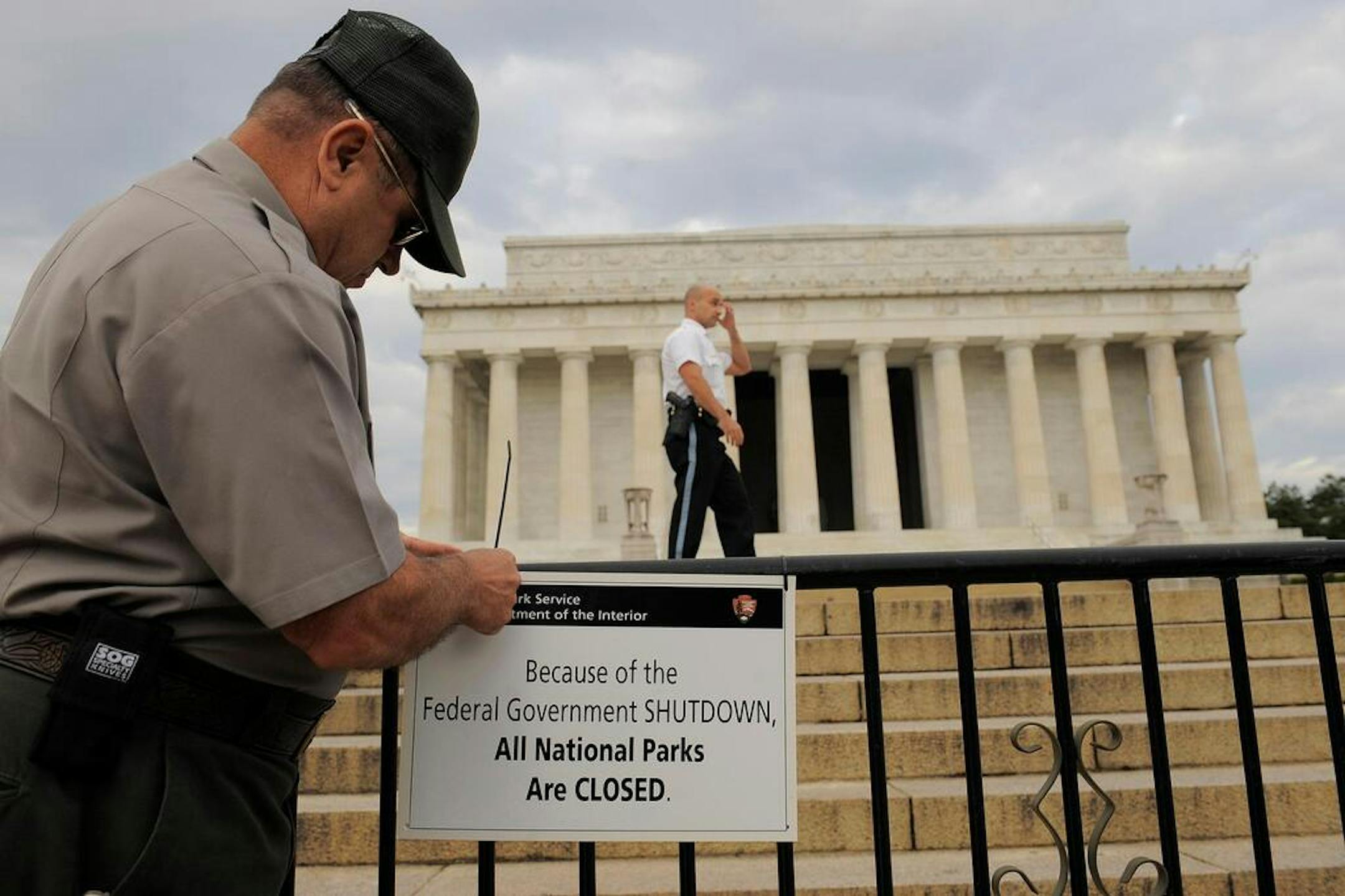
A National Park Service staffer puts up a sign announcing the closing of the Lincoln Memorial at the start of a government shutdown in 2013.
Advertisement

Steve Israel’s phone was ringing off the hook in early October 2013.

Then the chair of Democratic campaign efforts, Rep. Israel (New York), had potential challengers begging to talk about races against House Republicans who were getting blamed for a prolonged shutdown of the entire federal government.

A battle over Obamacare led to Republicans pulling out of spending negotiations that year. In the resultant chaos, Democrats seemed poised to win back the majority — until the government reopened, the Obama administration’s launch of the new health law flopped and the political environment quickly turned against Democrats.

“Those same people weren’t returning my phone calls,” said Israel, who went on to oversee a loss of 13 seats in November 2014 and retired from Congress two years later.

The lesson, according to Israel and other veterans of government shutdown battles, is that the initial political outcome might look really bad for one party, but over time, the environment can change completely. The party Washington expects to be punished for shutting down the government can end up triumphant in the next election.

This theory is an undercurrent helping push Democrats toward accepting a shutdown this year. Unless they reach a deal before midnight Tuesday with President Donald Trump and congressional Republicans, funding will expire for most federal agencies.

History provides plenty of examples that even a terrible political drubbing can have little impact on midterm elections.

In the fall of 2013, the Republican Party brand hit historical lows during the shutdown, leading to a complete surrender by House Speaker John A. Boehner (R-Ohio) without any concessions for forcing the shutdown.

Advertisement

That shutdown helped seal a Democratic victory in the November 2013 Virginia governor’s race. But a little more than a year later, Republicans gained more than a dozen House seats and nine Senate seats in a repudiation of President Barack Obama.

In late December 1995 and early 1996, Republicans shut down the government because of a fight over their desire to reduce spending on Medicare and make other budgetary cuts. Their actions helped President Bill Clinton burnish his image as a reasonable dealmaker and eased his reelection victory, but Republicans spent the rest of 1996 shoring up their congressional majorities in the November elections.

And in early 2019, Trump became the only president to politically lose a shutdown. After the nearly five-week partial shuttering of agencies, Democrats thought they had just been guaranteed big gains in the next election.

“Big deal at the time, seemed fatalistic on so many fronts,” recalled Cheri Bustos, who chaired the Democratic Congressional Campaign Committee in 2019 and 2020.

“Then life goes on. And some other big issue comes up closer to the election,” Bustos said.

Even as Joe Biden went on to win the popular election by more than 7 million votes, House Democrats lost more than 10 seats that election cycle.

Advertisement

Democrats believe this shutdown will play out differently because Trump’s popularity among voters has plummeted on what used to be his strongest point: his stewardship of the economy. A Washington Post-Ipsos poll last week showed voters opposed his signature tariff policy by 30 percentage points, and his approval on the economy overall was 19 points below water.

The government does seem to be headed toward a shutdown. Schumer and House Minority Leader Hakeem Jeffries (D-New York) have been on the same page about their demands for extending health care tax subsidies and other health initiatives, in exchange for the necessary Democratic support to overcome a Senate filibuster and avoid the shutdown.

Meanwhile, House Speaker Mike Johnson (R-Louisiana) and Senate Majority Leader John Thune (R-South Dakota) have been united in refusing those demands.

Israel, the DCCC chair in 2013 and 2014, has told current lawmakers that they are in a strong political position to fight for their health care policies.

“That’s ground worth fighting for, for Democrats,” he said.

Matt Gorman, a top adviser at the National Republican Congressional Committee in 2018, predicted that Democrats would suffer if the government shuts down — that they would be blamed because they are seen as instigating this fight.

Advertisement

The biggest reason Trump lost the late-2018-early-2019 shutdown was because he was publicly blamed for it. He accepted that blame, something Democrats are unlikely to do, and demanded that Congress include funding for his border wall.

“Losing a shutdown — and the first mover toward a shutdown always loses, no matter how they try to spin it — is potent in the moment,” Gorman said. “It just doesn’t have a long political half life.”

If this shutdown follows the same pattern as past battles, how Trump is viewed come 2026 may have more influence on how midterms go than whatever happens with any shutdown this year.

Jesse Hunt, who served as press secretary at the NRCC in 2018, recalled a brief political jolt benefiting Republicans when Senate Minority Leader Charles E. Schumer (D-New York) led a very brief, weekend-long shutdown in early 2018.

Democrats caved on the third day without getting any of their demands met on immigration legislation.

That political embarrassment quickly evaporated as voters began to focus more on Trump’s controversial actions and punished Republicans for trying to repeal the 2009 health law. Democrats gained 40 seats and the House majority in those midterm elections.

Advertisement

The news cycles move so much faster now than during the two shutdowns of Trump’s first term, so it’s difficult to imagine an October 2025 shutdown being a top issue in November 2026.

Israel has told Democrats that next year’s midterms will be about Trump’s policies and the “existential need to restore checks and balances.”

If Democrats are stuck still arguing about a 2025 shutdown next fall, Israel said, “we’ve got bigger problems than we think.”

Everyone should avoid the example of Lee Terry, the Nebraska Republican who complained that he needed his paycheck and wasn’t going to donate his salary to charity during the 2013 shutdown as other members were. That gaffe stuck with voters, and he was the rare Republican who went on to lose in 2014.

Otherwise, Josh Huder, an expert on congressional history at Georgetown University’s Government Affairs Institute, noted that there’s a reason shutdowns have only occurred with lots of time to change the political narrative with voters.

“If the shutdown occurred in an even numbered year, it might be different,” Huder wrote on his website, Seat of Democracy. “But odd-year shutdowns haven’t had the electoral consequences some fear.”

about the writer

about the writer

Paul Kane

The Washington Post

More from Politics

See More
card image
Renée Jones Schneider/The Minnesota Star Tribune

Republicans in the tied Minnesota House are already signaling opposition to the governor’s policy agenda, setting up early clashes as lawmakers returned to St. Paul this week.

Story Illustration
card image
Advertisement