

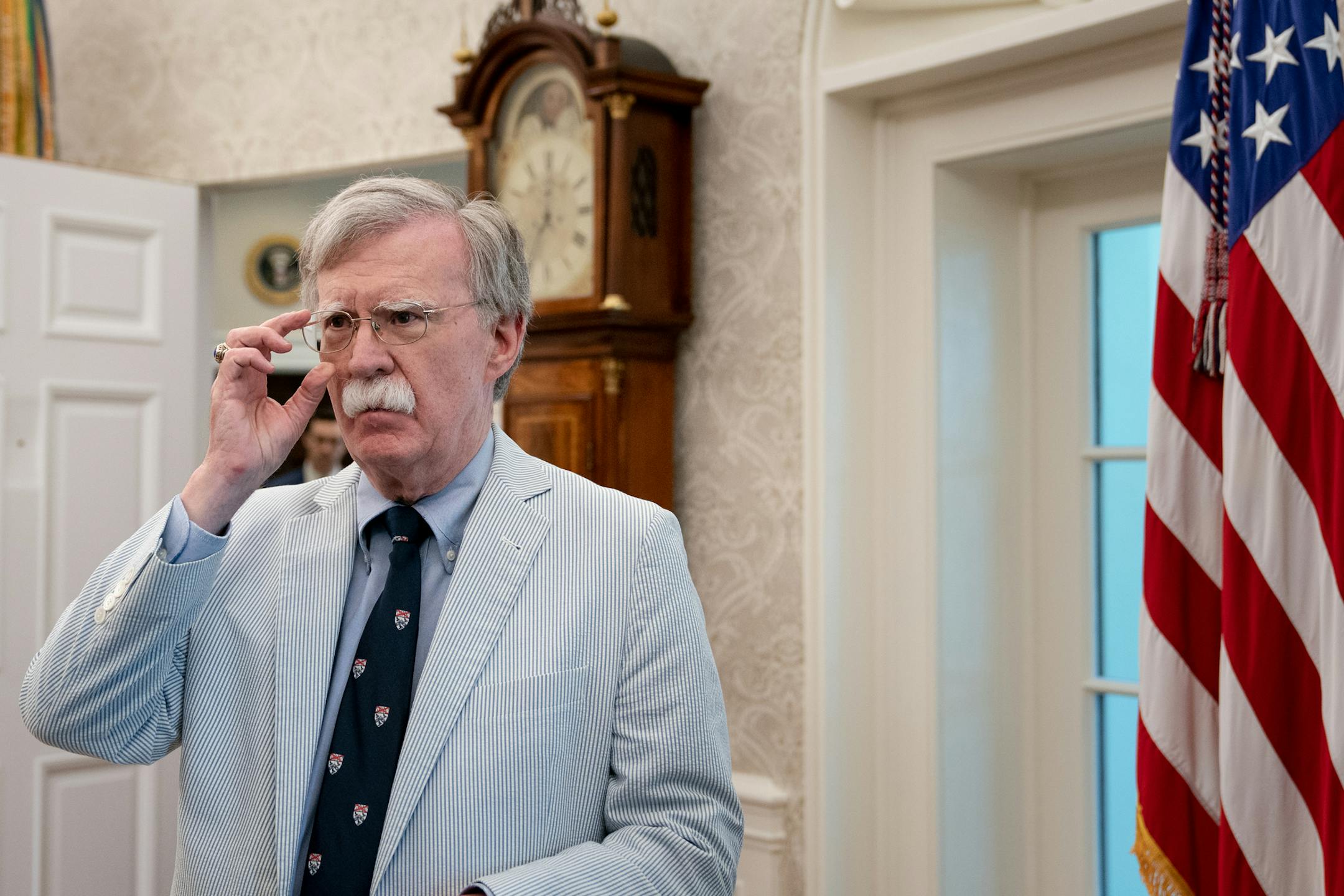
Former Trump administration official John Bolton mentions the "United States" or "America" exactly 351 times in his new memoir, "The Room Where It Happened: A White House Memoir." "Iran" or "Iranian," however, appears 755 times. To put it in perspective, that's about the word count equivalent of the length of this column. One might say that Bolton has an Iran fetish. Unfortunately for Iran, he also has a war fetish. Good thing he only rose to the level of — checks notes — U.S. national security adviser.
What's amazing about this memoir is that most people with war jollies have enough sense — or at least an editor with enough sense — to include a token humanitarian pretext for their warmongering. Former President Barack Obama bombed at least seven countries — Iraq, Syria, Pakistan, Somalia, Yemen, Libya and Afghanistan — but no one would chalk up these attacks to personal obsession. It's impossible to say the same of Bolton when he makes his own best case against himself.
In an alternate universe, where President Donald Trump had acquiesced to Bolton's openly stated desire to attack Iran, it's hard to imagine that Bolton would have gone offside and written something so entirely (and probably inadvertently) self-owning.
Over several opening pages, Bolton describes his failed personal quest to be Trump's first secretary of state and expresses gratitude for the support of pro-Israel Americans, Cuban-Americans, Venezuelan-Americans, and Taiwanese-Americans. These factions, apparently, ascertained that if you're jonesing for a regime change war in Iran, Cuba, Venezuela or China, respectively, then Bolton's your guy.
Bolton credits himself with convincing Trump to withdraw the U.S. from the multilateral nuclear deal with Iran. The decision, which has now left the U.S. sidelined, has pushed the other signatories — European nations keen to do business with Iran — economically closer to fellow signatories and longstanding Iranian allies, Russia and China.
Instead of staying the course with the profitable long-term business approach that the deal afforded, Bolton says that he told Trump that an attack on Iran's nuclear program was "the only lasting solution."
On Venezuela, which at least has the good fortune of not being Iran, Bolton positions himself as a voice of reason. Even though Bolton sees Maduro's leadership as a threat because it could open the door to foes — like Iran — he claims to have talked Trump down from attacking Venezuela. According to Bolton, former Trump chief of staff, Gen. John Kelly, said that Trump qualified a potential invasion of Venezuela as "cool." Bolton said that he tried to convince Trump that regime change could be just as easily achieved by working with Venezuelan President Nicolas Maduro's opponents. Smells a lot like political meddling in the affairs of a sovereign nation.
The theme of U.S. meddling — in Venezuela, in Iran, with Israel, in Syria — is secondary only to that of Bolton's lifelong quest to turn peacetime into war fun time. He scolds Russia for "meddling globally in U.S. and many other elections." Yet, during Bolton's tenure, a Venezuelan politician, Juan Guaido, proclaimed himself "interim president of Venezuela" with U.S. backing, and met with Bolton and Trump while calling repeatedly for Maduro's ouster.


