
German business: Things are looking up

A stock market milestone reflects optimism for German companies.

June 17, 2014 at 12:09AM
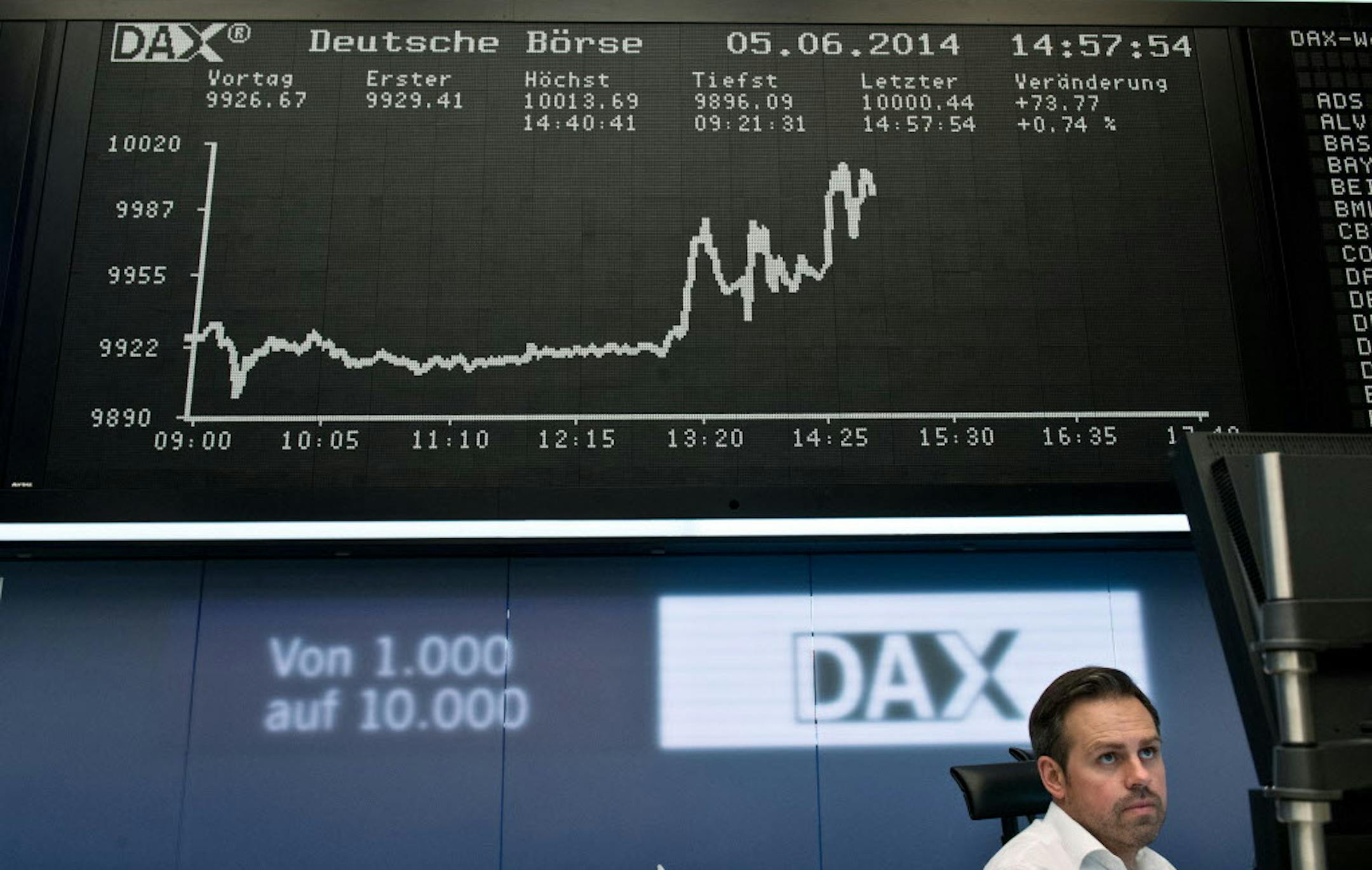
A trader watches his screens as the curve of the German stock index DAX appears on a board behind him, shortly after the German Stock Index, DAX, for the first time rose above 10,000 points at the stock market in Frankfurt, Germany, Thursday June 5, 2014. (AP Photo/dpa, Boris Roessler)
A trader watched his screens in Frankfurt as the German stock index DAX traded above 10,000 for the first time on June 5. (The Minnesota Star Tribune)

Economic growth of 2 percent this year, as is expected in Germany, is hot stuff only in the context of Europe's cool climes. But the DAX index of the country's 30 biggest publicly traded companies is truly sizzling, closing above 10,000 for the first time on June 9, up by 22 percent from a year ago and nearly treble the low it hit in March 2009.

The MDAX, an index of somewhat smaller companies, has performed even better. Share-traders' enthusiasm is shared by bosses: the Ifo business-climate index, a widely watched survey of German companies, shows an optimism not seen since 2011.

What justifies the cheer? Dirk Müller, a trader and commentator who is cautious about the heights share prices are reaching, still thinks the prospects for Germany's carmakers remain bright. Two of them, BMW and Volkswagen, have been among the top five performers over the past five years, and the DAX's best performer has been Continental, a maker of auto parts.

In recent years the run-up in German automotive and engineering firms' shares has been driven by booming emerging-market sales. Now, China's market is cooling, and the prospects for sales in Russia have been dampened by its confrontation with the West over Ukraine. However, markets closer to home are coming to the rescue: car sales in Europe have increased for eight months in a row. Volkswagen, which sold 4.4 percent more cars in the first five months of 2014 than in the same period last year, says western Europe is now only second to the Asia-Pacific region in sales growth, a big change from recent years.

Other German businesses may likewise see renewed vigor in domestic, European and rich-world markets. Barclays bank's analysts think that a long-overdue recovery in capital spending by companies in developed economies should help Germany's many makers of industrial equipment and services. As examples, Barclays mentions Siemens, an engineering conglomerate, Infineon, a microchip maker, and SAP, which makes business software.

All three have struck cheerier notes in recent results announcements. Growth in company profits tends to lag GDP growth by a couple of quarters, so Siemens expects the strong first-quarter economic figure to translate into higher sales later this year. SAP sees the software market in its Europe, Middle East and Africa region growing by more than 5 percent this year. Infineon expects revenue growth of between 4 percent and 8 percent in the current quarter, and thinks rising demand from carmakers and other industrial customers will drive its growth this year.

Although bosses are sounding increasingly happy about the prospects for their businesses, economists are wary. They think the hype on the stock market may be excessive. In particular, they worry that the decision on June 5 by the European Central Bank to push interest rates down into uncharted territory risks inflating a bubble.

But the industrial bosses see a positive side to the central bank's move: cutting interest rates should weaken the euro, making their exports outside the currency zone more competitive and boosting their value when translated back into euros.
Furthermore, with interest rates so low, German banks are falling over themselves to tempt customers with loans to buy new kitchens and take dream holidays, while loosening their loan criteria. Although retailers are not yet as cheerful as manufacturers, their spirits will be raised if the German Chambers of Commerce and Industry is correct in foreseeing a strong revival in domestic consumption.

Dirk Schlotböller, an economist at the Chambers of Commerce, says geopolitical tensions (such as those over Ukraine) and overgenerous government spending commitments should still give German businesses reasons for caution; but for now the chambers' member firms are telling him that things are looking up.


Copyright 2013 The Economist Newspaper Limited, London. All Rights Reserved. Reprinted with permission.

FILE - In this Nov. 9, 2012 file picture a worker fixes a sign at a Volkswagen Golf car during a press tour in Zwickau, central Germany. German automaker Volkswagen AG says its 2012 group sales hit a record high as growing demand around the world more than offset sluggish sales in Europe. It says Monday Jan. 14, 2013 that more than nine million vehicles were delivered for the first time. The total of 9.07 million was up 11.2 percent from the 8.16 million delivered in 2011. (AP Photo/Jens Meyer,F
FILE - In this Nov. 9, 2012 file picture a worker fixes a sign at a Volkswagen Golf car during a press tour in Zwickau, central Germany. German automaker Volkswagen AG says its 2012 group sales hit a record high as growing demand around the world more than offset sluggish sales in Europe. It says Monday Jan. 14, 2013 that more than nine million vehicles were delivered for the first time. The total of 9.07 million was up 11.2 percent from the 8.16 million delivered in 2011. (AP Photo/Jens Meyer,File) ORG XMIT: MIN2013020419524285 (The Minnesota Star Tribune)
FILE - The March 19, 2014 file photo shows the company logo of car manufacturer BMW during the annual balance press conference in Munich, Germany. Booming sales in China and signs of life from the depressed European car market helped BMWís net profit rise 11 percent in the first quarter. Earnings rose 1.462 billion euros (US$ 2.03 billion) from 1.312 billion euros in the same quarter a year ago. The increase was higher than the 1.345 billion consensus compiled from analysts by financial inf
Germany’s auto industry is thriving : BMW and Volkswagen are among the top five performers in the DAX stock index over the past five years. (The Minnesota Star Tribune)
about the writer

about the writer

the economist

More from Business

See More
card image
card image
