

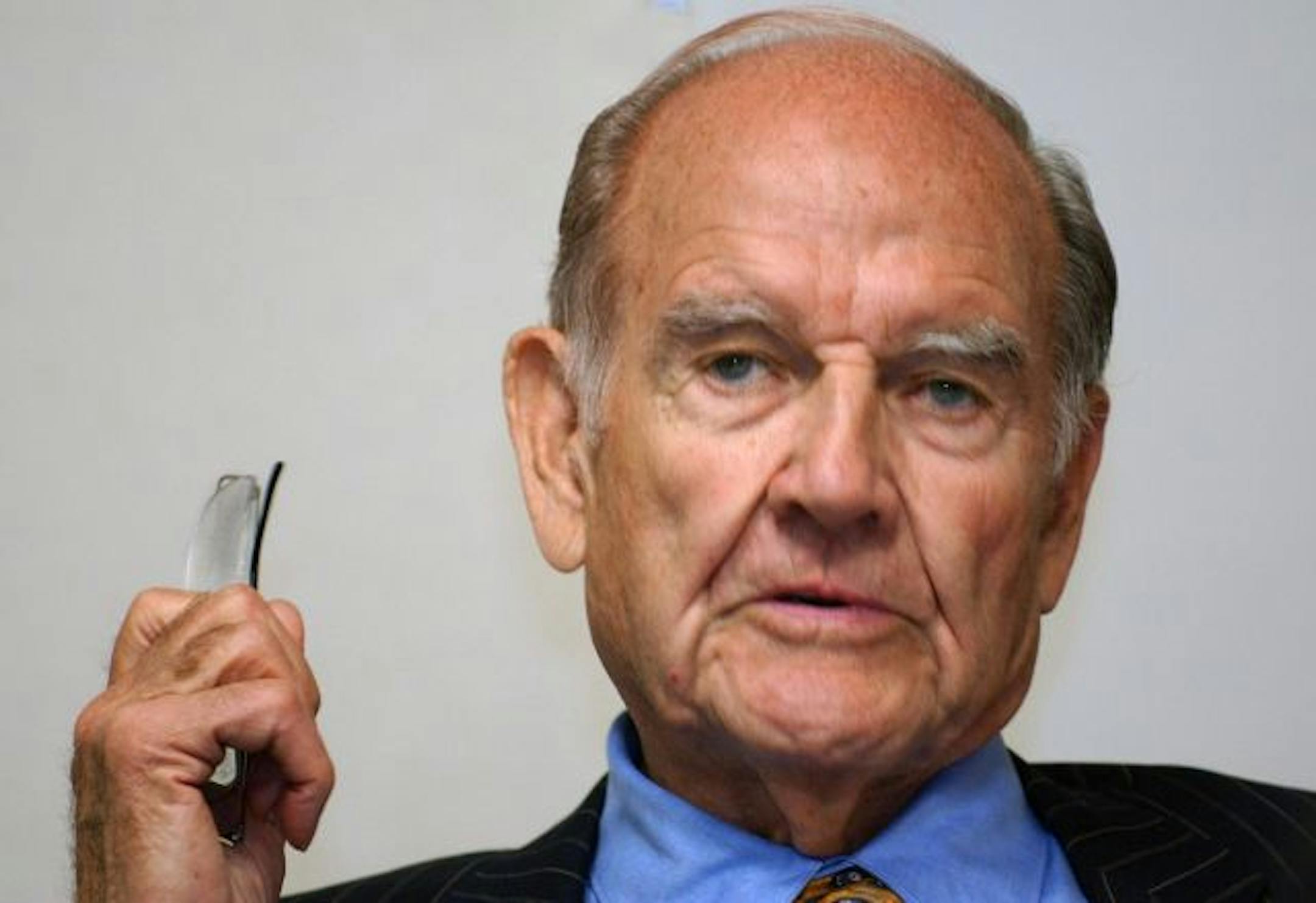
The venerable former senator and failed presidential candidate George McGovern, who died today at 90, is being remembered by many friends and foes alike as the archetypal ultraliberal.
McGovern, they say, effectively turned the Democratic Party over to wild-haired incompetents and left-wing dreamers whose extremism ultimately set the stage for the Reagan "revolution" and the rise of a right-of-center America.
There's truth in that. McGovern's early criticism of the Vietnam War (he first spoke against it as a newly elected Democratic senator from South Dakota in 1963) was out of step with a bipartisan Cold War consensus that smothered serious debate for too long.
Yet when you take a longer view of his career -- especially after he got bounced from the Senate in 1980 during the Republican landslide he helped create -- what emerges is a rare public figure whose policy positions shifted to an increasingly libertarian stance in response to a world that's far more complicated than most politicians can ever allow.
Born in 1922 and raised during the Depression, McGovern eventually earned a doctorate in American history before becoming a politician. But it was as a private citizen he became an expert in the law of unintended consequences, which elected officials ignore routinely. He came to recognize that attempts to control the economic and lifestyle choices of Americans aren't only destructive to cherished national ideals, but ineffective as well. That legacy is more relevant now than ever.
Republican Target
McGovern's loss against incumbent President Richard Nixon in 1972 was the second-biggest electoral-college blowout up to that point, and he managed to lose even his home state. His campaign was run by future Colorado Senator Gary Hart, a greenhorn whose poor judgment was later made fully public in his own 1984 presidential bid (which ended abruptly after he was photographed with a young woman not his wife on a pleasure boat called "Monkey Business," of all things).
The standard analysis was that it was a liability to be described as "another McGovern," which meant "unelectable." In August, the Republican magazine the Weekly Standard licked its chops in a story titled "Barack Hussein McGovern: The specter of 1972 is haunting the Obama campaign."


