

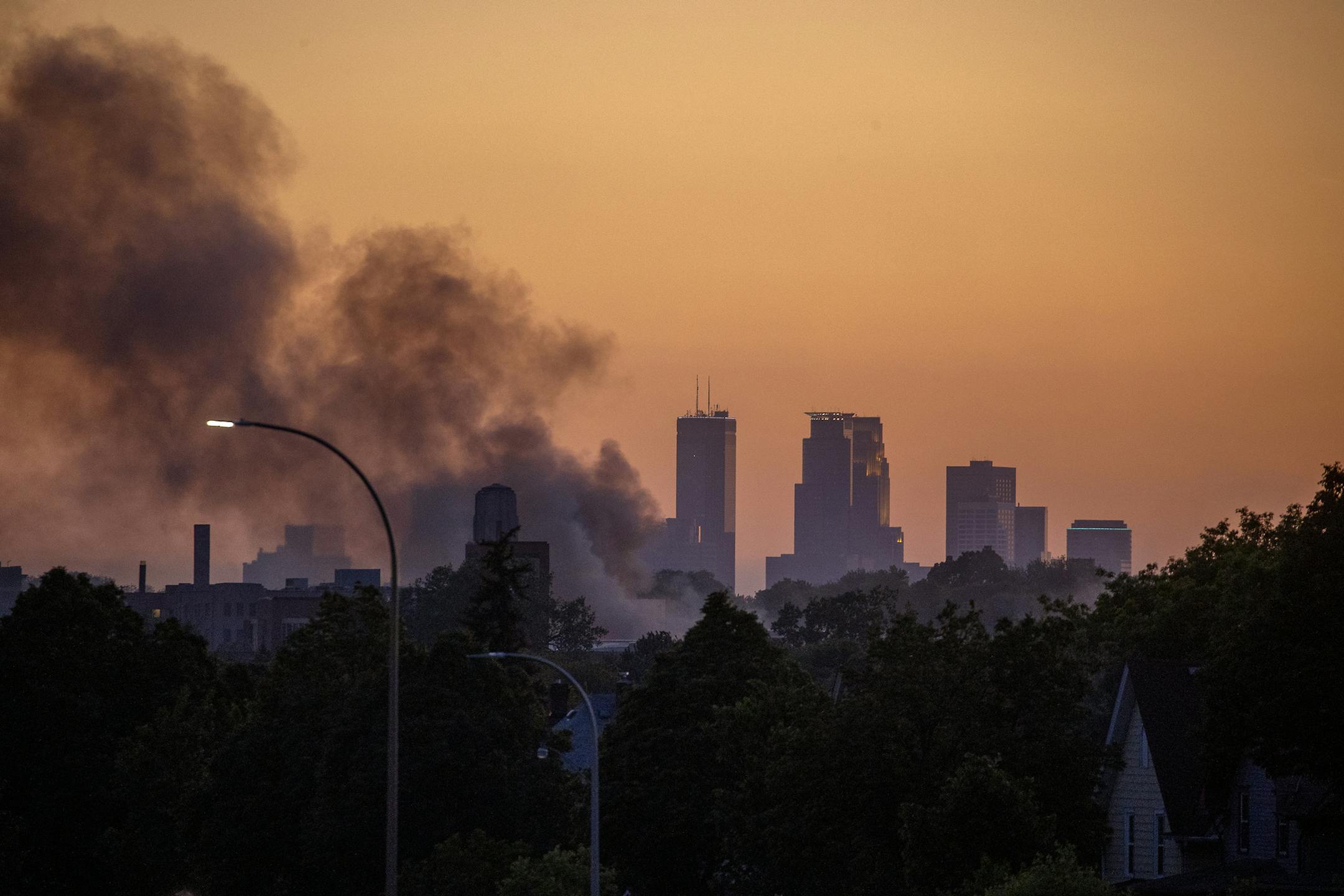
Like many segregated cities before it, Minneapolis is burning. George Floyd's killing by a police officer is tearing the city and the country apart. But this tragedy is also the result of two Americas, increasingly separate from each other, coming into wrenching conflict.
Floyd was from a different world than Derek Chauvin, the police officer who has been charged with second-degree murder in Floyd's death. Floyd grew up in Houston's Third Ward, one of that city's poorest and most racially segregated areas. The street corner on which he died itself sits inside one of Minneapolis's racial borderlands, where miles of majority-white residential neighborhoods begin transitioning into a cluster of majority-nonwhite blocks, in which black residents outnumber white residents two to one.
Chauvin made his home in different circles. Public records indicate that he lives in Oakdale, Minn., a suburb of St. Paul, in a neighborhood that is nearly 80% white, according to data from the U.S. Census Bureau. (This is the norm for Minneapolis police: more than 90% live outside the city.) He owns a second home, where he is registered to vote‚ near Windermere, Fla., an Orlando suburb that is 85% white.
Severe segregation in the Twin Cities region is a relatively recent phenomenon. In the 1960s and 1970s, the Minneapolis region was one of the most racially integrated in the nation. This was partially the product of a carefully designed "fair share" program that required all municipalities within the region to develop affordable housing within their borders, preventing suburbs from effectively barring low-income residents, as had occurred in most major American cities. Minneapolis also operated an aggressive school desegregation plan. But over time, both programs broke down under pressure from special interests and were substituted for by less politically troublesome programs.
This new approach focused more on improving segregated schools than eliminating them, and uplifting impoverished neighborhoods without directly addressing the region's racialized living patterns. Combined with an increase in the region's racial diversity, this policy shift caused residential and educational segregation — almost always closely linked — to rapidly spike. The population of segregated census tracts, where more than four-fifths of the population was nonwhite, grew 108% between 2000 and 2018; the number of K-12 schools more than four-fifths nonwhite grew nearly 200% over the same span. Demographically similar cities, like Portland and Seattle, saw no comparable increase.
Today, Minnesota has some of the largest black-white welfare gaps in the nation, in education, income and employment. The state has America's 11th-largest educational achievement gap, ninth-largest earning disparities, sixth-largest employment disparities, and the second-largest gaps in poverty and homeownership.
This all echoes a deeper truth: Racially segregated regions don't work. They're politically and economically unstable. They result in societies where people can't understand each other or work together. Research shows that segregation can create and reinforce stereotypes and that it erodes people's ability to interact across racial lines. Segregated cities are more likely to produce racism not just within the police force but throughout any political or civic institution with power.
For people of color, segregation has never been a choice. It is imposed by discriminatory practices, like exclusionary zoning or mortgage-lending discrimination. Segregation erodes the economic well-being of families of color by funneling them into economically destitute neighborhoods, where they often fall prey to exploitative practices designed to extract wealth from them, like predatory banking. In Minneapolis, black families earning more than $167,000 are less likely to be given a home loan than white families earning $42,000.


