

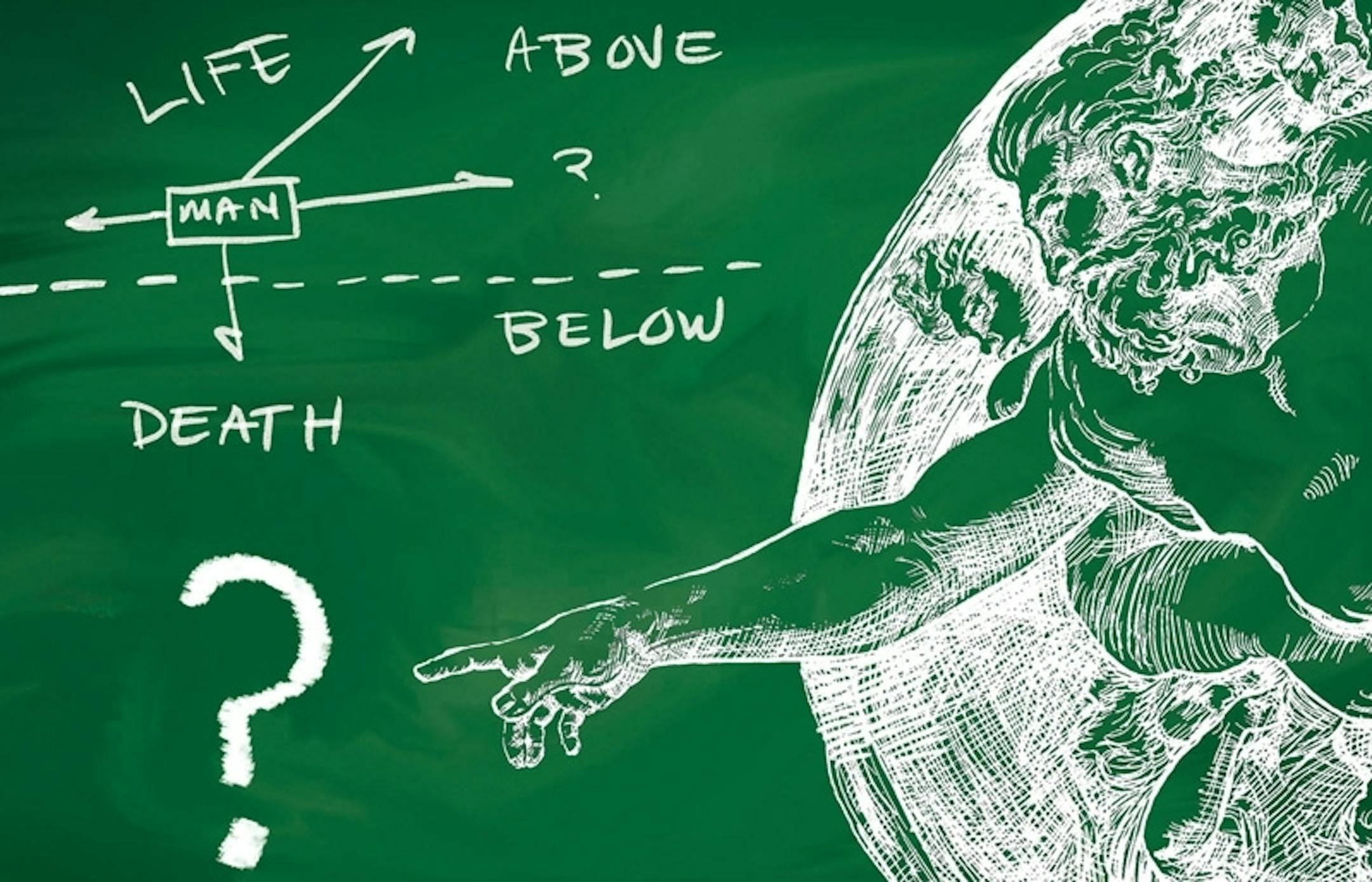
One December evening in 1992, I set two books side by side. One championed "scientific creationism," offering an alternative to biological evolution. The other was a collection of essays by noted evolutionary scientists, rebutting special creation. My self-assigned task was to study a chapter of each book in turn, taking notes and highlighting differences. The goal, based upon my faith in the Old Testament record, was to further hone arguments in favor of the Genesis account. I was a crusader, assaulting the citadel of science, and entertained no doubt concerning the conclusion of my analysis.
A few days later I closed the books and reviewed my notes. Over many hours of intense concentration it gradually dawned on me that I no longer accepted my initial premise; I did not believe the first two chapters of the Book of Genesis were a literal chronicle of how the Earth and its life forms originated. It was an astonishing revelation, shattering my worldview, and a painful experience. Though devastated on one hand, I was also pleasantly awed that I'd confidently set out to accomplish precisely the opposite result, and this right-angle pivot in my mental life was as valid and honest as such mutation can be.
According to a recent Gallup poll, 46 percent of Americans believe "that God created humans in their present form within the last 10,000 years." I understand why and how they believe this -- I was in their number for several years -- but even I was surprised that so many still support creationism. What does this mean? Is it just a tidbit of contemporary Americana that causes Europeans to shake their heads, or are there potentially serious consequences when almost half of us reject a basic tenet of modern science?
First, let's be clear that where you stand on creation (a k a intelligent design, these days) vs. evolution has nothing to do with personal intelligence. There are very smart people on both sides of the issue.
Second, the rationale behind most of the arguments against evolutionary science is to support religious faith. In a drive to place creationist textbooks in public schools, sympathetic organizations eschew all direct mention of God and divine agency in their publications, but that is merely cosmetic. If the universe was designed and/or created, the implication is clear: There is a designer and/or creator -- that is, God. There is nothing nefarious about such belief, but as I learned at my desk 20 years ago, it is not scientific.
Third, the word "theory" carries a popular connotation that does not exactly tally with the scientific meaning. In science, a theory is a body of knowledge that is incomplete, but not necessarily tentative. For example, science speaks of "The Theory of Gravitation." No one doubts the reality or effects of gravity; "theory" in this case just means we don't thoroughly understand how it works. Similarly, the vast majority of scientists do not doubt the reality of evolution, but debate over details of the process continues. In contrast, the popular usage of "theory" implies a guess or conjecture, that evolution itself is in question, and an alternative view is, if not likely, then certainly possible. The only option currently on the table is some variant of creationism, a religious solution.
So when I was a believer in a literal interpretation of Genesis, was I a danger to society? As are most creationists, I was a law-abiding voter, volunteer and taxpayer, involved with my community and concerned about the nation and the world. I did, however, support a self-righteous contempt for the scientific community -- how can you not when you believe its foundation is delusional at best, or Satanic at worst? This was not mere skepticism, which is an intellectually healthy response to data and pronouncements from all sources, including scientists. It was, rather, a philosophical hostility that denied credence and even sincerity to the other side.
In those years I was fond of arguing creation/evolution with all comers, and I recall the evening I dominated a sometimes heated exchange with an anthropologist. This individual later told me, laughing, "I wanted to kill you." He wasn't outraged by my actual arguments, but rather by my overweening stance of rectitude, and my smug disregard for the facts he marshaled in defense of his position. Despite my intransigence ("keeping the faith" in my mind), we remained friends, and simply avoided the topic instead of each other.


