
Fun comes in a smaller scale

During the recession, the folks at Hub Hobby Center have found there's big business in model trains, planes and automobiles. Not to mention toys.

April 8, 2009 at 3:38AM
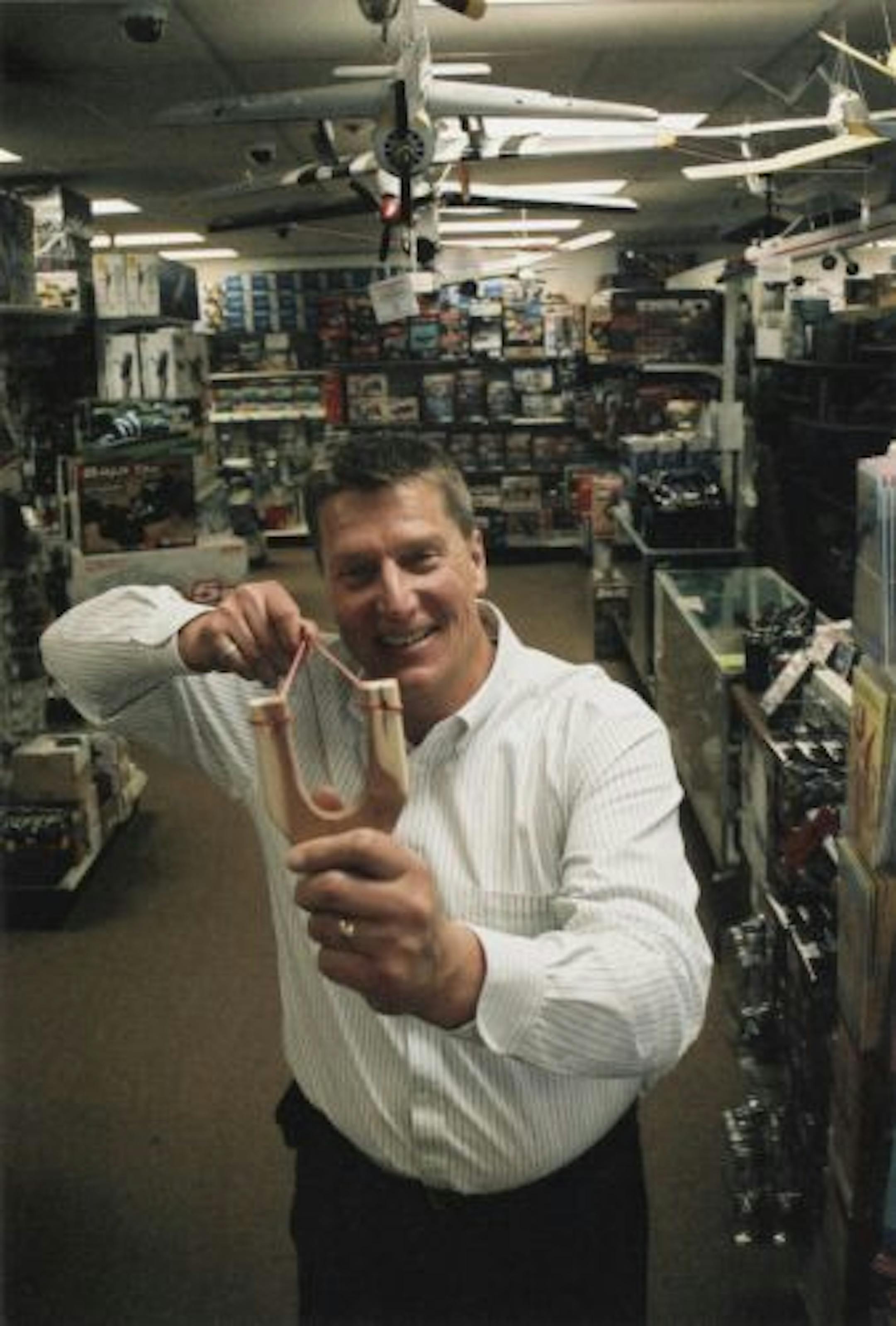
hub hobby center inc. offers a bit of nostalgia along with its leading-edge lines of toys, games and hobbies. In addition to the slingshot wielded by co-owner Todd Anderson, it also carries such old-time favorites as tinker toys and erector sets.
Hub Hobby co-owner Todd Andersen says the recession has not stopped the business from having a shot at a healthy bottom line. Sales rose nearly 5 percent last year, to $4.3 million. (Star Tribune/The Minnesota Star Tribune)

Hub Hobby Center Inc. is a Twin Cities area business that started as a small, conventional hobby shop and ballooned into a pair of hobby, toy and game superstores that offer everything from slot cars and train sets to radio-controlled helicopters and boats to classic car replicas that cost up to $450 and more.

Not to mention model rockets activated by a gunpowder propellant, collectible Madame Alexander dolls that cost more than your weekly grocery bill and aisle after aisle of puzzles, games, and arts and crafts.

Oh, yes, and a full ration of nostalgia: There are slingshots that are a tad more sophisticated than the weapons we constructed out of tree branches and rubber cut from inner tubes back in the day. And rubber-band guns with a slight resemblance to those we made with clothespins attached to the scrap lumber we cut into gun shapes with a handsaw.

And leave us not forget the classic Tinker Toys and Erector sets, and an arsenal of cap pistols.

It all adds up to a business that has defied the economic trends of the past year.

The company, with a 14,300-square-foot store in Richfield and a 12,500-square-foot outlet in Little Canada, hoisted its sales nearly 5 percent in 2008, to $4.3 million. That growth came despite a slight decline at the smaller Little Canada store, which was offset by a 10 percent jump in Richfield.

And in the first two months of 2009, sales are up at both stores: 6 percent in Richfield and 3 percent in Little Canada.

The question is, why the growth in such trying economic times?

"As people pull back, they spend more time at home, so they're looking for home-oriented activities," said Todd Andersen, 50, Hub Hobby's CEO and co-owner with Bill Barker, 51. "And my gut feeling as a parent is that they tend to try and buffer their kids. So they're buying games and toys for the kids and the families."

Wendy Hammond, assistant manager of the Richfield store, put it simply: "Hobbies are therapy in a down economy."

Radio controls

Hub Hobby Center started in 1979, when Barker bought the business. At the time, it occupied fewer than 3,000 square feet and focused mainly on toy trains, model kits and slot cars.

But he soon latched onto the emerging craze of radio-controlled cars and planes, and began expanding the business, first into a 5,000-square-foot space in Richfield, a second store in Robbinsdale and the third store in Little Canada. The Robbinsdale space was closed in 1993.

By that time, Barker had brought Andersen, a childhood friend, into the business and in 1994 turned over the CEO's job to him. It was a comfortable fit: Barker has a background in finance and no interest in a high-profile role; Andersen has an MBA in management and a salesman's outgoing demeanor.

The jump from hobby shop to superstore began in the mid-1990s with the addition of toys and games, most of which appealed to the male of the consumer species. And we're not talking just a smattering, but rather entire product lines.

Thus, the maze of floor-to-ceiling shelves showcase not only Hot Wheels for the kids but also a garage full of classic car models for Dad. Included is an Aston Martin V12 that sells for $449.99 and a Corvette C5R that goes for $930. I'm given to understand that otherwise rational adults are willing to pay such prices.

Then there's about 3,000 square feet of radio-controlled cars, planes and boats, not to mention a miniature Blade MCX helicopter that'll fly up and look you in the eye for a mere $130.

There are 500 to 600 board, card and other games; 28 feet of shelving just for jigsaw puzzles and six rows of Star Wars, Tiger Tanks and other model kits. Plus 80 feet of slot-car shelving, 50 feet of model rockets and 2,500 square feet of model railroad sets.

It wasn't long, until Andersen realized that the business was pretty much focused on just half the population. Which is why there are now about 2,500 square feet of doll houses, Magical Castle Fairy play sets and other items for young ladies. And 140 feet of eight-foot-high shelving filled with arts and crafts and beading and scrapbooking supplies for the moms.

Here's my favorite part: Asked how many stock-keeping units, or "SKUs," the stores carry, Andersen estimated there are nearly 100,000 -- though he admitted he has "no idea just how many there are."

The reason: While the store carries the latest, leading-edge lines of hobbies, toys and games, the business does not have an automated point-of-sale system. So how are inventory decisions made?

"They're pretty much based on empty shelves and the staff's instincts about what the next hot items will be," Andersen said.

It seems to be working.

Dick Youngblood • 612-673-4439 • yblood@startribune.com

about the writer

about the writer

DICK YOUNGBLOOD, Star Tribune

More from Business

See More
card image
Khalid Mohamed/Sahan Journal

The new café was born when owners decided to open a third space especially welcoming to Palestinian and Salvadoran customers.

card image
card image
