

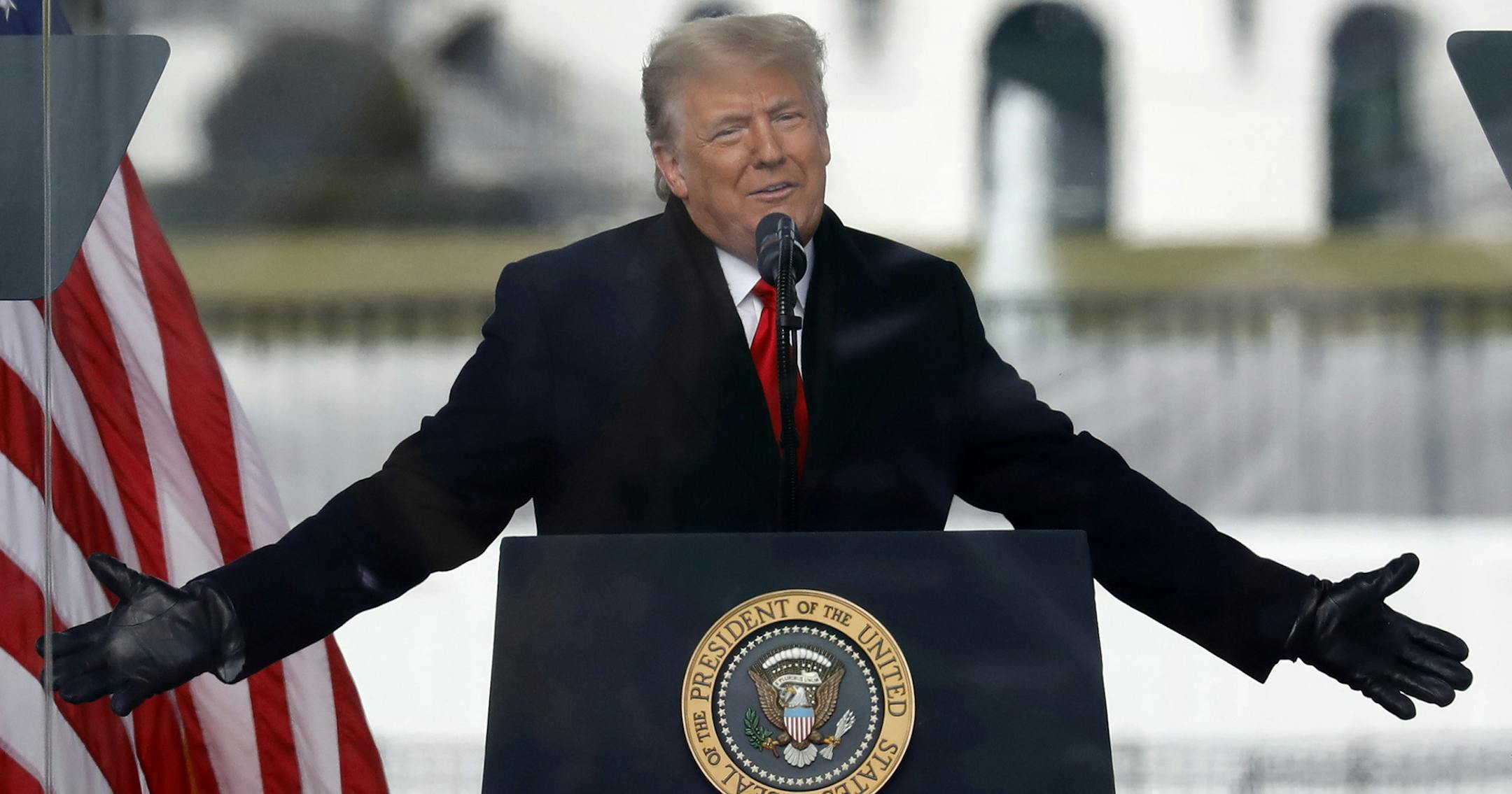
The extended trial brief filed by former President Donald Trump's lawyers advances three defenses: that Trump did not incite the Jan. 6 attack on the Capitol; that the Senate can't try a president who is no longer in office; and that the First Amendment protects Trump from being impeached for words that, they say, don't meet the requirements for criminal incitement conviction laid down by the Supreme Court.
The factual defense is highly unconvincing, as anyone who watched Trump's speech on Jan. 6 and saw the attack can attest.
The argument that the Senate lacks jurisdiction over a president who is out of office is disproved by history and Senate precedent.
The free speech argument is also wrong in a basic sense: The First Amendment prohibits Congress from making any law abridging freedom of speech. But this doesn't apply in impeachments any more than the Sixth Amendment right to a jury trial would apply to the Senate impeachment trial.
Yet the First Amendment defense requires deeper engagement than the other two, if only because it is less absurd. If it did apply to impeachments, the Supreme Court's incitement jurisprudence contained in the famous 1969 case of Brandenburg v. Ohio probably would have protected Trump's speech.
The major component of Trump's argument is that the First Amendment applies to elected officials. As the lawyers put it only a little ungrammatically, "the fatal flaw of the House's arguments is that it seeks to meet out governmental punishments — impeachments — based on political speech that falls squarely within broad protections of the First Amendment."
To support their argument, Trump's lawyers cite Wood v. Georgia and Bond v. Floyd. Both are important Supreme Court cases, but neither proves that the First Amendment should apply to impeachment.
The 1962 Wood case arose when a local Georgia judge impaneled a grand jury and charged it to investigate supposedly suspicious block voting by African American citizens. (Think of it as a precursor to today's false allegations of election scams, but in the context of the civil rights movement.)


