

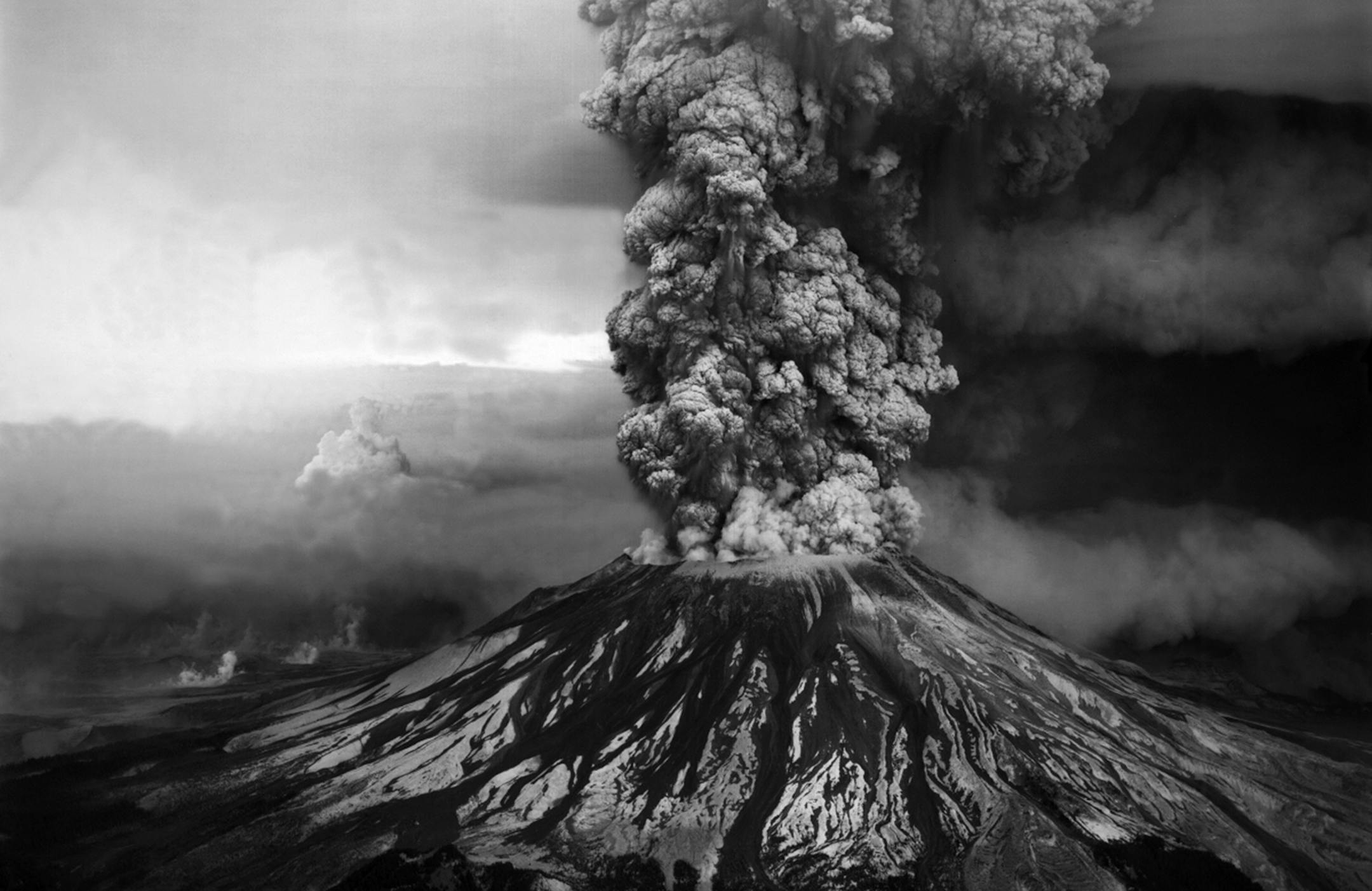
When I met David A. Johnston, it was on a spring evening about a month before he would be erased from existence by a gigantic cloud of volcanic ash boiling over him at 300 miles per hour. He was coming through the door of a makeshift command center in Vancouver, Wash., the closest city to the graceful snow-capped dome of Mount St. Helens, a volcano that had been dormant for 123 years. This was April 1980, and Johnston, a 30-year-old geologist, was one of the first scientists summoned to monitor new warning signs from the mountain — shallow earthquakes and periodic bursts of ash and steam.
As a young reporter I had talked my way into the command center. At first Johnston was wary; he wasn't supposed to meet the press anymore. His supervisors had played down the chance that the smoking mountain was about to explode, and they had already reprimanded him for suggesting otherwise. But on this night he'd just been setting measuring equipment deep in the surrounding forest, and his runner-thin frame vibrated with excitement, his face flushed under his blond beard, and Johnston couldn't help riffing on the likelihood of a cataclysmic event.
"My feeling is when it goes, it's going to go just like that," he told me, snapping his fingers. "Bang!" At best, he said, we'd have a couple of hours of warning.
Johnston was mostly right. Early on a Sunday morning several weeks later, the mountain did blow, in the most destructive eruption in U.S. history. But there was no warning. At his instrument outpost, on a ridge more than five miles from the summit, Johnston had only seconds to radio in a last message: "Vancouver! Vancouver! This is it!"
May 18, marked the 40th anniversary of the 1980 Mount St. Helens eruption, and as we now face our own struggle to gauge the uncertain risks presented by nature, to predict how bad things will get, and how much and how long to protect ourselves, it may be useful to revisit the tension back then between science, politics and economics.
The drama played out on a much smaller stage — one region of one state, instead of the whole planet — but many of the same elements were present: Scientists provided a range of educated guesses, and public officials split on how to respond. Business owners and residents chafed at the restrictions put in place, many flouted them, and a few even threatened armed rebellion. In the end, the government mostly accepted the analyses of Johnston and his fellow geologists. As a result, while the eruption killed 57 people and flattened hundreds of square miles of dense Pacific Northwest forestland, the lives of hundreds, perhaps thousands, were spared.
At the first warning signs, state and federal officials moved to distance people from the mountain. They sought to block nonessential visitors from nearby Spirit Lake, ringed with scout camps and tourist lodges. Other than loggers, few people hung around the peak year-round, but the population surged in late spring and summer, when thousands hiked, camped and moved into vacation homes. Many regulars dismissed the risk. Slipping past roadblocks became a popular activity. Locals sold maps to sightseers and amateur photographers that showed how to take old logging roads up the mountain. The owner of a nearby general store shared a common opinion of the threat: "It's just plain bull. I lived here 26 years, and nothing like this happened before."
Like the probability of a pandemic, though, it was well established that one of the dozen or so volcanoes in the 800-mile Cascade Range might soon turn active. Averaging two eruptions a century, they were overdue. A 1978 report by the U.S. Geological Survey, where Johnston worked, identified Mount St. Helens as most likely to blow next. Yet forecasting how big the event could be was a matter of art as well as science. Geologists could model only previous explosions and list the possible outcomes. ("That position was difficult for many to accept, because they believed we could and should make predictions," a USGS report said later.)


