
We mapped 340,000 trees in the Twin Cities to find the best fall color

October 6, 2025
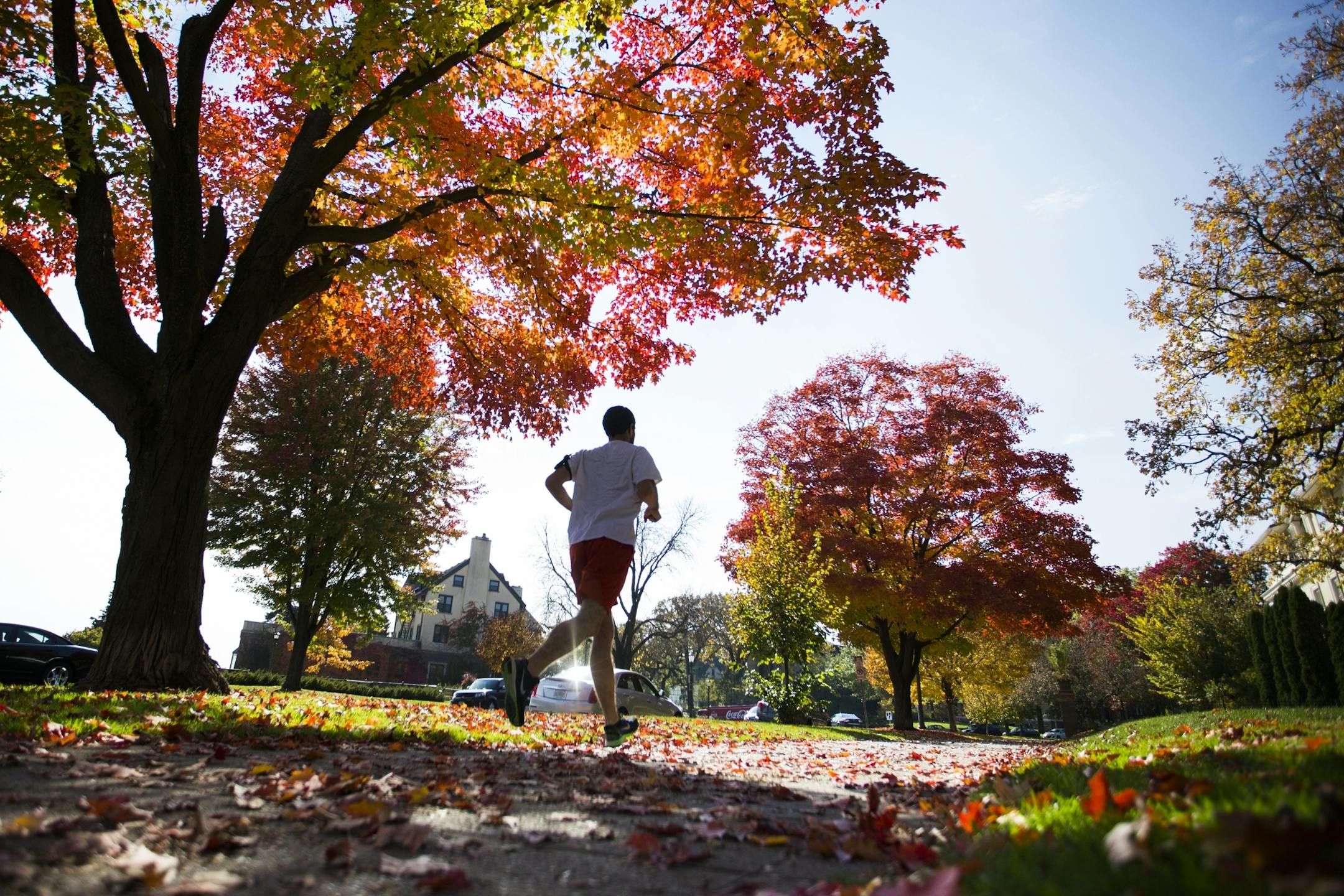
A maple tree ablaze in fall colors lights the path for a jogger on Summit Avenue in St. Paul.
A maple tree ablaze in fall colors lights the path for a jogger on Summit Avenue in St. Paul. (Leila Navidi/The Minnesota Star Tribune)

Minneapolis and St. Paul’s tree inventory shows where density and color collide.

The Minnesota Star Tribune

Finding great fall color doesn’t have to mean a road trip out of the city.

To find the best urban fall colors, we looked at more than 340,000 trees and 342 species documented in 2021’s Minneapolis-St. Paul Long Term Ecological Research program to find the highest tree density — where there are a lot of trees in a space — and species mix.

In both cities, the tree canopy isn’t even. Socially vulnerable neighborhoods often have less tree cover than others.

In Minneapolis, density is higher along parkways and around the Chain of Lakes. North Minneapolis has less tree cover, in part due to losses from a 2011 tornado. In St. Paul, thick trees extend across Mac-Groveland and Hamline-Midway, and along wider boulevards like Summit Avenue and Lexington Parkway.

To reduce risk from pests and disease, cities aim for diversity, limiting reliance on any single species. That can help with great fall color with a mix of yellows, oranges and reds.

Leaves contain yellow carotenoids that become visible as chlorophyll fades in the fall. Some species also produce anthocyanins, adding crimson. Trees that usually turn yellow can shift warmer — toward orange or red — if weather conditions help produce anthocyanin.

No single tree dominates either Minneapolis or St. Paul, but there are pockets of each city that have dominant species.

In Minneapolis, hackberry trees make up about 7.4% of the city’s inventoried trees. They often run the length of wide avenues and parkways, especially Park Avenue and Minnehaha Avenue.

Honey locusts are broadly even across the city, but their bright gold runs through Uptown and Marcy-Holmes in particular.

Maples have a strong presence in south Minneapolis, especially along Portland Avenue and in the Whittier neighborhood.

In St. Paul, Norway maple is prominent, accounting for nearly 14% of inventoried trees. It appears citywide, including along major thoroughfares like Snelling Avenue and Randolph Avenue and across the Hamline-Midway area.

Combined with the hybrid and sugar maples, nearly 1 in 4 trees in St. Paul are a maple variety.

Though our analysis showed green ash as the third most common species in 2021, the city finished removing ash trees from most boulevards and parks last year to combat the emerald ash borer. The city took out tens of thousands of ash trees over the last 15 years.

Bright fall color isn’t guaranteed. Steady rain as the weather cools tends to produce punchier color; dry spells can mute it.

Satellite imagery from 2023 shows where pockets of the metro see a collision of both dense trees and vibrant color: the banks of the Mississippi River, rows of red maples in St. Paul, and Maple Grove’s Fish Lake Regional Park with its bright orange patches, for example.

Data methodology & sources

Block-level tree density was calculated by joining city tree inventory data with Minnesota Department of Transportation street centerlines and matching each tree to its nearest street segment within a 12-meter buffer to count the number of trees in each segment, then normalizing by the segment length.

Tree inventory: Minneapolis-St. Paul Urban Tree Inventory, Environmental Data Initiative, 2023.

Satellite imagery: Planet Labs PBC

about the writer

about the writer

Yuqing Liu

Graphics Producer

Yuqing Liu is a graphics producer at the Minnesota Star Tribune, focusing on charts, maps and other visual formats for data-driven stories in digital and print.

See Moreicon

More from Outdoors

See More
Rising above the treeline (Top of this photo), on the shore of Birch Lake, the Twin Metals Copper Nickel Mine Plant site and Tailings Management site is part of the proposed plan. ] In theory, the copper-nickel mine Twin Metals wants to build in the headwaters of the Boundary Waters Canoe Area Wilderness is a zero-discharge mine — a closed loop that will endlessly recycle millions of gallons of water, including rainwater and the polluted process water it uses to extract ore and
Brian Peterson/The Minnesota Star Tribune

The copper-nickel mine is controversial for its proximity to the Boundary Waters Canoe Area Wilderness, and the Biden Administration had canceled its leases.

card image
card image