

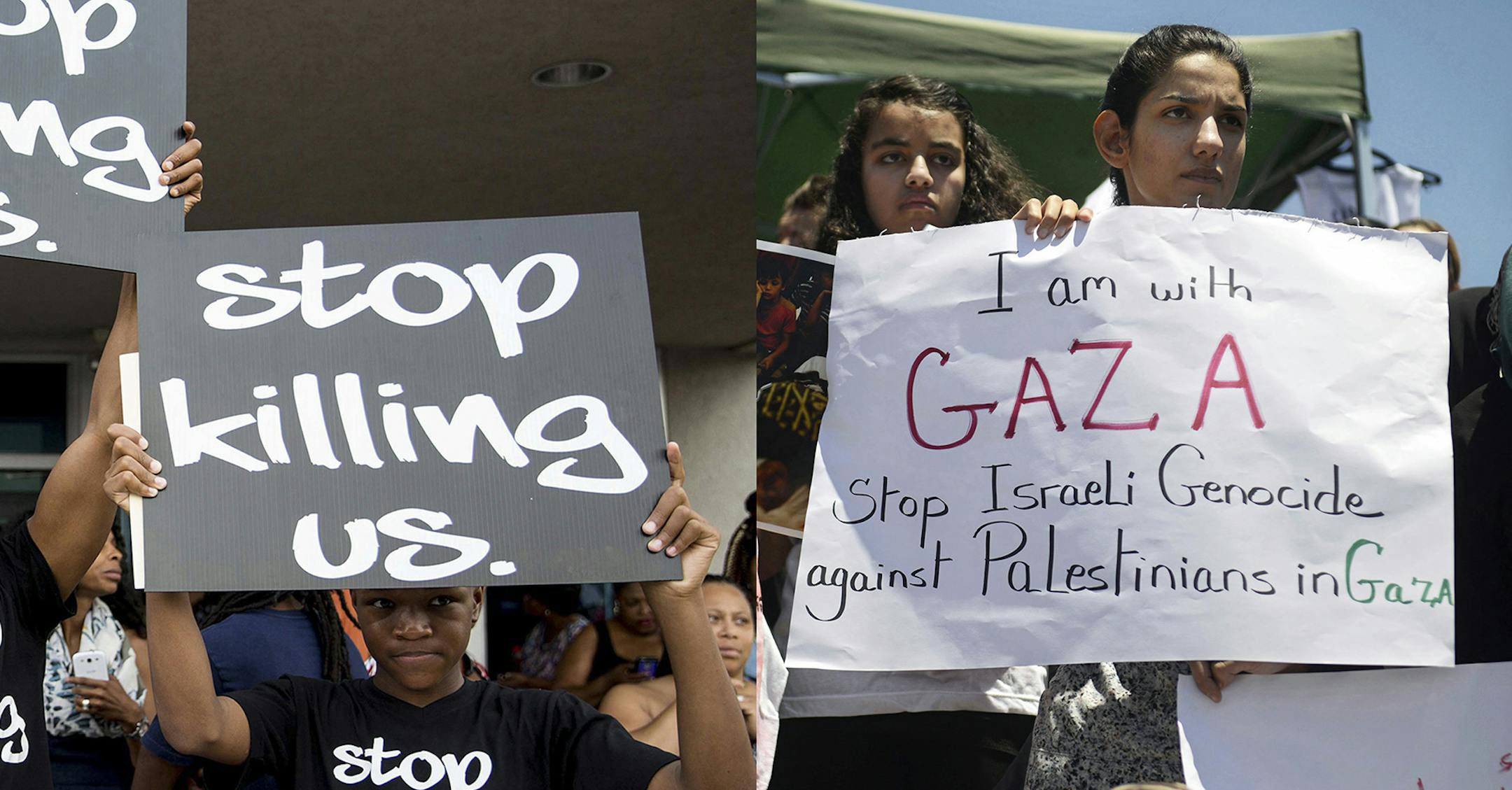
I grew up in Ferguson, Mo. No one ever heard of it, unless you lived elsewhere in St. Louis County. Then my family moved to Palestine — my father's first home.
A friend says, "Your parents really picked the garden spots."
In Ferguson, an invisible line separated white and black communities. In Jerusalem, a no-man's land separated people, designated by barbed wire.
My father and his family became refugees in 1948, when the state of Israel was created. They lost everything but their lives and memories. Disenfranchised Palestinians ended up in refugee camps or scattered around the world. My dad found himself in Kansas, then moved to Missouri with his American bride. He seemed a little shellshocked when I was a child.
Ferguson was a leafy green historic suburb with a gracious red brick elementary school called Central. I loved that school, attending kindergarten through sixth grade there. All my classmates were white, of various derivations — Italians, French-Canadians, etc. My father was the only Arab in Ferguson. But he ran for the school board and won.
At 12, I took a berry-picking job on "Missouri's oldest organic farm" in Ferguson. I wanted the job because I had noticed that the other berry-pickers were all black boys. I'd always been curious about the kids living right down the road whom we hardly ever got to see. We had contests to see who could pick the most in the searing humidity. I had obliterated Ferguson's "line." I felt a secret pride.
My mom often warned, "Be your best self." This seemed odd.
It would be 1968 before the Supreme Court ordered U.S. states to dismantle segregated school systems (Green vs. County School Board of New Kent County) and Ferguson began mixing it up. We were gone by then.


