
Federal Reserve ends its multitrillion-dollar bond-buying program

Its bond-buying program of economic first aid is over. Did it do what it set out to do?

The New York Times
October 30, 2014 at 5:38AM
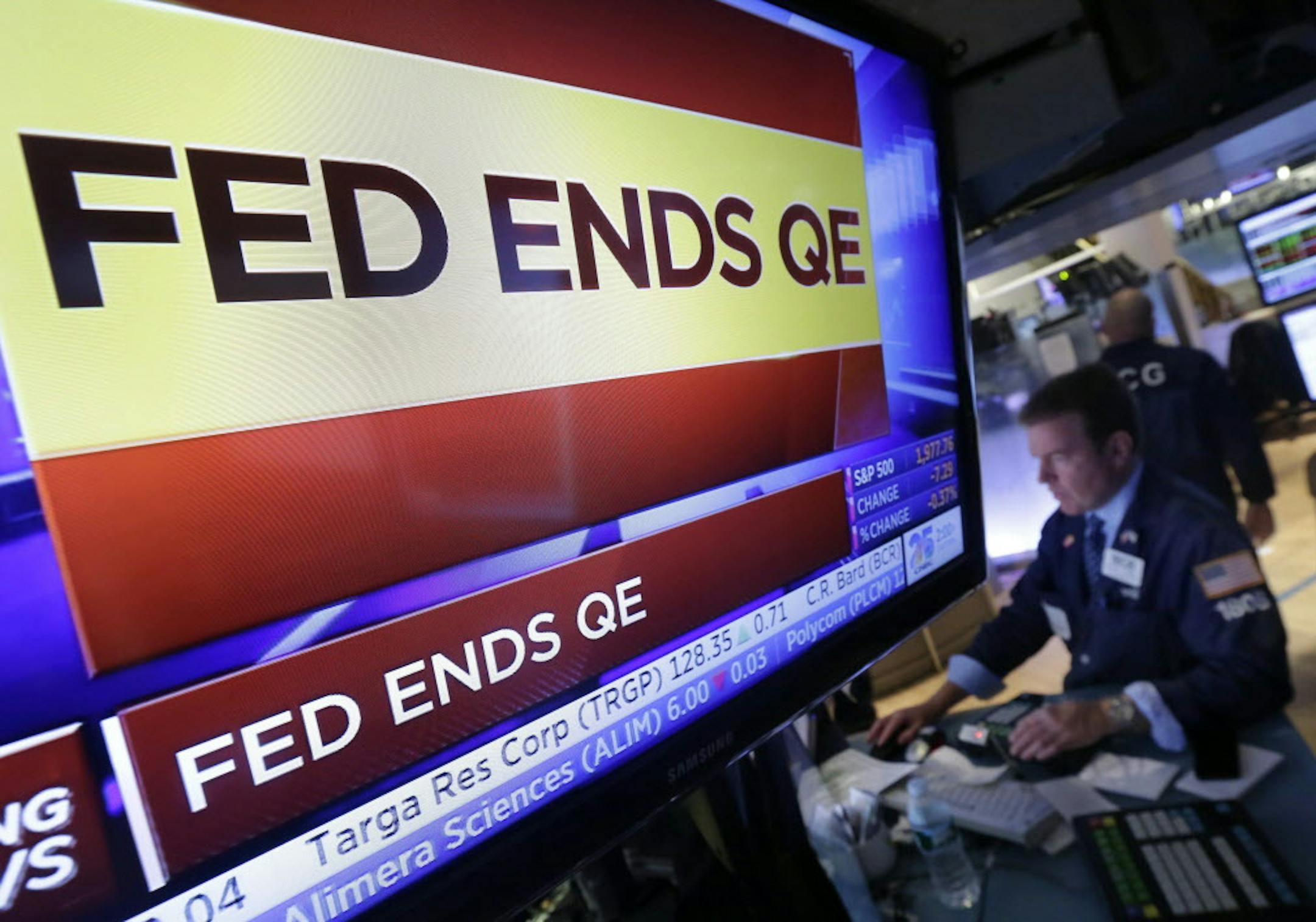
Specialist Michael O'Mara works at his post on the floor of the New York Stock Exchange, as a television screen shows the decision of the Federal Reserve, Wednesday, Oct. 29, 2014. The Fed plans to keep a key interest rate at a record low to support a U.S. job market that's improving but still isn't fully healthy and help lift inflation from unusually low levels. As expected, it's also ending a bond purchase program that was intended to keep long-term rates low. (AP Photo/Richard Drew)
The Fed plans to keep a key interest rate at a record low and is also ending its “quantitative easing” bond purchase program. (The Minnesota Star Tribune)

Its bond-buying program of economic first aid is over. Did it do what it set out to do?

By BINYAMIN APPELBAUM • New York Times

WASHINGTON

In a series of sweeping campaigns to revive the American economy, the Federal Reserve has spent much of the past six years purchasing trillions of dollars of bonds. Now it is done.

The Fed said Wednesday that the economy no longer needed quite so much help. It is the third time since 2008 the Fed has announced such a move, but this time officials and analysts say the decision is more likely to stick, signaling an important milestone in the nation's painfully slow recovery from the Great Recession.

The central bank still plans to keep short-term interest rates near zero for a "considerable time," it said in a statement after a two-day meeting of its policymaking committee. And it said it would replace maturing bonds to keep its holdings at about $4.5 trillion.

The bond-buying campaign has helped to fuel one of the longest bull markets in American history. The Standard & Poor's 500 index has risen 131 percent since the Fed started its first round of purchases in November 2008. The campaign has also helped to suppress borrowing costs. The yield on the benchmark 10-year Treasury has declined from 2.96 percent to 2.32 percent over the same period, even as economic conditions have improved.

The impact on the rest of the economy is much harder to assess. The Fed and its supporters say the purchases have held down the cost of mortgage loans and corporate debt, contributing to faster job growth. Other economists dismiss the purchases as inconsequential. And some say the Fed has exacerbated economic inequalities by helping to lift financial markets while the rest of the economy languishes.
The Fed critics' dire predictions, however, have clearly failed to materialize. Some Fed officials and economists warned that the bond purchases, often referred to by experts as quantitative easing, or QE, would devalue the dollar and drive up inflation. So far the opposite has happened.

The U.S. economy has outperformed other developed parts of the world, helping to strengthen the dollar, while inflation has remained so sluggish that the greater worry is now whether prices are rising too slowly.

Kim Schoenholtz, an economics professor at New York University, said the Fed's bond purchases were particularly effective and important in stabilizing the financial system and stimulating the broader economy in the immediate aftermath of the financial crisis. But he said that the impact of the purchases had diminished as conditions improved, and that it now made sense to end the program.

"I applaud the Fed's willingness to be aggressive, especially early on in the crisis, and it has made sense for the Fed to run a very accommodative policy," Schoenholtz said. "But we should not be surprised that monetary policy has diminishing returns."

Schoenholtz added that the Fed's quick and strong response helped to explain why the Fed was nearer to achieving its economic objectives than the European Central Bank or the Bank of Japan, both of which are now battling to avoid deflation.

On Monday, the ECB disclosed the first purchases in a planned campaign to buy private sector assets, a kind of entry-level quantitative easing. But the amount the central bank bought — 1.7 billion euros, or $2.16 billion, worth — was considered a drop in the bucket by analysts.

Many House Republicans regard the bond purchases as a form of reckless meddling, and they have passed legislation to constrain the Fed's flexibility during future downturns. "I'm afraid the long-term legacy of the policy will reflect the harm it has done to our nation's seniors, savers, and all Americans faced with greater uncertainty and the possibility of a QE-induced bubble," Rep. Randy Neugebauer, R-Texas, said Wednesday.

The Fed started buying bonds for the first time in modern times because it had run out of other options. Under Ben Bernanke, then the Fed's chairman, the central bank cut its benchmark short-term interest rate to zero in December 2008, maxing out its primary means of influencing economic conditions.


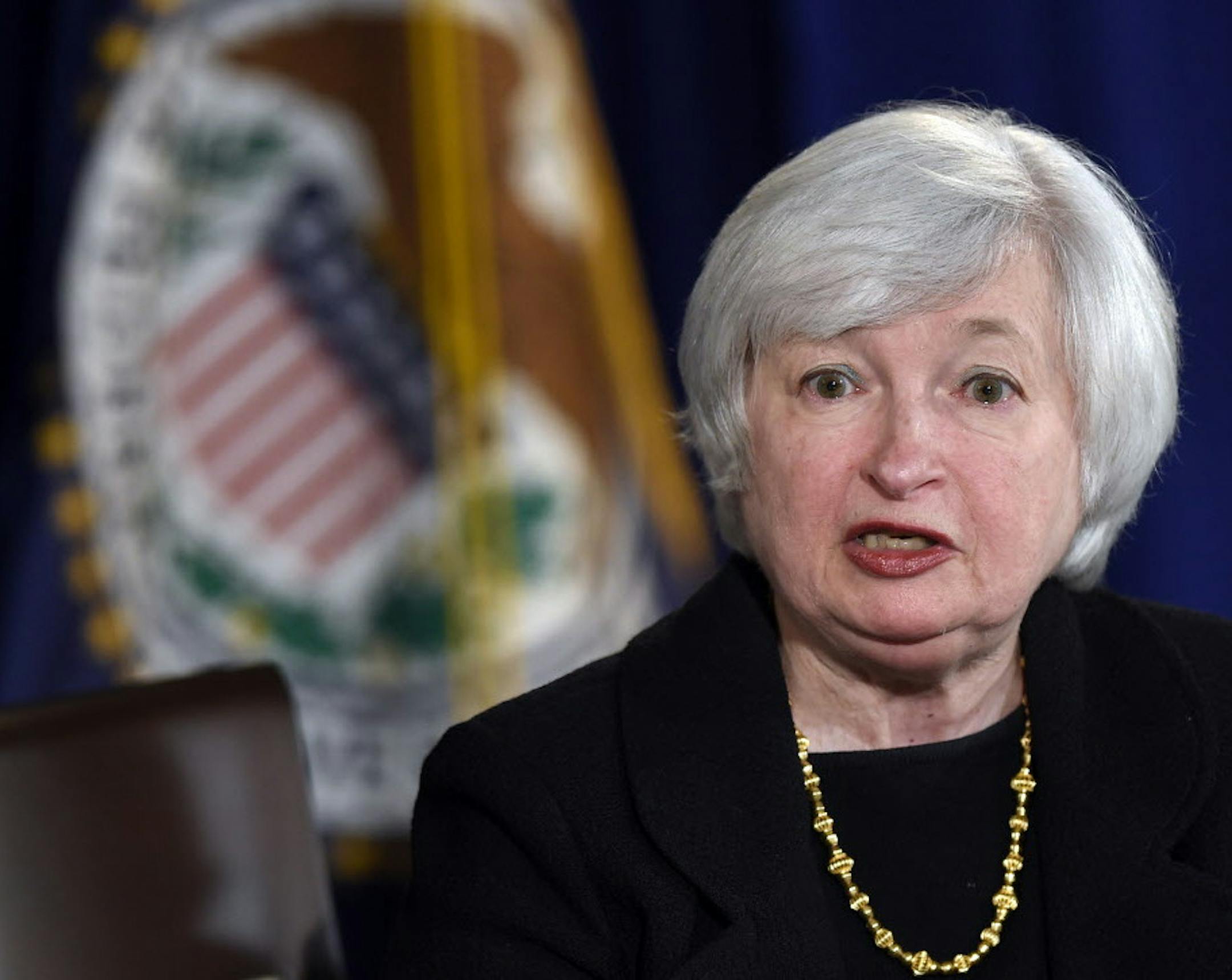
Federal Reserve Chairman Janet Yellen speaks during a news conference at the Federal Reserve in Washington, Wednesday, Sept. 17, 2014. The Federal Reserve signaled Wednesday that it plans to keep a key interest rate at a record low for a considerable period because a broad range of U.S. economic measures remain subpar. (AP Photo/Susan Walsh)
Federal Reserve Chairwoman Janet Yellen received the support of all members of the committee to except one: Narayana Kocherlakota. (The Minnesota Star Tribune)
about the writer

about the writer

BINYAMIN APPELBAUM

More from Business

See More
card image
Spencer Platt

The U.S. stock market roared back on Friday, as technology stocks recovered much of their losses from earlier in the week and bitcoin halted its plunge, at least for now.

Attendees of Frostbike made their way through the convention Saturday at the Quality Bike Products campus in Minneapolis. ] (AARON LAVINSKY/STAR TRIBUNE) aaron.lavinsky@startribune.com Frostbike 2016 was held at the Quality Bike Products Campus on Saturday, Feb. 27, 2016 in Bloomington, Minn.
card image
