
Experts: It's when, not if, Greece defaults

But a controlled default would be preferable, they say.

January 16, 2012 at 3:45AM
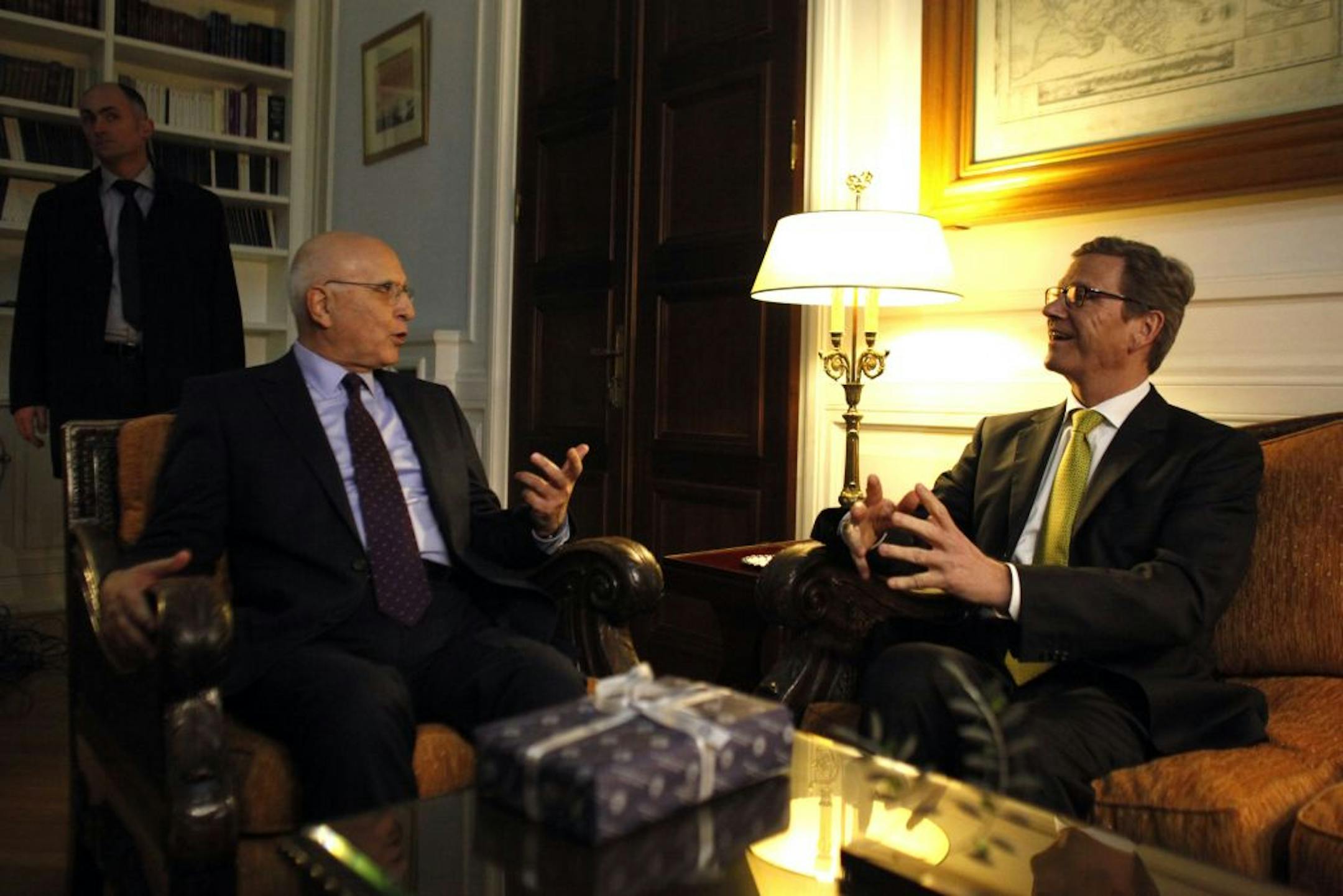
Greek Foreign Minister Stavros Dimas, left, spoke to his German counterpart, Guido Westerwelle, at a meeting in Athens on Sunday.
Greek Foreign Minister Stavros Dimas, left, spoke to his German counterpart, Guido Westerwelle, at a meeting in Athens on Sunday. (Associated Press/The Minnesota Star Tribune)

ATHENS - As Greece and its lenders prepare for another week of tense negotiations, European officials now say that the task is less to help the country through its troubles than to avoid the sort of uncontrolled default that many experts fear could threaten the global financial system.

Officials from the so-called troika of foreign lenders to Greece -- the European Central Bank, European Union and International Monetary Fund -- have come to believe the country has neither the ability nor the will to carry out the economic reforms it has promised in exchange for aid, according to people familiar with the talks, and they say they are prepared to withhold the next installment of aid in March.

Adding to the anxieties in financial markets, talks broke down Friday between the Greek government and private lenders over a plan to reduce Greece's debt by $130 billion, a "voluntary" default that the troika has demanded before extending more aid.

Those negotiations, aimed at forcing hedge funds and other private holders of Greek debt to accept large losses in order to make the country's debt more manageable, will resume on Wednesday amid rising concerns about the consequences of failure.

Fanning fears

The markets have taken into account a voluntary default by Greece, experts say. But financial experts fear the possibility of an "involuntary" default if the negotiators are unable to reach an agreement. That could unleash violent market reactions that could produce another market cataclysm like the 2008 bankruptcy of Lehman Brothers and throw the world into another recession.

Fanning those fears is a growing conviction among the Greek establishment and the country's lenders that the old dynamic -- with Greece pretending to make structural changes and its lenders pretending to save it from default -- has become untenable.

As recently as November, Greece and its lenders were optimistic that the country's newly installed prime minister, Lucas Papademos, a well-respected financial technocrat, would stabilize Greece's soaring debt and help nurse the country back to health.

But since then, his interim government -- stocked not with technocrats but with politicians gunning for national elections as soon as March -- has been paralyzed. Although it passed the 2012 national budget, it has failed to put into effect most of the unpopular changes mandated by the loan agreement that the previous government made back in 2010, when the country first admitted it was broke.

"The prime minister is a fine personality ... but no one is helping him," said George Kirtsos, owner of the Athens City Press. "Those that take the decisions at a national level believe Greece will not make it."

Sense of inevitability

There is considerable posturing in these sorts of negotiations, and the troika has threatened to withdraw aid in the past, only to approve the next loan installment. It may do so again despite its misgivings, because the alternative of an uncontrolled default is too risky.

But amid a stream of gloomy news from Europe, including the credit downgrade of France and eight other countries, the sense that default is inevitable is growing.

"When you simply go over the bare figures, I can't really imagine another scenario," said Michael Fuchs, a leading member of Chancellor Angela Merkel's Christian Democratic Union in the German parliament. "Mathematics is mathematics, and one plus one has to equal two and not five," he said, describing how, even with a significant restructuring of its debt, the Greek government's deficit would still be too large and its economy not competitive enough to put the country back on a sound footing.

about the writer

about the writer

RACHEL DONADIO and NIKI, KITSANTONIS

More from Business

See More
card image
Evan Ramstad/The Minnesota Star Tribune

DigiKey seven years ago made a huge bet on staying in Thief River Falls. It built the state’s largest building, adopted new processes and sees no limits to its opportunities.

card image
Berkshire Hathaway Chairman and CEO Warren Buffett, left, and Vice Chairman Charlie Munger, briefly chat with reporters Friday, May 3, 2019, one day before Berkshire Hathaway's annual shareholders meeting. An estimated 40,000 people are expected in town for the event, where Buffett and Munger preside over the meeting and spend hours answering questions. (AP Photo/Nati Harnik) ORG XMIT: NENH1
