
Expert hails state's efforts to foster financial smarts

A financial literacy activist says kids need to see how wise handling of money is tied directly to jobs and success.

October 6, 2012 at 10:07PM
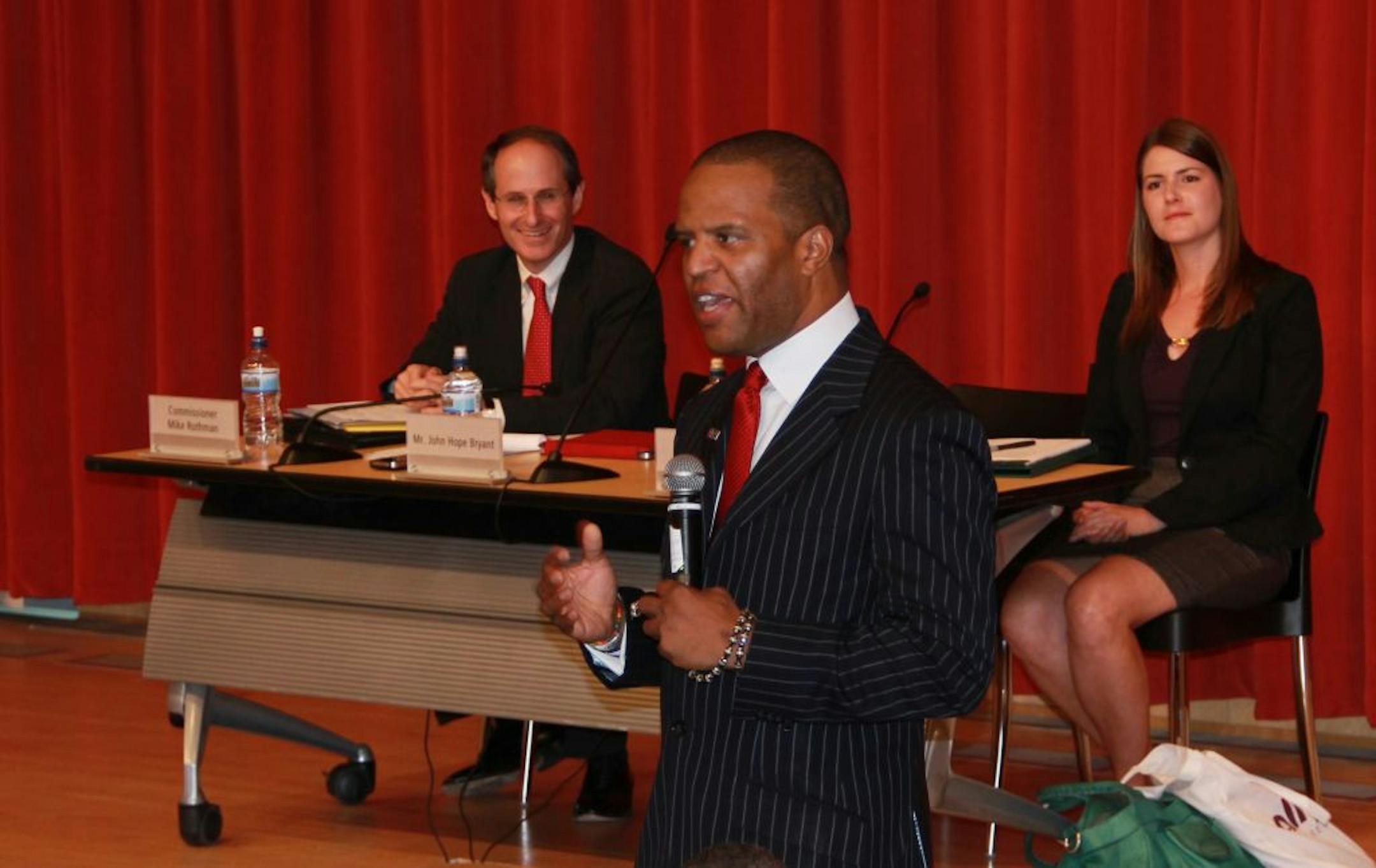
John Bryant, who works on the President's Advisory Council on Financial Capability, spoke Monday to the Minnesota Financial Literacy Interagency Work Group at the invitation of DOC commissioner Mike Rothman. Also sitting in was Mary Hoch from the National Endowment for Financial Education
John Bryant, who works on the President’s Advisory Council on Financial Capability, spoke Monday to the Minnesota Financial Literacy Interagency Work Group at the invitation of DOC commissioner Mike Rothman. Also sitting in was Mary Hoch from the National Endowment for Financial Education (Star Tribune/The Minnesota Star Tribune)

Got your financial house in order? Of course you do, you're a Minnesotan.

John Bryant, a member of the President's Advisory Council on Financial Capability, recently told a group of financial literacy stakeholders in Minneapolis that Minnesota ranks at or near the top of states for the success of its financial literacy programs.

Does the country need a Council on Financial Capability? "Most consumers are spending without a financial license," said Bryant, who was invited by Minnesota Department of Commerce Commissioner Mike Rothman to discuss hurdles Minnesota faces. He encouraged Rothman to find new stakeholders at the city and county levels to expand financial literacy.

Rothman brought Bryant to speak to about 130 department reps in education, employment and economic development, housing finance, human services and military affairs. "He understands that kids need more than 'Here's a checkbook and here's an IRA,'" Rothman said of Bryant. "You need to ask children what their dreams are and then frame that in terms of how they build a network, build a business, and support themselves."

Bryant shared some of his observations in an interview after his visit.

QHow does Minnesota compare to what other states are doing to increase financial literacy?

AMinnesota is one of the only states to institute financial literacy statewide, which is expected to be integrated into the K-12 curriculum next year. On the other hand, even Minnesota isn't focusing its financial literacy efforts on the end game -- jobs. No state is doing that yet, at least not among financial literacy groups.

QWhat is Minnesota doing in its financial literacy efforts that impressed you?

AMinnesota is the only state that I've talked to where the Department of Corrections was included. You recognize that inmates need to be as financially literate as anyone else. That deserves commendation.

Minnesota also recognizes that not every family can afford higher education. We need to let those families know that an alternative to a college education is raising entrepreneurs who start their own businesses with money that would have gone to student loan repayments.

QYou said in your talk that most financial literacy education is sleep-inducing. How should financial literacy be taught?

AFor kids, it needs to be tied directly to jobs and success. It has to be practical and personal to their life experiences. If I say to kids that they need to open a bank account, their eyes may glaze over, but if I show them how to become an iTunes technician and they make a 99-cent sale, pretty soon kids realize that they need bank accounts to deposit the 99 cents.

QYou grew up in a poor household, and you were even homeless for six months before you were 18. How did you go from a person craving financial security to someone who helps others discover it?

AMy mom and dad had a gas station, and we lost it all. Seeing them fight over money in front of me was seared into my brain. Then when I was 9, a banker dressed in a blue suit, white shirt and red tie came to my school. It was 1976 in South Central L.A., and I didn't know any businessman who wore a suit and had business cards. So I asked him, "Sir, what do you do and how did you get rich legally?"

He talked about the global economy and even though I didn't understand it at the time, I decided that I had to figure out free enterprise and package it and repackage it with poor people in mind. At age 10 I started a candy [store] in my neighborhood and made $300 a week.

QWhy is it so difficult to keep financial literacy on most people's radar? It seems as if would be a slam dunk.

AMoney is emotional. It's a shame thing. Many people who went into foreclosure on their homes never even bothered to call their lender. How can parents talk to their kids about money when they don't want to talk about it themselves? Many of us have a financial situation that's like rearranging the deck chairs on the Titanic.

John Ewoldt • 612-673-7633

about the writer

about the writer

John Ewoldt

Reporter

John Ewoldt is a business reporter for the Star Tribune. He writes about small and large retailers including supermarkets, restaurants, consumer issues and trends, and personal finance.  

See Moreicon

More from Business

See More
card image
Fairview Health Services

The school is changing an elective course while still working with the Eden Prairie-based health care giant after students raised concerns.

This transmission electron microscope image shows SARS-CoV-2, the virus that causes COVID-19, isolated from a patient in the U.S., emerging from the surface of cells cultured in the lab. (NIAID/TNS) ORG XMIT: 1659810
card image