

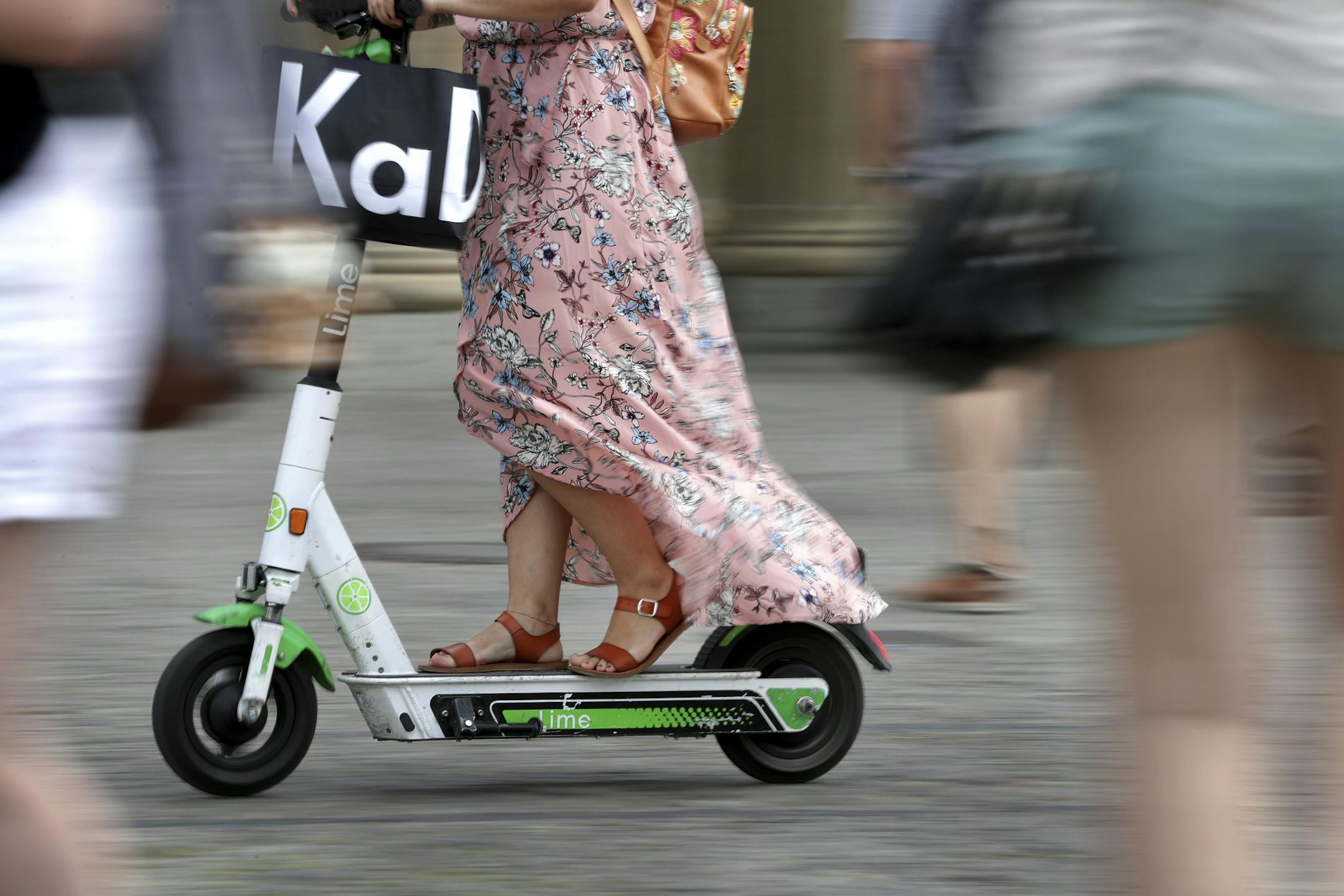
This has been the summer of the electric scooter in Europe, but the U.K. and Ireland, which still ban the things, are probably right to hold out. So far, no government in the region has figured out a good way to regulate them.
U.S. e-scooter-sharing companies like Bird, Lime and Jump (a subsidiary of Uber) have all been expanding in Europe this year. There, they face competition from local startups like Stockholm-based Voi and Berlin-based Wind. It's impossible to determine the exact number of scooters that have appeared on the streets this year, but it's likely to be in the tens of thousands. At this point, they look more like a plague than a transport solution.
Germany permitted e-scooters on cycle paths and roads in May, limiting their speed to 20 kilometers per hour. The following month, they were made available for sharing in Berlin. It is estimated that there are now 5,000 of them on the city's streets and, in the two months since they appeared, they have been involved in 40 accidents in which six people were seriously injured. That's a significantly higher serious-injury rate per vehicle than for cars.
At least no one has died on the streets of Berlin yet. But Paris, which has some 15,000 scooters, has already seen its first fatal crash: A 25-year-old rider was killed by a truck in June. A truck also ended the life of a YouTube star in London, where e-scooters aren't allowed on the roads. In May, the first e-scooter user died in Brussels. No other vehicle was involved in that crash — but the scooters are hard to control on uneven road surfaces, and with hardly any riders wearing helmets, that can be deadly.
It's possible, of course, that many accidents occur because riders are only just learning how to use them. A U.S. study earlier this year found that 29% of all injuries occur to first-time users. But, even so, it makes sense to ask whether this new transportation mode contributes usefully to city life.
To justify the risk of riding an e-scooter and the chaos the gadgets create for pedestrians, the new mode of transportation needs to solve some mobility problem — say, the "last mile," or helping people get to subway stations. But e-scooters don't quite do that in Europe now for a number of reasons.
First, they are available only in limited business areas — mostly in city centers, which are already well-served by public transportation. In Berlin, not a single scooter-sharing company covers the entire city.
Second, rides tend to cost more than public transit. In Berlin, the price of a 2.5-kilometer ride is about 2.80 euros (that's $3.12 per 1.55 miles), while the same trip by bus or subway would set a rider back 1.70 euros. Even car-sharing, something which is ubiquitous in Berlin, is likely to cost less for that distance.


