

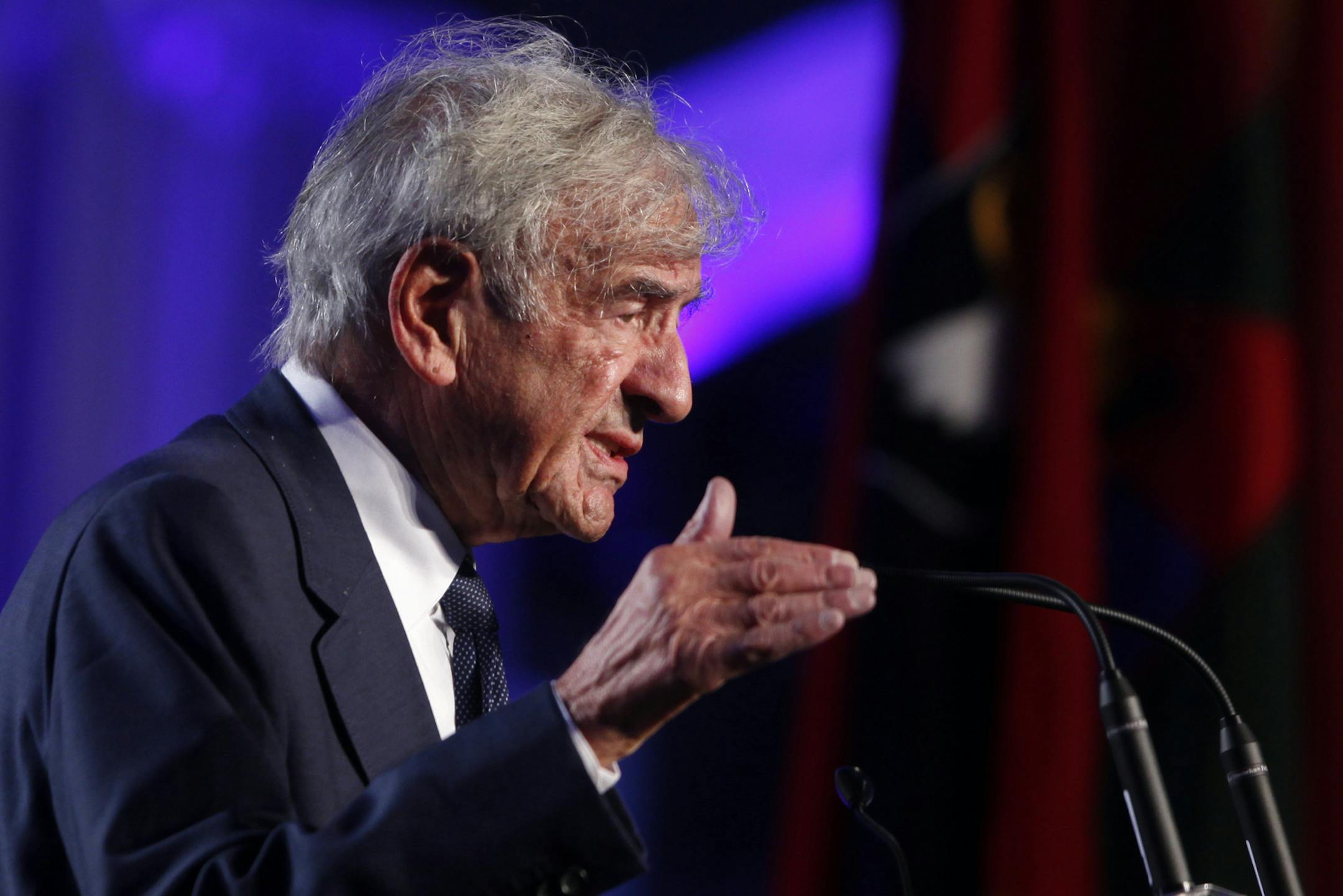
Elie Wiesel's searing prose and testimonial eloquence made him a living symbol of the Holocaust that he survived, and the moral obligation to never forget what happened to the Jews of Europe during World War II. As he passes away, most of the world will simply remember him as a beacon of hope that decency and humanity can survive and overcome the darkest abuses people are capable of at their worst.
For many Arabs, though, the legacy of their encounter with Wiesel is far more complicated. Tribal suspicions, on both sides, stemming from the Arab-Israeli conflict, trumped the very humanitarian impulses Wiesel sought to exemplify.
Wiesel and the Arabs viewed each other across an impassable moat of mistrust and ultimately exclusionary group identification. Wiesel did not, and could not, ever really speak critically of Israel, which he saw as the embodiment of the Jewish people, and frequently expressed a refusal to criticize Israel. He did not see himself as a nationalist, but his identification with Israel was couched so strongly in ethnic and religious terms that one is obliged to conclude he was mistaken about this. The Arab resistance, and in some cases aversion, to the symbolic resonance attributed to Wiesel stems from an equally nationalistic affect.
For Palestinians in particular, their fraught relationship with Wiesel is a function of being in the philosophically, morally and politically untenable position of being, as Edward Said so precisely put it, "the victims of the victims" of modern Western history. The Holocaust was a culmination of centuries of European anti-Semitism that morphed from the folkloric and religious intolerance of the Middle Ages into the pseudoscientific racism and overt political agenda of the nineteenth century and ultimately led to the Nazis' industrialized killing machine. For Zionists, and especially those who were Holocaust survivors like Wiesel, the birth of Israel in 1948 was an almost miraculous rebirth for people who had just faced near extinction as a culmination of centuries of persecution.
For Palestinians and other Arabs, however, the events of 1948 marked not the birth, let alone the rebirth, of a people, but the violent death of another community. However blame is apportioned, and according to whatever narrative, the society of the Arabs of the British Mandate of Palestine, who had come to define themselves as "Palestinians," did not survive the conflagration that attended the establishment of Israel. Its population was largely displaced, its national institutions vanished, and most of its families — from the prominent to the obscure — spent the better part of the next two decades at least reconstituting their existence as exiles or refugees. What had been there was now gone, and something new and different had taken its place. And at every stage, from the U.N. partition debate of 1947 to the Israeli Declaration of Statehood of 1948, the catastrophe that befell the Jews of Europe was invoked.
In this context, the Holocaust — and therefore Wiesel's testimony about it, from which he derived so much of his aesthetic and political authority — became exceptionally fraught and contested. As a number of crucial recent books, including "The Arabs and the Holocaust" by Gilbert Achcar and "From Empathy to Denial: Arab Responses to the Holocaust" by Meir Litvak and Ester Webman, have demonstrated, the range of Arab reactions to the Holocaust from the earliest days until now have run the gamut from compassion to dismissal and even, especially among Islamists, denial.
Wiesel, too, promoted narratives that negate established history. In 2001, he suggested in the New York Times that in 1948, "Incited by their leaders, 600,000 Palestinians left the country …" The historical record, including as established by prominent Israeli historians, debunked this myth long ago. The genesis of the Palestinian refugee problem was much more messy, complex and ugly than this comfortable fantasy allows. Just as mass dispossession is hardly the equivalent of mass murder, Wiesel's denial of Israel's role in the expulsion of Palestinian refugees is hardly the equivalent of Holocaust denial. But it is a retreat from a rather obvious and well-documented reality into reassuring fictions that protect ethnic sensitivities from unsettling truths. It is also a familiar pattern on both sides of this highly charged conflict.
One of the most common Arab responses to Wiesel's attitudes toward the conflict with the Palestinians is a microcosm of a question that is asked more broadly of Jews in general: "How can a people who suffered this fate possibly be treating Palestinians so badly?" But the underlying assumption is irredeemably flawed. It presumes that people, whether individuals or collectivities, somehow learn from their negative experiences not to repeat them. In fact it's more common for abuse to engender more abuse. Suffering is not ennobling. If it were, prisons would be epicenters of grace.


