
Electric cars attract buzz, but few buyers

Carmakers have introduced a wide range of electric vehicles, yet drivers remain reluctant.

Chicago Tribune
February 11, 2012 at 8:42PM
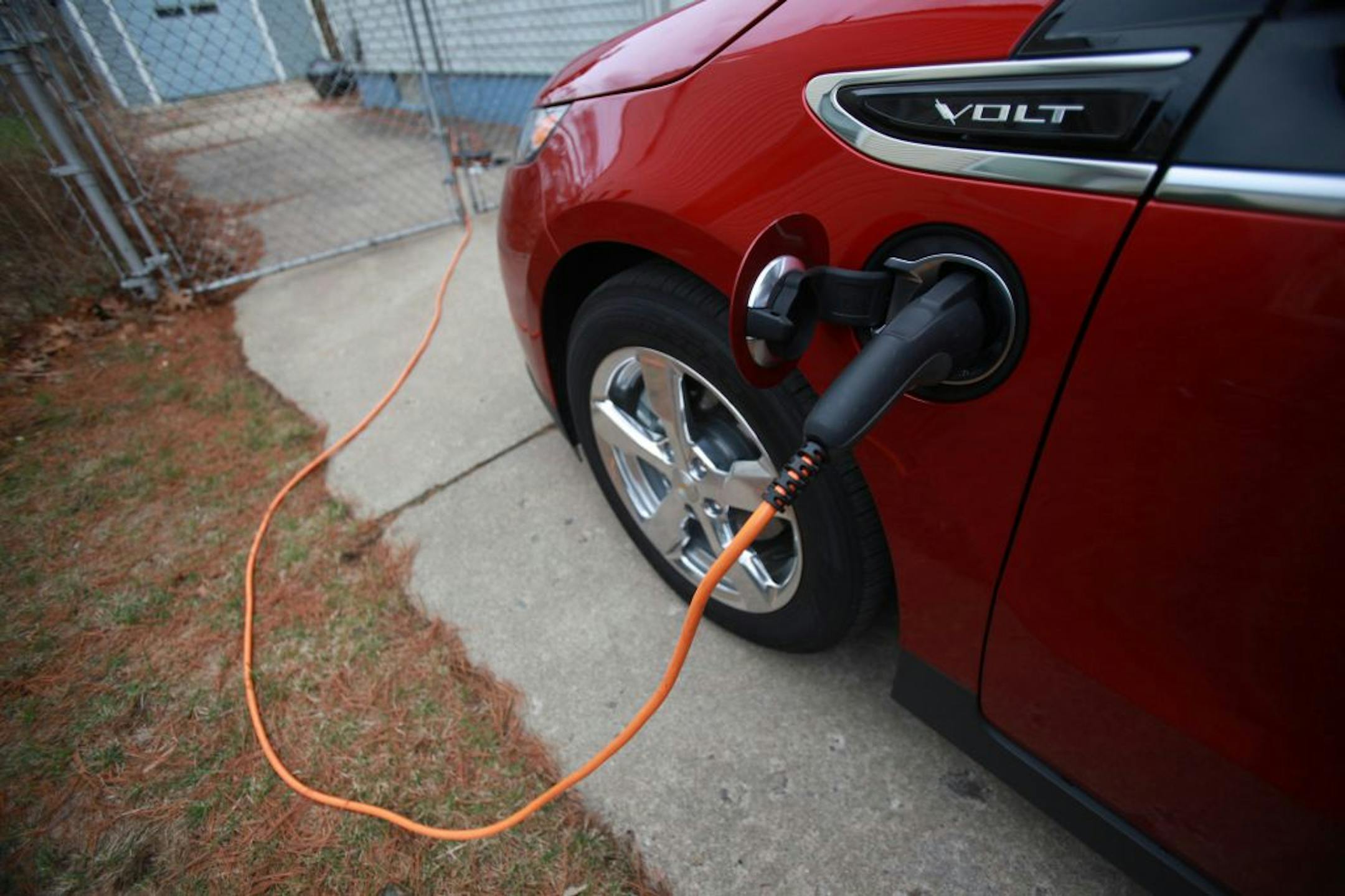
The 2011 Chevrolet Volt plugged into a 120 volt outlet.
The 2011 Chevrolet Volt plugged into a 120 volt outlet. (Mct/The Minnesota Star Tribune)

CHICAGO - In the early days of the electric vehicle, they called it "opportunity charging." You plugged in wherever you could.

"Laundromats, gas stations that have an outlet, car washes, hotels, churches, friends' houses ... everywhere and everything," said Todd Dore, a North Riverside, Ill., resident who converted his first gas vehicle to electric in 2003.

With the delivery of the all-electric Nissan Leaf and plug-in Chevy Volt to Chicago area early adopters in late 2011, Dore isn't the only pioneer getting around without gasoline.

Drivers can choose from more than 100 places to charge up in the area to eliminate so-called range anxiety, the fear of being stranded with no juice left in the battery. And for the first time, the charging stations in his downtown parking garage are frequently in use when he pulls up.

"Any given week there are more electric vehicles wanting to charge than there are charging stations," he said. "This is my nirvana. These are the days I've wanted to see for the last 10 years."

At the Chicago Auto Show, which opened Friday, there's no shortage of vehicles getting an electric boost. There are hybrids that use the gas engine to charge the battery, hybrids that have sockets for plugging in and, of course, totally electric vehicles. It's enough to make a formerly unique concept seem almost ordinary.

Even several tried-and-true models on the showroom floor now offer various levels of electrification.

The 2013 Ford Fusion -- hitting the market this fall -- comes available as a hybrid, electric plug-in or regular old internal combustion. Beginning this March, hybrid granddaddy Toyota Prius is offering a plug-in in some states rated at the equivalent of 95 miles per gallon that, when charged, would allow the vehicle to run on battery power longer and at higher speeds.

But if there's a full-blown revolution coming, it isn't here yet. While the hybrid market is growing, in 2012 it's still just 2.46 percent of the overall market. Electric vehicle sales represent less than 1 percent, according to industry watcher Edmunds.com.

"We're in the covered-wagon days of this industry," said Michelle Krebs, a senior analyst with Edmunds. "We're in a pioneering time."

Electric vehicles are still a hard sell for the average consumer. The price tag is high, and the lower fuel costs don't immediately make up the difference. Charging stations are available but not on every corner, and most take hours instead of minutes. Even the best-laid plans can leave some motorists doing just about anything to hold their battery's charge, particularly in cold weather.

Just ask Paul Beeker, 40, who lives in Chicago's Old Town neighborhood. He only had his Nissan Leaf a month before he traded it in for a Chevy Volt. He'd paid $38,000 for the Leaf and managed to get $37,000 back at the Chevy dealer.

In the cold(ish) Chicago weather, he was getting about 60 miles range on a charge. But on one trip, he and his wife were forced to drive with the heat off and at lower speeds to conserve battery power.

"With the Volt, if you have something unexpected come up, you just go," he said. The Volt is a plug-in vehicle that switches to gasoline if battery power runs out, extending its range beyond that of a fully electric vehicle. "We thought that if we had a longer trip we would just rent a car, but in practice, we found we didn't do it."

In the Volt, Becker has managed to stay on battery power most of the time, charging up as often as possible. The benefit: In electric mode, he said, he's paying about 20 cents every 30 miles by charging up at night at a 220-volt charger he had installed on the outside of his house. In his old Toyota Matrix, it cost about $3.50 to go 30 miles on gasoline.

But with the price tag for new plug-ins still in the $30,000 to $50,000 range, drivers are choosing to purchase electrics for reasons other than economics.

"Most of the action in the car market is under $30,000," said Jack Nerad, executive editorial director and executive market analyst for Kelley Blue Book. "So you're hard-pressed to find a whole lot of demand. The Volt certainly isn't under $30,000, and the Leaf in terms of the package is compatible with vehicles that are [$7,000 to $10,000] less expensive and offer unlimited range."

Krebs at Edmunds said we're unlikely to see electric cars become a notable part of the market until at least the end of this decade. In the meantime, she said, electrification technologies will become integrated into traditional gas-guzzling vehicles. Even the "little old gasoline engine" is become smarter.

"Last year we saw a flurry of vehicles that made it into the 40-mile club [as in per gallon]," she said.

Fuel-saving alternatives

Theo O'Neill, a clean-tech analyst at Wunderlich Securities, doesn't see electric vehicles ever moving beyond a small niche. Automakers, he said, have discovered that they can meet new emissions standards by borrowing from hybrid "start-stop" technology, which shuts off the engine while a car is stopped in traffic or at a red light.

"It was brilliant," he said. "And they can use the same old engine they were using before. It's all over Europe, and it will be all over the United States next year."

At GM, the Chevy Volt is selling to a mostly affluent, niche market of buyers, but bits and pieces of the technology behind it (well more than 200 patented technologies) can be found in the Chevy Malibu, the propulsion system for Cadillac and elsewhere.

For Dore, driving electric is a moral issue. He doesn't want to support the oil industry.

Recently, he set out to prove that he could drive across one of the largest states in the union without gasoline. He shipped his VW Beetle (a car that gets 60 to 70 miles per charge that he converted himself for about $20,000 to run on a lithium ion battery) to Texas, where charging infrastructure is plentiful, and drove 550 miles in 4.5 days.

"There were a couple of times we had to be creative," he said. "The thing about charging stations is they're popping up all over the cities. There aren't too many in between cities."

In San Antonio, he got "ICEd" -- the term he says "electric vehicle nuts" like him use to describe an internal combustion engine vehicle that parks in a charging spot reserved for electric vehicles.

At another charging station, he couldn't get the thing to turn on and called a 24-hour hotline listed on the station.

"I got a call a week later," he said.

about the writer

about the writer

JULIE WERNAU

More from Business

See More
card image
Alex Kormann/The Minnesota Star Tribune

The companies say deal will combine route networks to offer Minneapolis-St. Paul International Airport to more mid-sized markets and vacation destinations.

card image