Opinion | Linda McMahon is playing a shell game with our kids’ education

The Trump administration is betting that people won’t know enough or care enough to act.

November 30, 2025 at 7:31PM
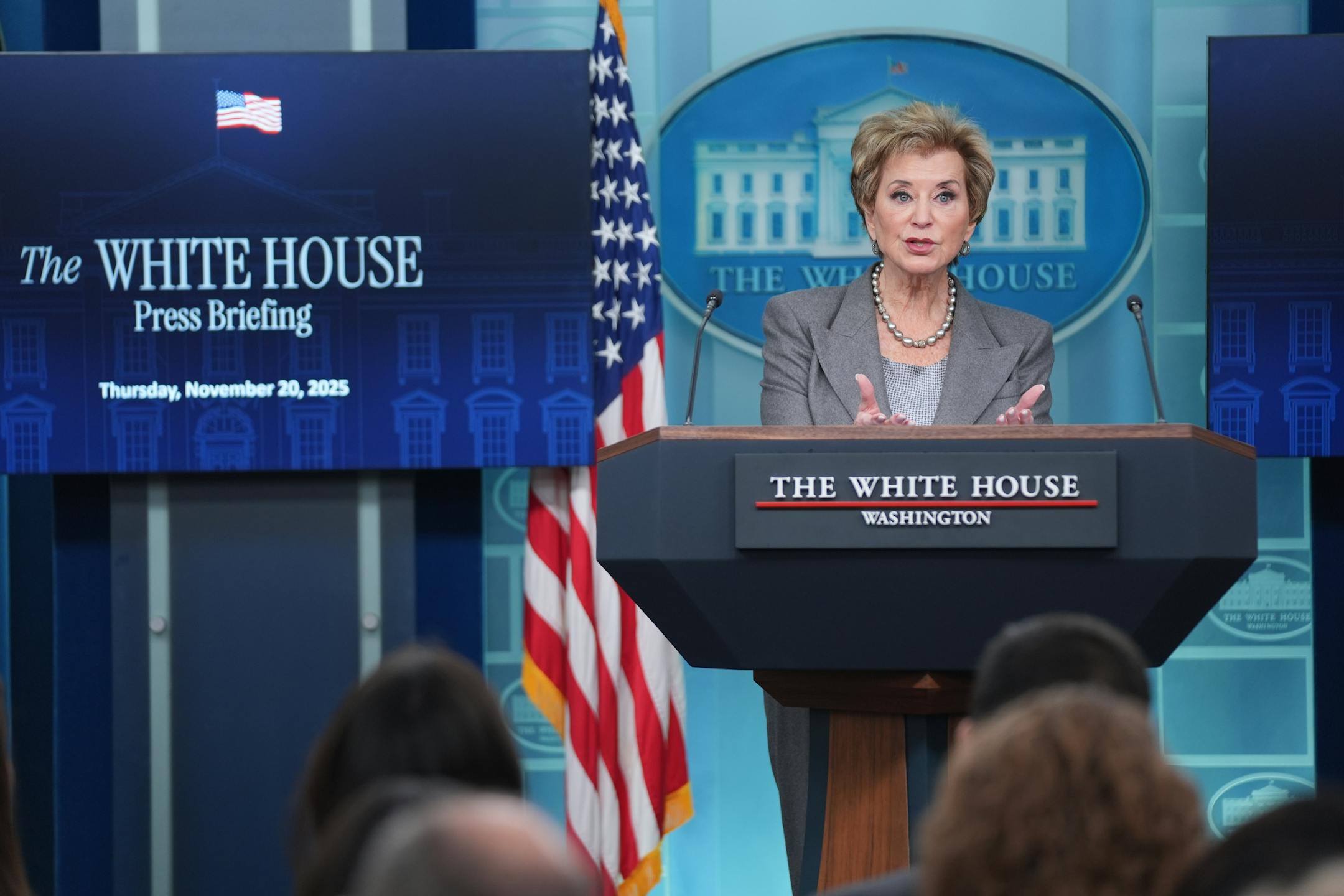
Education Secretary Linda McMahon speaks during a news briefing at the White House on Nov. 20 in Washington. (Evan Vucci/The Associated Press)

Opinion editor’s note: Strib Voices publishes a mix of guest commentaries online and in print each day. To contribute, click here.

•••

Education is fundamental to our nation’s progress.

All Americans deserve an excellent education, and no one should be denied access to learning opportunities due to their personal or ancestral identities.

States and districts have the primary public responsibility for education but must always support a parent’s role in their child’s education.

Our society is becoming increasingly complex, and technological advances make modernizing education an urgent national priority.

These self-evident truths were enshrined in federal law when Congress first authorized the U.S. Department of Education in 1979, and they remain the foundation upon which the agency stands.

They aren’t abstract ideas. A single agency improved efficiency and accountability. An education secretary reporting directly to the president made teaching and learning a national priority. Committed civil servants with deep expertise ensured children weren’t excluded or ignored in pursuit of their education.

Despite early backlash, Congress kept the department alive and even expanded programs many times to meet the evolving needs of America’s learners. Serious threats made to abolish the department were pushed to the furthest fringes of American politics.

That is, until the furthest fringes ascended to the presidency.

On Nov. 18, President Donald Trump and Education Secretary Linda McMahon followed through on those threats in a way that might best be described as a political shell game. The department announced that it had entered into interagency agreements to delegate programs and funds to the Departments of Labor, Health and Human Services, State, and Interior. These agreements are often used when multiple agencies want to formalize a legitimate partnership; the Education Department is instead using these agreements to transfer management of several congressionally mandated functions.

Offloading the department’s work to other agencies was prescribed by Project 2025, and it comes after the administration already spent months impounding funds appropriated by Congress, firing civil servants, destroying the nation’s education research and development infrastructure, weaponizing civil rights and student privacy laws, and generally conducting itself with extraordinary pettiness on a Pyrrhic crusade to dismantle the agency.

What may seem like another mundane administrative action is likely to unleash an eldritch horror of unintended (and probably intended) negative consequences.

First, you can’t dismantle a bureaucracy by creating a bigger one. Dispersing one agency’s work across four other departments literally increases administrative burdens and decreases efficiency. State superintendents weren’t consulted on these changes and were informed only hours before this news was made public. As Jill Underly, Wisconsin’s state superintendent of public instruction, said after McMahon’s formal announcement, these actions are “the opposite of ‘returning education to the states.’”

Consider Title I, a federal funding program intended to ensure students from low-income families have equitable access to a high-quality education. This vital investment in communities affects nearly 1 in 4 Minnesota students and will now be administered by the Labor Department’s Employment and Training Administration. ETA exists to administer job training, worker dislocation programs and unemployment insurance benefits. It’s a worthy mission, but has little to do with children, teachers or schools. Programs to increase access to skilled K-12 educators, help English language learner students achieve English proficiency, boost rural districts’ resources and open high-quality charter schools will also be joining Title I at ETA.

Education Department employees privy to this plan’s details worry it will make things more difficult for states and school districts. For example, the Labor Department’s grant management systems reportedly have fewer capabilities. Experienced career civil servants could help support a smooth transition, but staffing capacity is severely limited after massive layoffs earlier this year. Even Angela Hanks, who once led ETA as acting assistant secretary, predicts the changes will “unleash chaos on school districts, and ultimately on our kids.”

If this all feels confusing, that’s precisely the point. “There is no clear child-centered goal to this strategy,” observes Josh Crosson, executive director of Minnesota-based advocacy organization EdAllies. “This is an ideological experiment with children’s lives on the line.” When federal programs designed to support our most marginalized students work inefficiently or ineffectively, states and districts must make life-altering decisions about staffing, programming and services without knowing whether the federal funds will ever be available. Students then bear those costs entirely in their safety, health and learning.

The Education Department was never perfect, but dismantling the whole system and abandoning what works rather than fixing what doesn’t just harms kids. The principles that inspired the agency’s creation are as relevant today as they were in 1979, and we should pursue every pathway to preserve a strong federal role in education.

First, Congress needs to act. The Trump administration doesn’t have clear legal authority to reallocate these programs and statutory responsibilities. Only Congress can authorize those changes, and it hasn’t done so. Members of Congress can also introduce language prohibiting these actions during the ongoing appropriations process, and Minnesota’s parents should demand our delegation do so before McMahon hands over the power to investigate schools to Attorney General Pam Bondi or lets the Small Business Administration service our student loans.

Bolder state leadership can help defend what works and build local capacity. Our Legislature’s education policy committees should hold public hearings this upcoming session to reveal the impact these federal actions are having locally. We should expect candidates seeking any office to have a relentless focus on student success, and they should be able to explain to voters how they will ensure Minnesota’s students can thrive without federal leadership and with impending state cuts.


The Trump administration is betting we will be too distracted, won’t know enough or won’t care enough to resist its latest destructive actions.

Let’s prove that wrong.

Anil B. Hurkadli led the U.S. Department of Education’s Office of Educational Technology during the Biden-Harris administration. He lives in Minneapolis.

about the writer

about the writer

Anil B. Hurkadli

More from Commentaries

See More
card image
Evan Vucci/The Associated Press

The first rule about dark money is to quit blabbing about it.

card image