

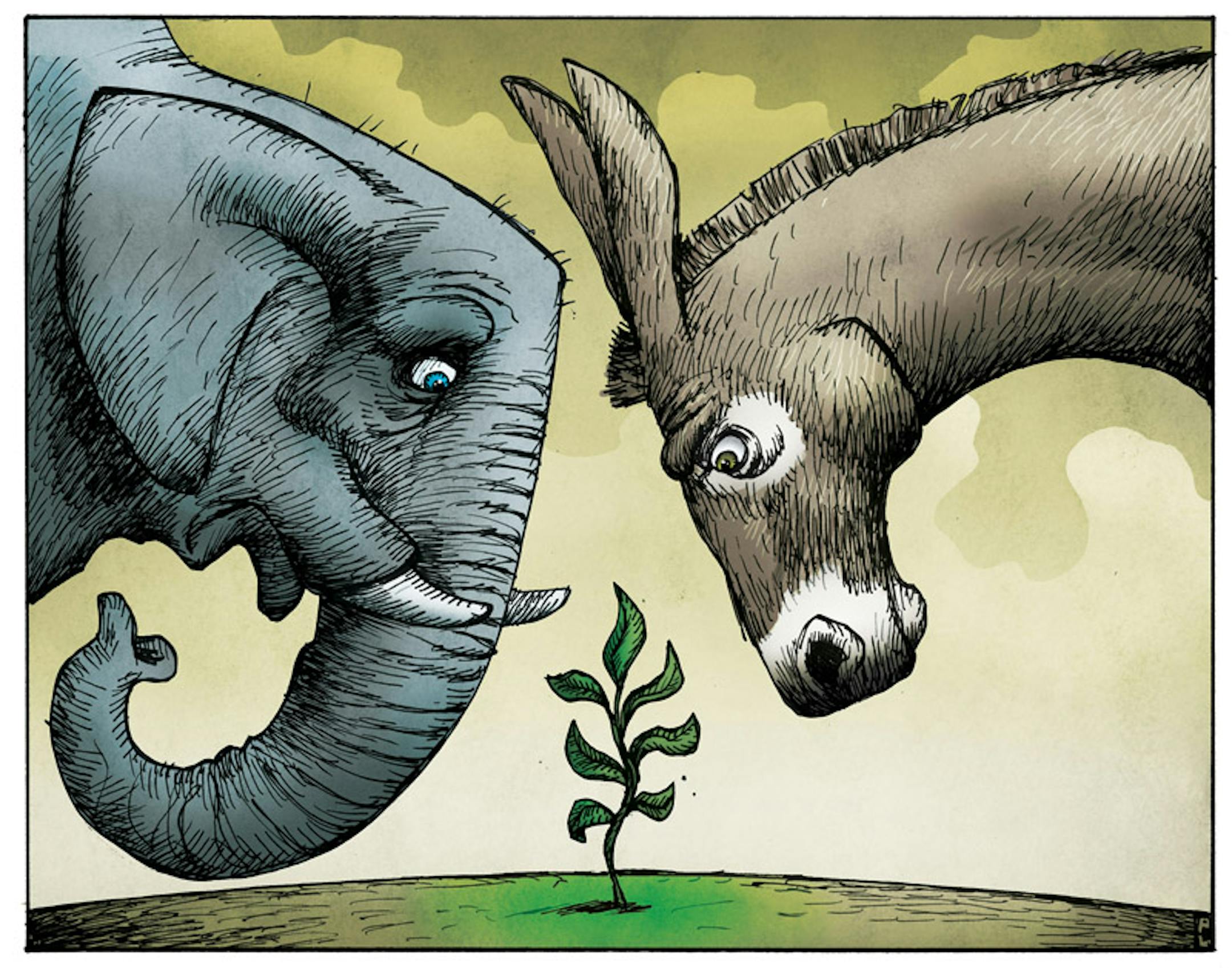
Amid postcliff anger in Washington and pre-legislative angst in St. Paul, some long-faced apocalyptics on the left and the right might as well be wearing sandwich boards that proclaim "The End is Near" or "All is Lost."
It's become routine after big elections or policy fights to hear zealots threaten to leave for Canada (liberals) or to secede from the union (conservatives).
The rest of us also can fall prey to Armageddonism -- viewing the political process with despair and cynicism, as a mutually destructive war. Or as a football game, where if one side is scoring points and gaining ground, the other side must be losing something, being pushed ever closer to the final agony of defeat.
For purposes of raising funds and boosting interest group clout, few tactics work better than ginning up horror that the villains and fools on the "other side" are just this close to ending our world as we know it -- and that's why further compromise or cooperation is unthinkable. The news media also tends to demand not only some sort of "score," but a destiny, and often rushes to describe every twist and turn in terms of decisive, watershed, turning-point finality.
Here's the case for a broader and more mature historical perspective. Let's entertain the notion that in recent decades, as conservatives have triumphed nationally and globally by establishing free economies shaped by individual initiative as the optimum social model, liberals have simultaneously been winning the battle for stronger, more inclusive democratic governments focused on the public good and greater equality.
In other words, we would be on our way to having this and that -- lofty goals in constructive tension with each other -- if we could get past thinking that our only choice is this or that. Or that just beyond every election result or policy change lies a cliff, or at least a slippery slope.
Perhaps the best antidepressants for conservatives these days are being dispensed by journalist David Frum, who in a brilliant column immediately after Election Day summarized 50 years of conservative policy gains in a nation and a world in which "free enterprise has been winning the game for a long time."
A former speechwriter for George W. Bush, Frum noted that the top marginal federal income tax rate in 1962 was 91 percent, that regulation of every sector of the economy was more pervasive and that Marxism was "a live intellectual force."


