

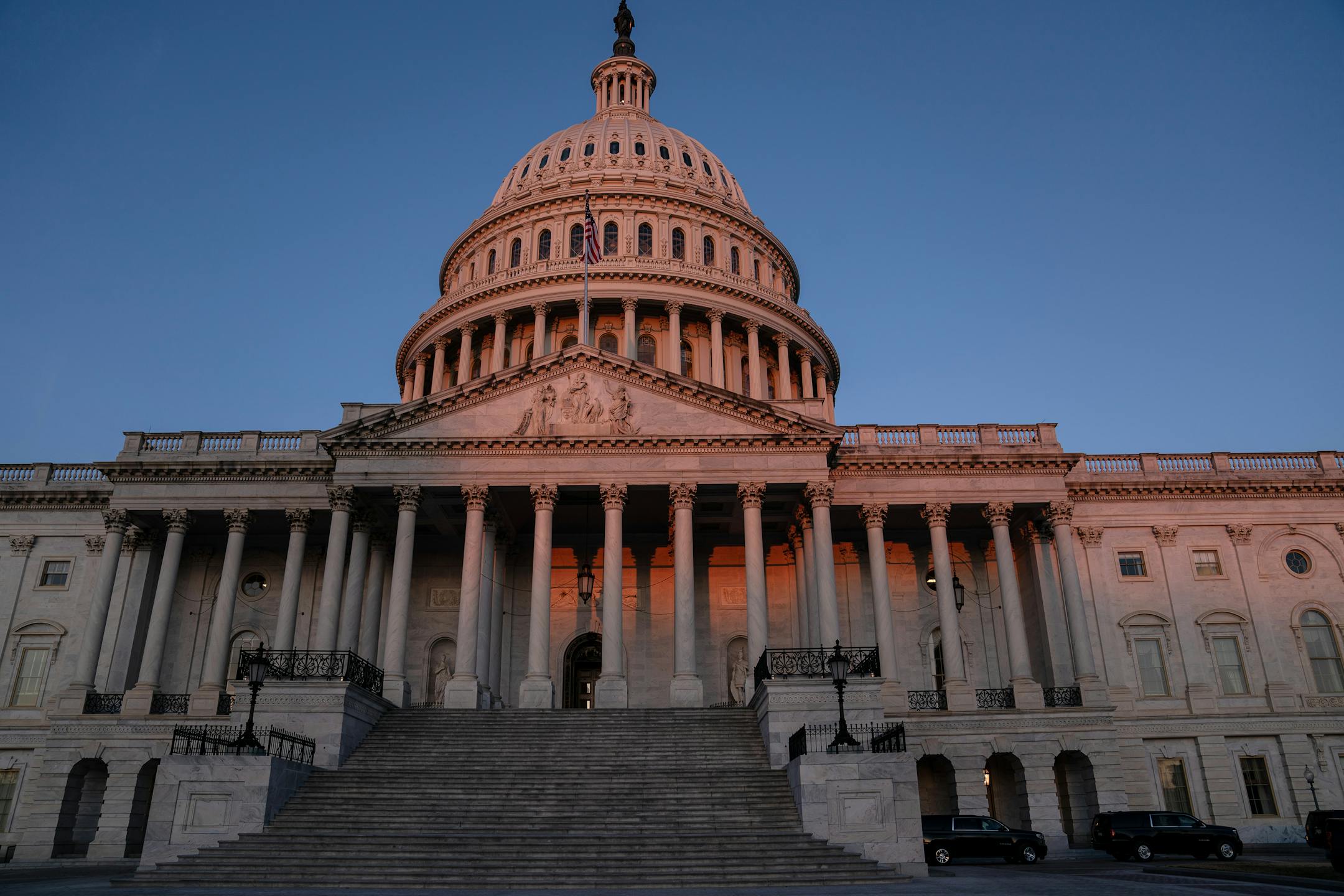
The 117th Congress opened with the political bang of Donald Trump's second impeachment and is ending with the legislative bang of a $1.7 trillion spending bill.
It's a fitting conclusion to a term that's been notable not so much for its accomplishments — which are significant, though not historic — but for the relatively quiet and orderly way they came together. As my colleague Jonathan Bernstein has written, this is in part a testament to the diligence and professionalism of Democratic leaders, whose approach stands in stark contrast to the crash-and-burn legislative efforts of congressional Republicans in 2017 and 2018.
But it also underscores the extent to which GOP Senate Minority Leader Mitch McConnell has confounded his longtime critics by making a real effort to show that American democracy can actually work.
This has at times devolved into absurdity, as when McConnell committed all Republicans to voting "no" on an increase in the statutory debt ceiling without making any demands whatsoever of Democrats. All he wanted was for his members to be able to say that they voted no. But he didn't want the U.S. to breach the debt ceiling. So he agreed to create a mini-exception to the filibuster allowing Democrats to do it on a party-line vote.
Alec MacGillis' excellent 2014 biography of McConnell is titled "The Cynic," and the leopard hasn't much changed his spots. But this was cynical politics with heavy guardrails in place: Yes, McConnell was trying to win the political game, but he was also trying to not blow up the economy.
Something similar happened to prevent a last-minute derailment of the spending bill.
Sen. Mike Lee of Utah got the idea of attaching an amendment to the bill that would require the federal government to keep the Trump-era policy of expelling asylum-seekers at the southern border. This was shrewd politics, as the issue has divided moderate Democrats from the White House.
The problem is that it was almost too shrewd — for a moment, it seemed like the amendment might pass. That was a deal breaker for House progressives, which would have meant the omnibus could have passed only with some GOP support. And even though the bill has strong bipartisan support in the Senate, House Republicans are uniformly opposed.


