

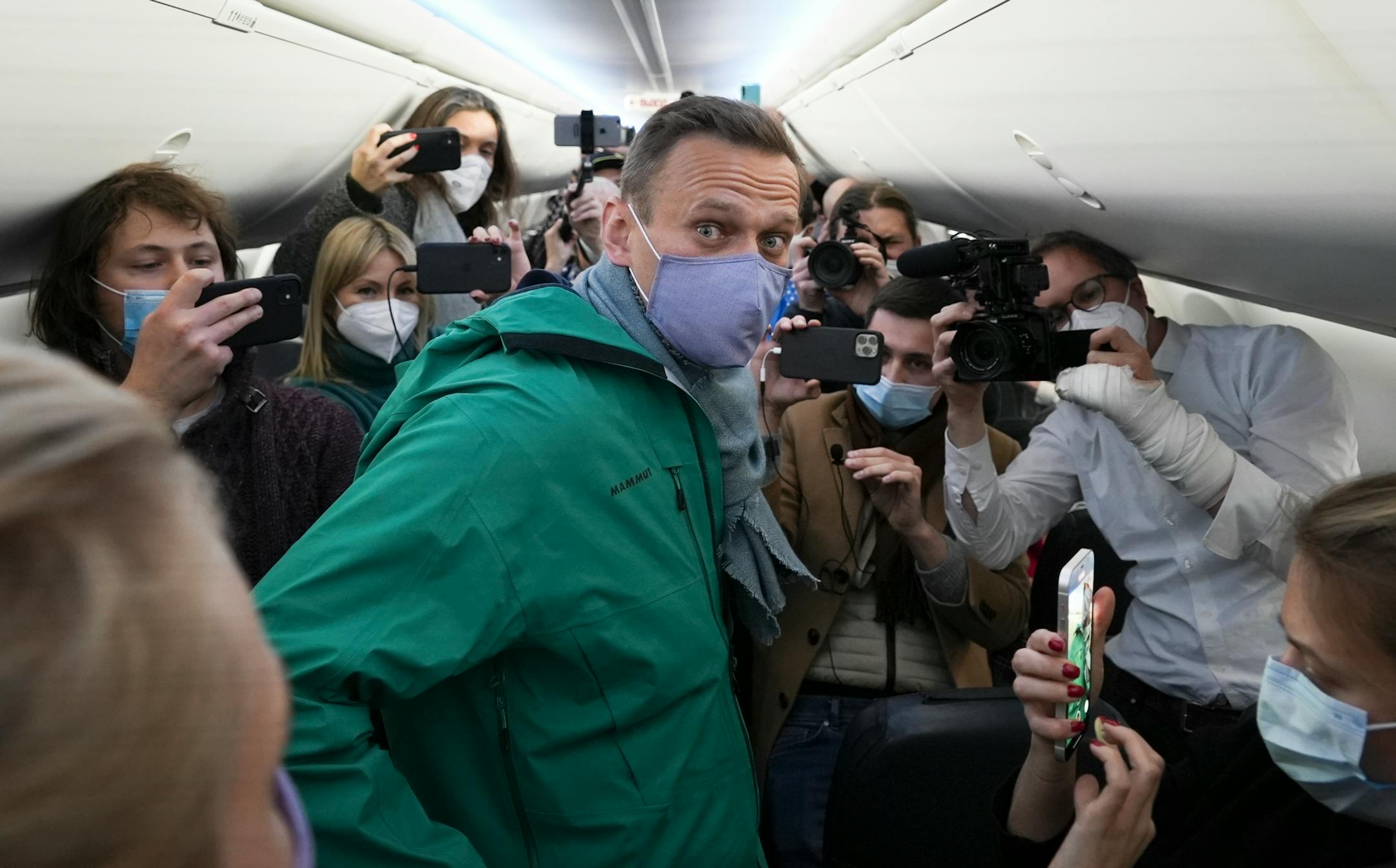
Thirty years from now, what will historians consider the most consequential event of January 2021 — the storming of the U.S. Capitol by an insurrectionist mob, or Alexei Navalny's heroic return to Moscow, followed by his immediate arrest?
In a broad sense, the two events are about the same thing: the future of freedom. In one version of the future, the assault on the Capitol marks the point at which the forces of illiberalism, mob violence and disinformation, much of it stoked and financed by the Russian government, reached critical mass in the West. In another version, the assault will be remembered as a historical anomaly when compared with the recovery of freedom in places where it once seemed lost — not just Russia but also China, Iran, Cuba and Venezuela.
How can President Joe Biden move history toward the second version? By pursuing a foreign policy that puts dissidents first.
A common view of dissidents is that they are a humanitarian problem, but one that gets in the way of more important issues. Hillary Clinton gave voice to this view when, on her way to Beijing as secretary of state in 2009, she insisted that human rights questions "can't interfere with the global economic crisis, the global climate change crisis and the security crisis." This isn't cynicism, but rather a version of the utilitarian idea that doing the greatest good for the greatest number always takes precedence over the immediate interests of a handful of people.
But that's wrong, and not just philosophically. Dissidents matter to the U.S. strategically. The dictatorships that most threaten the free world are too powerful to be brought down militarily. Nor are they likely to moderate their behavior thanks to economic prosperity or reformers working within the system. Anyone in doubt on this score need only look at China's recent trajectory as an ever richer and ever more repressive regime.
What can bring dictatorships down is a credible domestic opposition that galvanizes public indignation through acts of exposure, mockery and heroic defiance. That defiance highlights the hypocrisies of the regime while demonstrating the possibilities of challenging it.
International pressure alone was not sufficient to bring down the apartheid government in South Africa. It took Nelson Mandela. Economic decay alone was not sufficient to bring down the communist regimes in Poland and Czechoslovakia. It took Lech Walesa and Vaclav Havel. The Soviet Union might be standing today had it not been for Alexander Solzhenitsyn, Andrei Sakharov and Natan Sharansky.
What is happening to Navalny is of a piece with that history. After barely surviving a brazen assassination attempt in August, Navalny duped one of his alleged would-be killers and extracted an unwitting confession. He followed up with an investigative video on the lavish lifestyle of Russian President Vladimir Putin, complete with a billion-dollar palace on the Black Sea, that's been viewed north of 70 million times.


