

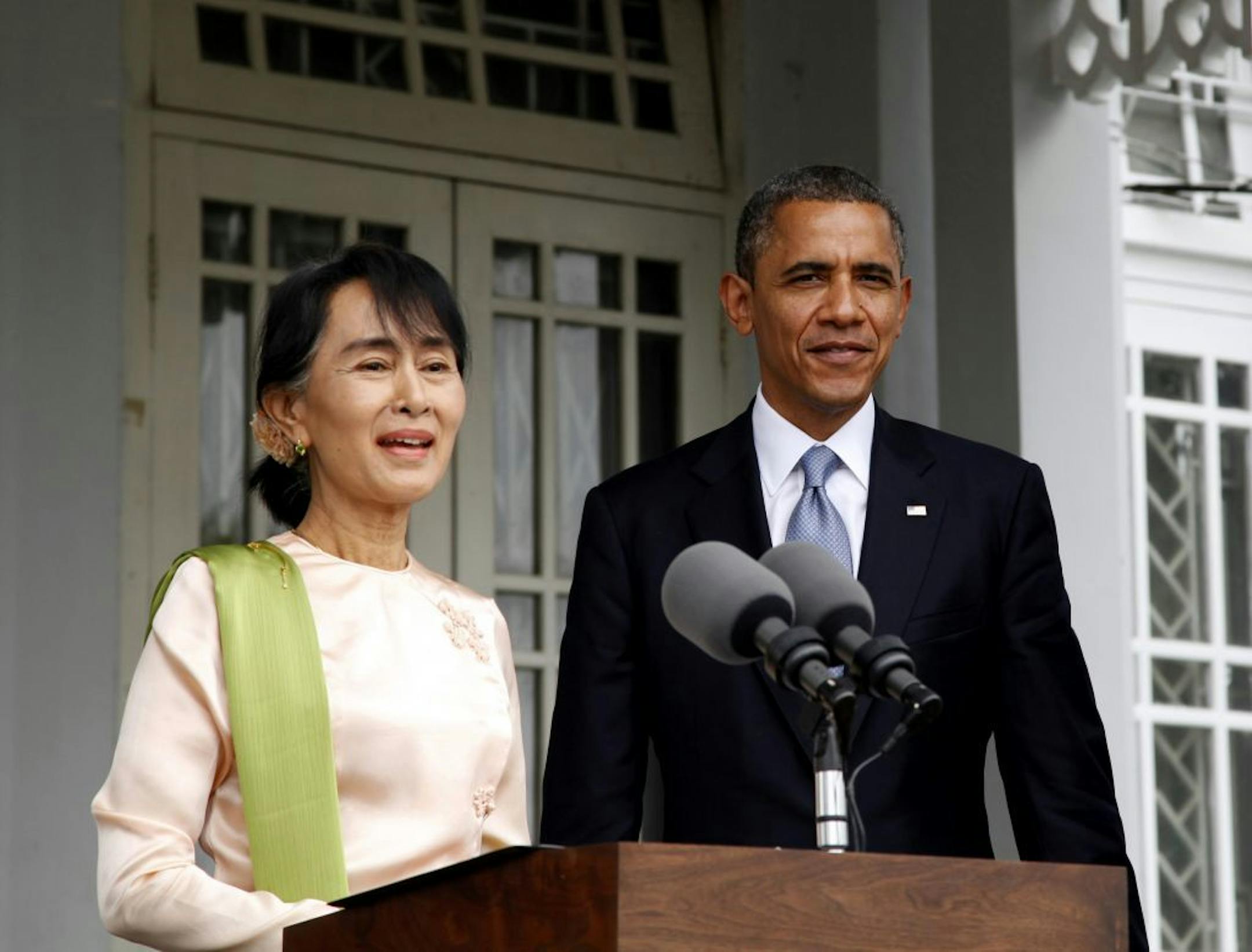
Burma, renamed Myanmar, has been remade so swiftly that, last November, Barack Obama became the first sitting U.S. president to visit the country. But Myanmar — the subject of this month's Minnesota International Center's "Great Decisions" dialogue — is still far from democratic. And the greater international recognition comes at a time of increased interethnic strife.
Alongside Myanmar's military junta, the major player in the country's political process is Nobel Peace Prize laureate Daw Aung San Suu Kyi, who now serves as opposition leader in parliament and is increasingly criticized for compromising with the military. Suu Kyi, the daughter of one of Burma's liberation leaders, has played many roles in the country's drama. Most notably, she is the internal and international symbol of resistance.
"It was very important to have someone who symbolized to people all over the world what was good and hopeful and promising about the Burmese democracy movement, and someone who could articulate its goals and serve as such a beautiful contrast to the ugliness and evil of the regime that was repressing her, " said Tom Malinowski, Washington director for Human Rights Watch.
The optics were optimal in getting the world's focus, said Malinowski. "Everyone could visualize this — this beautiful, striking, courageous woman who seemingly single-handedly (although not at all true) was standing up to this brutal regime. Presidents and prime ministers … stood up for human rights in Burma not for the country; they felt like they were doing it for Aung San Suu Kyi. And that's just human. We care more when we can personalize an abstract cause."
There were practical applications, too. Suu Kyi united the opposition in order to negotiate with the ruling regime in the same way that Nelson Mandela, Lech Walesa and Václav Havel did during their nations' transitions.
Conversely, many Arab Spring nations lacked a legitimizing figure, which created chaos or, worse, a different kind of authoritarianism, like in Mohammed Morsi's Egypt.
A galvanizing leader works the other way, too. Hugo Chavez's Venezuela wasn't the only leftist Latin American regime — neighboring nations such as Bolivia and Ecuador adopted similar stances. But Evo Morales and Rafael Correa didn't crystallize concerns the same way Chavez did.
"We respond to caricatures," said Malinowski. "Having a Gadhafi to personalize the evil of the Libyan regime, or an Assad to personalize the Syrian regime, helps explain things to people. In the end, it's not a person, but a system that we are at war with. But that's harder to explain in shorthand."


