

Advertisement

Dick Youngblood: Tapping into a burning desire

Rimage Corp. has found a broad range of markets for its technology, used to make CDs and DVDs of everything from family photos to X-rays to 747 manuals.

February 27, 2008 at 3:37AM
CEO Bernie Aldrich, front, and Executive Vice President Manny Almedia are the brains behind Rimage Corp., which makes the machines used by retailers to turn your photos into DVDs, top.
CEO Bernie Aldrich, front, and Executive Vice President Manny Almedia are the brains behind Rimage Corp., which makes the machines used by retailers to turn your photos into DVDs, top. (Star Tribune/The Minnesota Star Tribune)
Advertisement

OK, I know my beat is small business, and the $109 million Rimage Corp. grossed last year doesn't sound particularly diminutive.

But Forbes Magazine recently named Rimage to its list of the 200 best small companies in America, so who am I to argue?

Despite the gathering economic slowdown, the Edina company announced last week that it earned $15.8 million, or $1.52 a share, in 2007, a 20 percent profit gain on sales that grew 5.4 percent from a year earlier.

And good news just keeps piling up: Last month, Forbes.com listed Rimage as one of the top 15 technology companies to watch.

What's the attraction? Well, Rimage is a leading producer of equipment and software used by businesses for on-demand transfer of digital data to customized CDs and DVDs.

More intriguing, this digital publishing technology is credited with rescuing the 30-year-old company from the trash heap of obsolescence after it ran up nearly $7 million in losses and upwards of $10 million of debt in the mid-1990s. In contrast, Rimage finished 2007 with no debt and $90 million of cash in the bank. Among the three securities analysts who follow the company, two made "buy" recommendations earlier this month.

When I introduced you to Rimage and its CEO, Bernie Aldrich, eight years ago, the company had just emerged from a floundering diversification effort aimed at replacing the outmoded diskette-duplicating technology on which it was founded in 1978.

Aldrich, who signed on as CEO in 1996, spent the next three years developing the digital publishing business while disposing of such diversification turkeys as a software development business, a digital storage operation and a manufacturer of blank CDs.
Advertisement

By 1999, Rimage had climbed back to $36 million in sales and $6.3 million, or $1.09 a share, in earnings. The sales were generated largely by use of Rimage's digital publishing system as a business-to-business tool, by banks to distribute statements, by telephone companies to send billing data and by software developers to deliver their products to corporate clients.

There has been considerable progress since then -- but not in the way Aldrich expected. The way he saw it, music retailers using Rimage equipment to fill consumer CD orders on demand presented a "home run" opportunity. Alas, thanks to the Internet, that market never even got to first base.

As it turned out, however, Rimage was swatting doubles and triples all over the place, most importantly in a retail niche that has become the company's largest market: photo shops.

With such retailing giants as Wal-Mart and Costco using Rimage equipment to produce on-demand discs to store customer photos, this market segment generated 20 percent of the company's sales last year.

And Chuck Murphy, securities analyst at Sidoti & Co. in New York, sees significant growth in sales in a related market niche: on-demand creation of videos. The appeal is that the Rimage equipment will allow video stores to offer "a wide selection with a lower inventory," Murphy said.

Better yet, equipment used to produce photo CDs can be used on videos with a minor software adjustment, said Rimage executive vice president Manny Almeida. A former executive at Fuji Films, Almeida has led the retail shift, which includes international markets that have doubled from 20 percent to 40 percent of sales in the past eight years.

Advertisement

Rimage has found a variety of other market niches in recent years, including:

Medical: GE Medical, the nation's largest supplier of medical imaging equipment, incorporates Rimage technology into its systems to copy MRIs, CAT scans and X-rays to a disc.

Government: State and federal clients use Rimage equipment to record and distribute data. For example, all congressional committee hearings are recorded and transferred with Rimage technology.

Audio books: This is becoming a major market.

Religion and education: Sermons, lectures and concerts, along with college catalogs, recruiting materials and course materials, are being transferred by Rimage equipment.

But while the retail sector is becoming more important, corporate clients remain a key market, with 70 percent of the Fortune 100 companies using Rimage equipment for a variety of uses.

Advertisement

Exxon Mobil, for example, uses it to distribute geological data to interested parties in and out of the company. And Boeing is putting its technical and repair manuals on CDs for easier access.

Why? "Because all the maintenance manuals for a 747 wouldn't fit inside a 747," Almeida said.

Dick Youngblood • 612-673-4439 • yblood@startribune.com

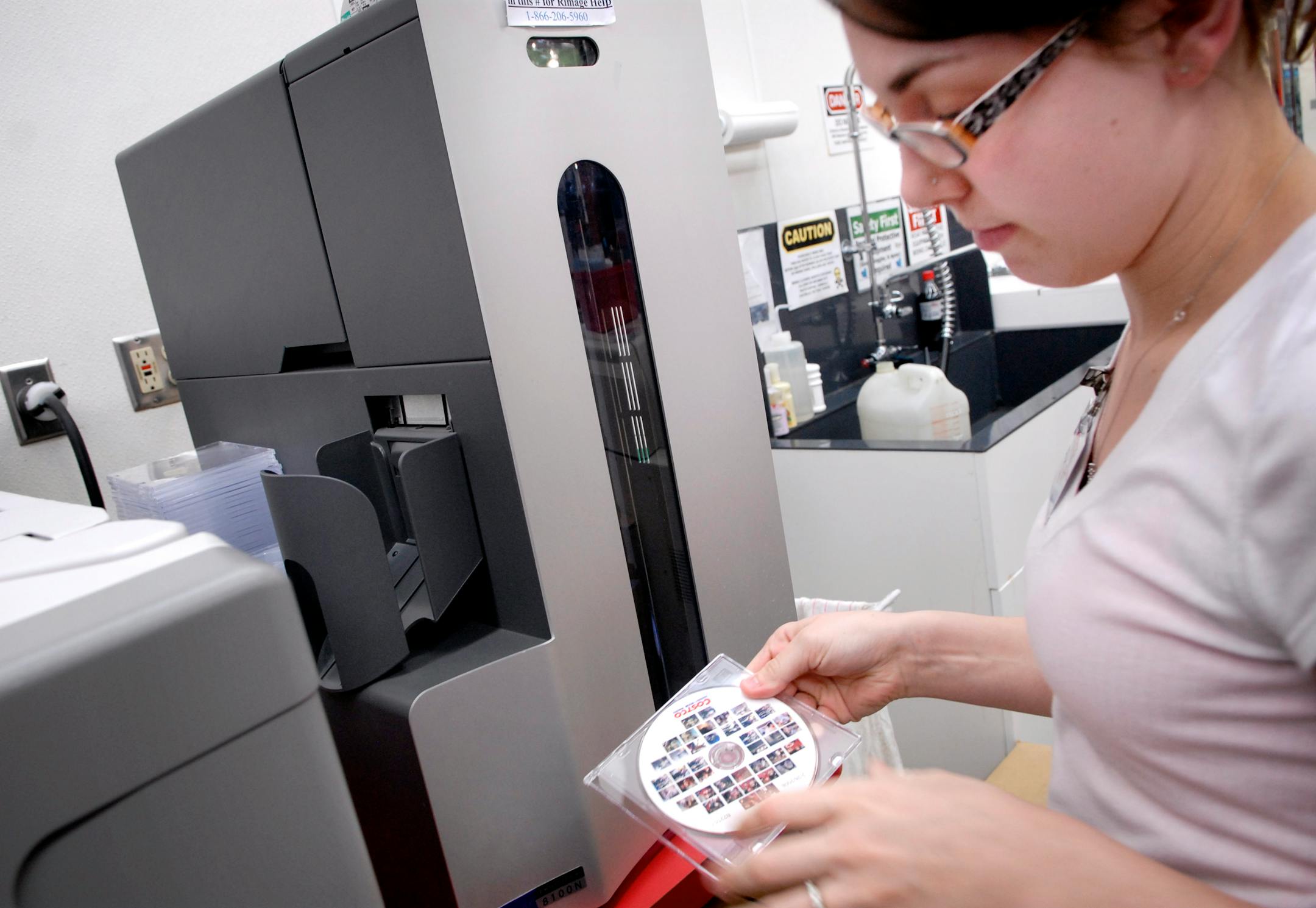
Ashley Lanigan used a system manufactured by Rimage Corp. to put a customer's photos on an image CD at the St. Louis Park Costco. The machine can also burn the images to a DVD or a Blu-ray disc. They are printed as thumbnails on the cover using thermal imaging.
Ashley Lanigan used a system manufactured by Rimage Corp. to put a customer’s photos on an image CD at the St. Louis Park Costco. The machine can also burn the images to a DVD or a Blu-ray disc. They are printed as thumbnails on the cover using thermal imaging. (Star Tribune/The Minnesota Star Tribune)
about the writer

about the writer

DICK YOUNGBLOOD, Star Tribune

More from Business

See More
Cirrus Vision SF 50. Photo credit: Cirrus Aircraft Corp.
The Minnesota Star Tribune

The Duluth-based plane maker had another billion-dollar year and topped all U.S. general aviation manufacturers by volume.

card image
Todd Geselius, vice president of agriculture at the Southern Minnesota Beet Sugar Co-op, shows what a sugar beet looks like when it is harvested in the field on Sept. 9, 2015 in Renville, Minn. (Jim Gehrz/Minneapolis Star Tribune/TNS) ORG XMIT: 1175088 ORG XMIT: MIN1510142301350530
Advertisement