
Opinion | Why DeWayne Davis is the best choice for Minneapolis mayor

Do we want to put a statesman — as he is — in that role, or choose among pugilists?

October 7, 2025 at 9:59AM
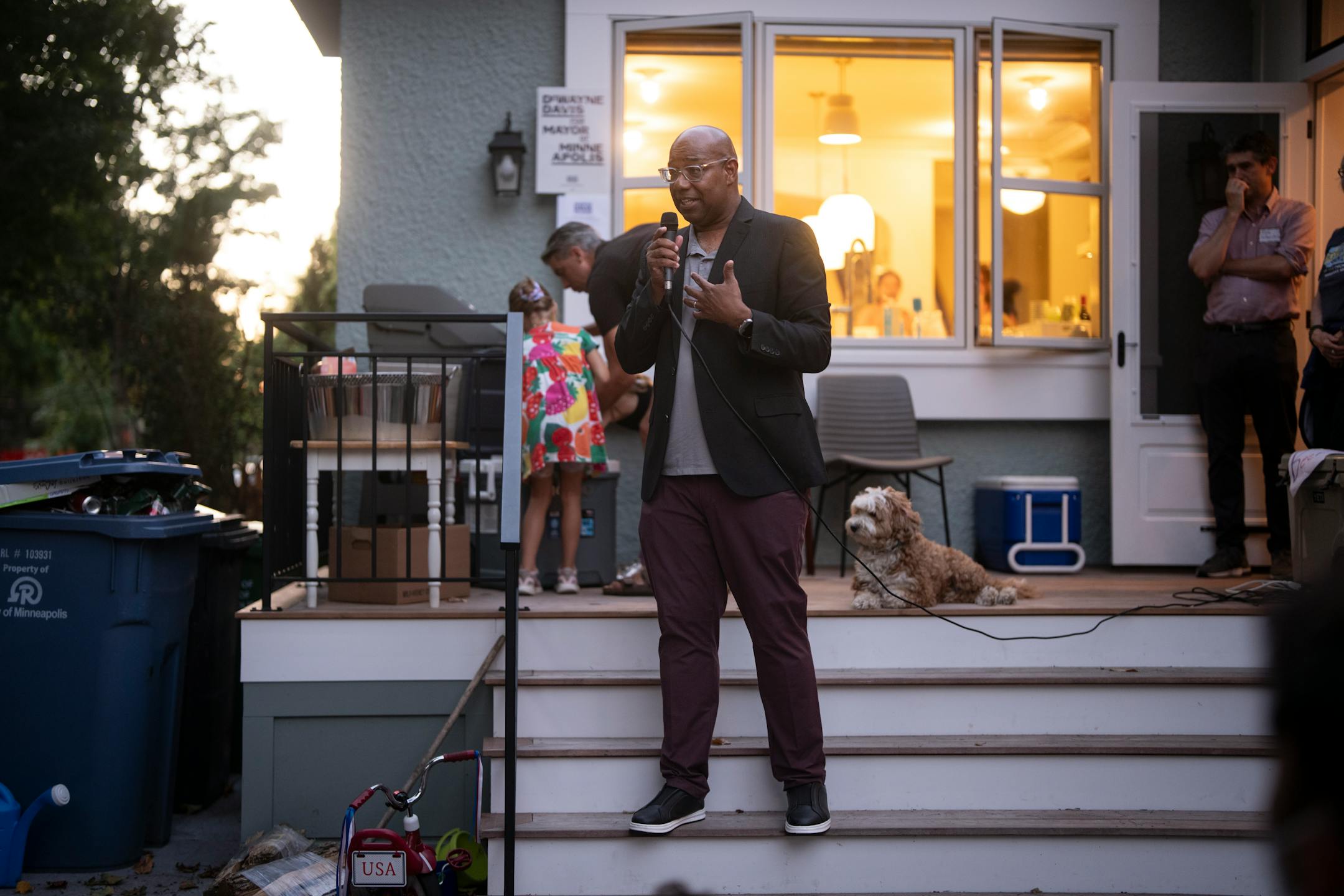
DeWayne Davis talks to a crowd attending a fundraiser for his mayoral campaign at a home in Linden Hills on Monday, Sept. 29 in Minneapolis. (Renée Jones Schneider/The Minnesota Star Tribune)

Opinion editor’s note: Strib Voices publishes a mix of guest commentaries online and in print each day. To contribute, click here.

•••

The real statesman running for Minneapolis mayor is DeWayne Davis. His campaign’s theme, “We Deserve Better,” emphasizes the “We” that Jacob Frey and Omar Fateh miss as they fight in a political boxing ring.

We know Davis well as our former lead pastor at Plymouth Congregational Church in downtown Minneapolis. In his final sermon June 22, he told us he seeks “justice and liberation,” “bread for the hungry, homes for the homeless” and “a life that is good and full” for all.

We first saw him five years ago: a tall Black man gracing our pulpit with a warm smile and glow. He waved his arms with electric words in a Deep-Southern delivery that most of us — white, middle-class Minnesotans — hadn’t heard beyond the Rev. Martin Luther King Jr. newsclips. Weekly, filled with love, many facts and experiences, he spoke of justice. Each day he led us through the pandemic, facilitating us to help our own community, neighborhood and city. We’ve seen his heart, his hand and his head.

Davis climbed a long way. Born the 15th child of Mississippi sharecroppers, he learned early to listen to everyone. He broke the mold of poverty with a Howard University degree in economics and philosophy, and a University of Maryland master’s degree in government and politics.

For 15 years, he worked in Washington, D.C., to make a difference. He started as a legislative aide for three U.S. representatives — one of them the Democratic whip — developing policies for financial services, health care, housing, judicial issues, LGBTQ rights and transportation. Next, he worked for Sallie Mae as its director of federal and industry relations, helping Congress with student loan financing and collections. Then he was appointed domestic policy adviser in Congress for the Episcopal Church’s Office of Government Relations.

Called to ministry, he earned advanced degrees at Wesley and Luther Seminaries. He led two churches in Minneapolis, All God’s Children Metropolitan Community, then Plymouth Congregational, and joined an advisory board at St. Paul’s United Theological Seminary.

But his deep love of helping others through government beckoned. He co-chaired the Minneapolis Community Safety Working Group with civil rights attorney and former Minneapolis NAACP President Nekima Levy Armstrong. And he co-chaired Minnesota’s chapter of the national Poor People’s Campaign, resurrected from King’s founding of it for economic inequality and poverty. He also became the first Black, gay chaplain of the Minnesota state Senate.

One of us and his wife have been close to Davis and his longtime partner and husband, Kareem; we have shared meals and have enjoyed hours of great conversation. We have witnessed the depth and devotion to service that Davis is committed to bringing to Minneapolis.

Davis offers a breath of fresh air, a way to look at our city unclouded by white-privilege culture. As a resident of north Minneapolis and pastor in south Minneapolis, he experiences how the present administration ignores too many people. When he talks about bringing dignity, justice and liberation for everyone, he means all.

We deserve better, he says. Our city has seen years of homeless encampments, yet the current mayor seems uninterested in many of the compassionate and dignified options that Davis has found are working elsewhere. He says on his campaign website that “our unhoused neighbors need to be supported by providers and resources, not police and bulldozers.”

We also deserve better for our sisters and brothers struggling to find stable housing. Fateh wants rent control, but Davis has gathered national examples of how nonprofit and public housing organizations can do the job.

He also has studied and endorsed the Baltimore Violence Prevention Plan from that city’s 2007 Safe Streets initiative: intervention (with a renewed police force), prevention (community and public interagency collaboration) and treatment (through public health). It was adopted from a similarly successful Chicago plan.

Davis has more experience than his competitors, proposes better systems and offers positive leadership. Our current mayor is a pugilist in the ring, more often verbally hitting than talking with his democratic socialist opponents. And Fateh defensively fights moderate Democrats. Davis leads us all to talk — together — about how other cities succeed.

Peter Eichten is past moderator of Plymouth Congregational Church and a member of its Board of Spiritual Formation. Richard Jewell is co-chair of the Board of Spiritual Formation and a member of Plymouth’s Leadership Council.

about the writer

about the writer

Peter Eichten and Richard Jewell

More from Commentaries

See More
card image
Richard Tsong-Taatarii/The Minnesota Star Tribune

If you are approaching the holidays with an ache in your heart, remember that love continues to shape life, even in loss.

card image
card image