

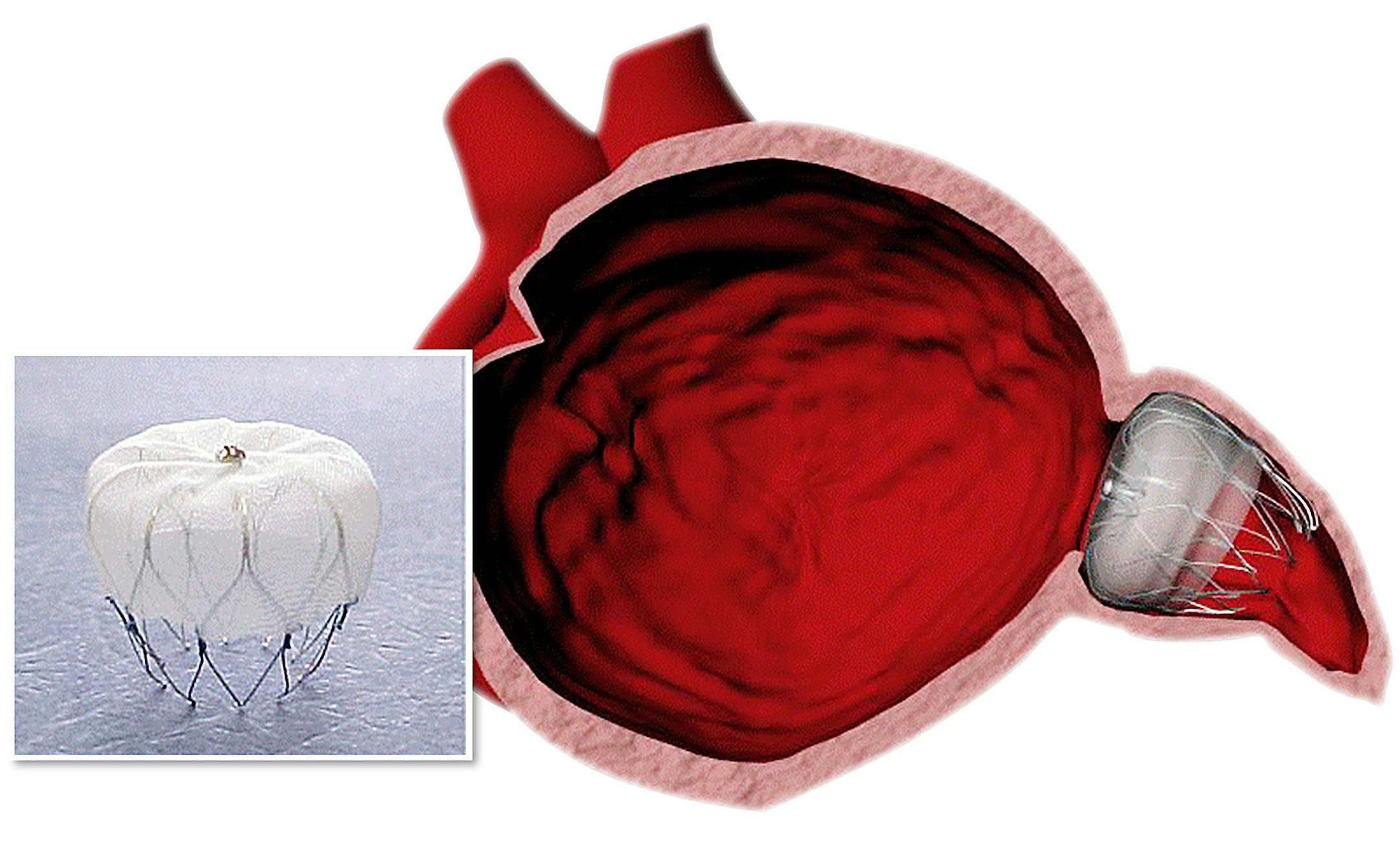
A tiny wire and mesh device to prevent strokes, first doodled on a napkin by a pair of Minneapolis cardiologists, is a step closer to regulatory approval and to what analysts estimate will be a $1 billion market.
The Watchman, which helps stave off strokes by plugging a cul-de-sac in the heart where clots form, will go before an advisory panel of the U.S. Food and Drug Administration on Dec. 11. The product was developed years ago by a small Minneapolis company and was purchased three years ago by Boston Scientific Corp.
In patients with atrial fibrillation — a disorder that interferes with the heart's rhythm — blood can pool in the left atrial appendage and clots can form. The clots can then migrate to the brain and cause stroke. The Watchman will help prevent this because plugging the appendage will stop clots from traveling.
Data from clinical trials and from years of tracking patients show the device not only reduces the risk of stroke, but that it may be a better option for patients who shouldn't take blood-thinning medications. Currently, medication is the only way doctors have to combat the chance of stroke in those patients. All of which is excellent news to Dr. Robert Schwartz and Dr. Robert Hauser, cardiologists with the Minneapolis Heart Institute Foundation, who came together on the idea nearly a decade ago.
"My goal in life is to replace drugs with devices," Schwartz said.
Said Hauser: "This is really going to change things for patients. … The only real disappointment is that it's taken so long."
The device, which looks like a tiny parachute, is inserted into the heart with a catheter that snakes through a blood vessel in the leg. Once inside the heart, the device is placed in the left atrial appendage, a small pocket off the left atrium.
Once the device is implanted, tissue grows over it and permanently closes the area: no more clots, and no need for years of blood thinners that can carry their own risks over time.
 ORG XMIT: MIN2012082117142282](https://arc.stimg.co/startribunemedia/6D5H7LQY3QBTXVI7PCF6XKLCYY.jpg?&w=1080)
![Richard Sennott•rsennott@startribune.com] Dr Robert Schwartz, at Mpls heart Inst doing a study of runners and heart health He uses a CT scan to look at patients hearts ORG XMIT: MIN2013110812535920](https://arc.stimg.co/startribunemedia/JKJNN34VOKPCSRD4KGW3DGEOFU.jpg?&w=1080)



