
Anderson: Forward-facing sonar threatens Minnesota walleyes and other fish

The DNR should restrict when and where gadgets can be used, one longtime Ely guide says.

Columnist Icon
The Minnesota Star Tribune
January 2, 2026 at 8:34PM
Fishing guide and former Ely mayor Ross Petersen said anglers' use of forward facing sonar threatens walleyes and other fish. Limits should be put on the gadget's use, Petersen said. (Dennis Anderson)

The fact that Ross Petersen is a fishing guide and also a former mayor of Ely doesn’t make him unique. Two other recent mayors of that small town on the edge of the Boundary Waters Canoe Area Wilderness also are fishing guides.

But Petersen does stand out among both fishing pros and politicians for another reason.

He’s not afraid to tell it like it is.

Petersen says forward-facing sonar (FFS) — the latest gadget being peddled to anglers as a “must-have” — is ruining Minnesota fishing.

Or will ruin it.

Muskies and crappies are particularly vulnerable to anglers who use these hi-tech fish locators.

Muskies because they show up like torpedoes on anglers’ FFS video screens, allowing a stealth approach and pinpoint casting. Crappies because they can be located from up to 100 feet away before being targeted with baited hooks.

Now, in winter, crappies stand even less of a chance against the modern angler. Beneath the ice, crappies often suspend in deep water, where historically they’ve been a challenge to find.
ADVERTISEMENT

But with FFS, an angler can scan a wide area beneath the ice, locate a school of crappies and drop a bait.

In these situations, some crappies are caught and kept, while others are released but die anyway due to “barotrauma,” or what in humans is sometimes called decompression sickness, or “the bends.”

Worried as Petersen is about muskies and crappies, he’s even more concerned about the effect FFS is having on walleyes.

“These days, I only guide 10 to 12 days a year, but in the early 2000s, I guided three to five days a week, mostly on Basswood and Snowbank lakes,” he said. “Most of those were day trips with tourists staying at resorts. If they were Minnesotans, they wanted walleyes. If they were from Kentucky or elsewhere in the South, it was smallmouth bass. And Californians, for whatever reason, often wanted big northerns.”

Petersen could put clients on fish most of the time. But not always. Some days, the fish he found using an old-fashioned flasher — a simple type of sonar whose signal expands in a cone shape beneath a boat — wouldn’t bite.

On other days, he couldn’t find fish.

Now, he said, walleyes have no place to hide from anglers using FFS.

“Take Snowbank [Lake], which has had some excellent year classes of walleyes recently,” he said. “It used to be that locals would go out there in August and September and maybe they couldn’t find walleyes because they were too deep.

“Now you fish those lakes and you see guide boats rigged with forward-facing sonar targeting walleyes in 35 to 40 feet of water and they’ll sit right over them. They might catch 30 or more, throwing the small ones back. But when they’re brought up from that depth, some of them, or maybe a lot of them, die after being released.”

DNR fisheries chief Brad Parsons will advocate again this year for the state’s walleye limit to be cut from six to four — an initiative started before the widespread adoption of FFS by Minnesota anglers.

In the days before FFS, the cutback would have done little to protect walleyes, because few anglers caught more than one or two of these fish per outing — if that.

Now, the increasing number of anglers who are willing to pay the $3,500 or so that’s required to buy a forward-facing sonar unit are able to catch many more than that.

As importantly, virtually all of the state’s guides have outfitted themselves with FFS — you would, too, if your livelihood depended on it — thus increasing their efficiency on the water.

And they’re on the water every day. Or most days.

So credit Parsons for being prescient and advocating for a lower walleye limit.

Yet the DNR should do much more to protect Minnesota fisheries, Petersen says, or risk losing an industry that contributes $5 billion or more a year to the Minnesota economy.

“If things keep going the way they are, the average guy with a 16-foot aluminum boat and a 15-horse outboard might as well not even go fishing,” he said. “He won’t have a chance.”

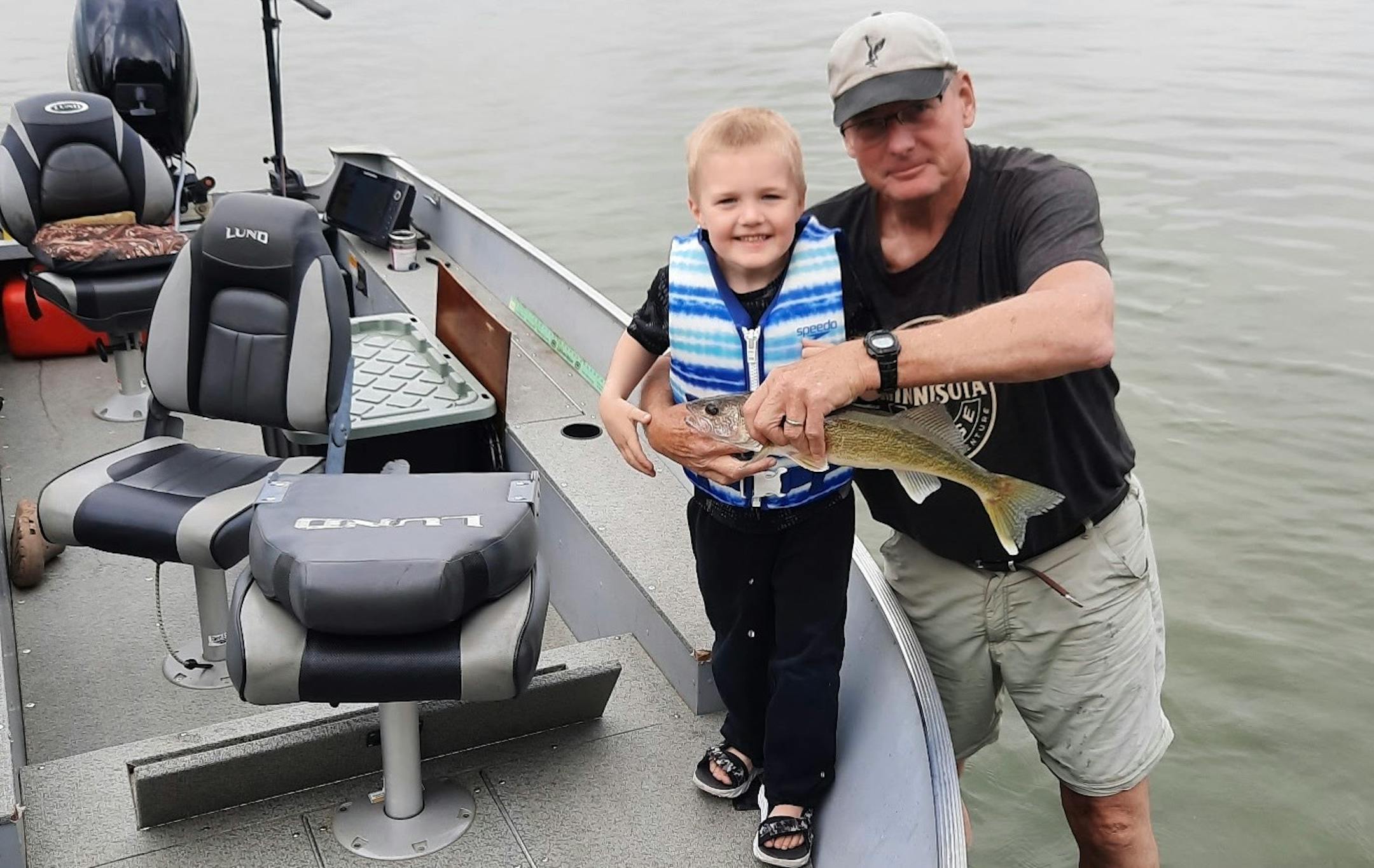
Ely fishing guide Ross Petersen won't buy or use a forward facing sonar unit, believing it's not the right way to teach fishing to his grandchildren, including, shown here, Adam Dietzenbach. (Dennis Anderson)

The argument against action is that FFS is just another tool anglers use to catch fish, and that worries about its effect on muskies, crappies, walleyes and other fish are overblown.

After all, similar concerns were raised when the original Lowrance Little Green Box, the world’s first transistorized sonar instrument for fishing, debuted in 1957.

This is different, Petersen says. I agree.

There’s plenty of precedent for resource agencies to hit the brakes on inventions or other developments that threaten game and fish.

When the pump shotgun was first introduced, followed by the semi-auto, state and federal laws were written to limit the number of shots each could take when used for migratory bird hunting.

Punt guns also were outlawed, and live decoys, because they gave hunters an advantage.

Similarly, FFS gives Minnesota anglers an advantage they couldn’t have imagined even five years ago.

There’s no going back, everyone acknowledges that. But restrictions on when and where this technology can be used should be implemented, as they have been in other states.

“At the very least, the DNR should make some lakes off-limits to forward-facing sonar,” Petersen said. “I’ve already seen them used by canoeists in the Boundary Waters, and for sure they should be outlawed there. And other lakes as well.

“I’m just sick about it. I’ve got five grandkids, and they all love fishing. I’m not going to buy one of those things. It’s not the right way to teach fishing — by watching a video screen to find fish, and then to make sure your bait lands right in front of a fish’s nose."

about the writer

about the writer

Dennis Anderson

Columnist

Outdoors columnist Dennis Anderson joined the Star Tribune in 1993 after serving in the same position at the St. Paul Pioneer Press for 13 years. His column topics vary widely, and include canoeing, fishing, hunting, adventure travel and conservation of the environment.

See Moreicon

More from Sports

See More
card image
Alex Kormann/The Minnesota Star Tribune

The team’s star safety entered the transfer portal and will have plenty of options in college football’s strange new world.

card image
card image