

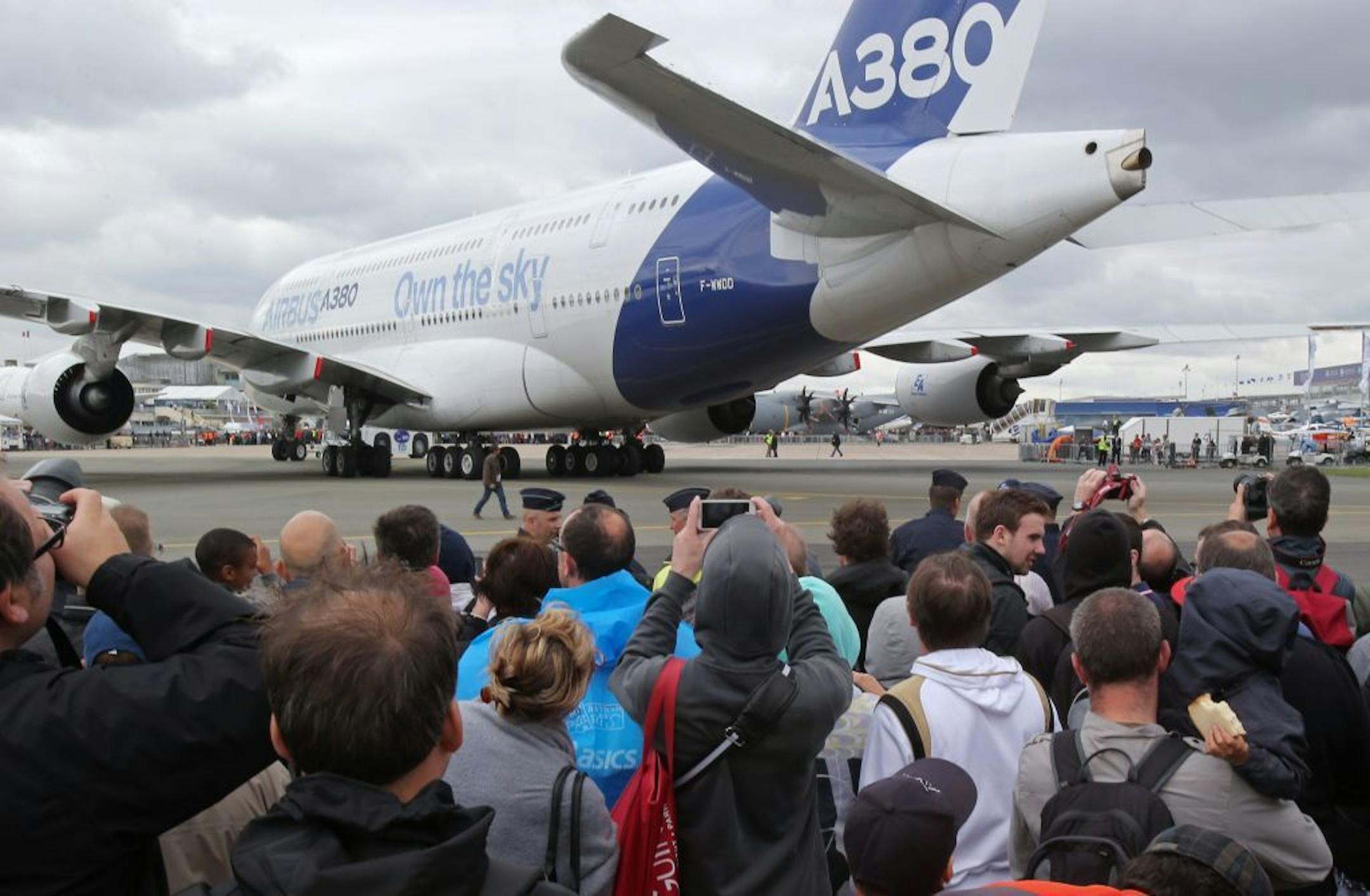
News of new aircraft, orders and technology rained from the skies last week at the Paris Air Show, where a bumper crowd of producers and customers dodged a real downpour with mingled curses and exhilaration. The biennial event at Le Bourget airfield is the aviation world's biggest jamboree, and every manufacturer and supplier struts its stuff in the hope of attracting more business.
Things are looking bright for the civilian side of aerospace these days, though not for defense, with budget cuts in developed countries. As emerging economies grow, enthusiasm for air travel is growing even faster. Technological advances have made aircraft cheaper and cleaner to run, so airlines everywhere are keen to replace older planes.
According to Boeing's annual forecast, published this month, more than 35,000 new aircraft — worth perhaps $4.8 trillion — will be needed over the next 20 years. Almost 25,000 of them will be single-aisle planes, and almost 13,000 of them will be used in Asia. This is a market that Western manufacturers — two in particular — now dominate.
Airbus got off to an early public-relations lead with the maiden flight of its new A350 on June 14. The 314-seater boasts a 25 percent lower operating cost than its predecessors, thanks to lightweight composites and a new Rolls-Royce engine. By midweek Airbus had added 59 to its original 613 orders for the aircraft, and more for its older models. Even its little-loved double-decker superjumbo, the A380, got a look-in, with its first order since last October.
Chicago-based Boeing insisted it had expected to be outsold in Paris by the home team (Airbus is owned by the French-German-Spanish EADS). But Boeing still managed a creditable haul of its own. And it took the next-generation fire to the enemy, launching a stretch version of its midsize 787 Dreamliner, briefly grounded this year with battery problems, to compete with the slightly larger A350, and revealing over 100 new orders for it.
Boeing also upped the stakes against the upgraded "neo" version of Airbus's single-aisle A320, due to go into service in the second half of 2015, by promising to bring forward the first deliveries of its competing 737 MAX from the end of 2017 to the third quarter.
But for once it was not just "the usual ping-pong between Boeing and Airbus," as French television put it. Other firms, including ones from developing countries, have long been eyeing the mainstream single-aisle market, where growth is strongest. They are closing in.
Closest of all is Bombardier of Canada. Pierre Beaudoin, its boss, promises that its new CSeries, aimed at the 100- to 150-seat market, will make its maiden flight this month, give or take a week, and that deliveries will start in 2014.



