

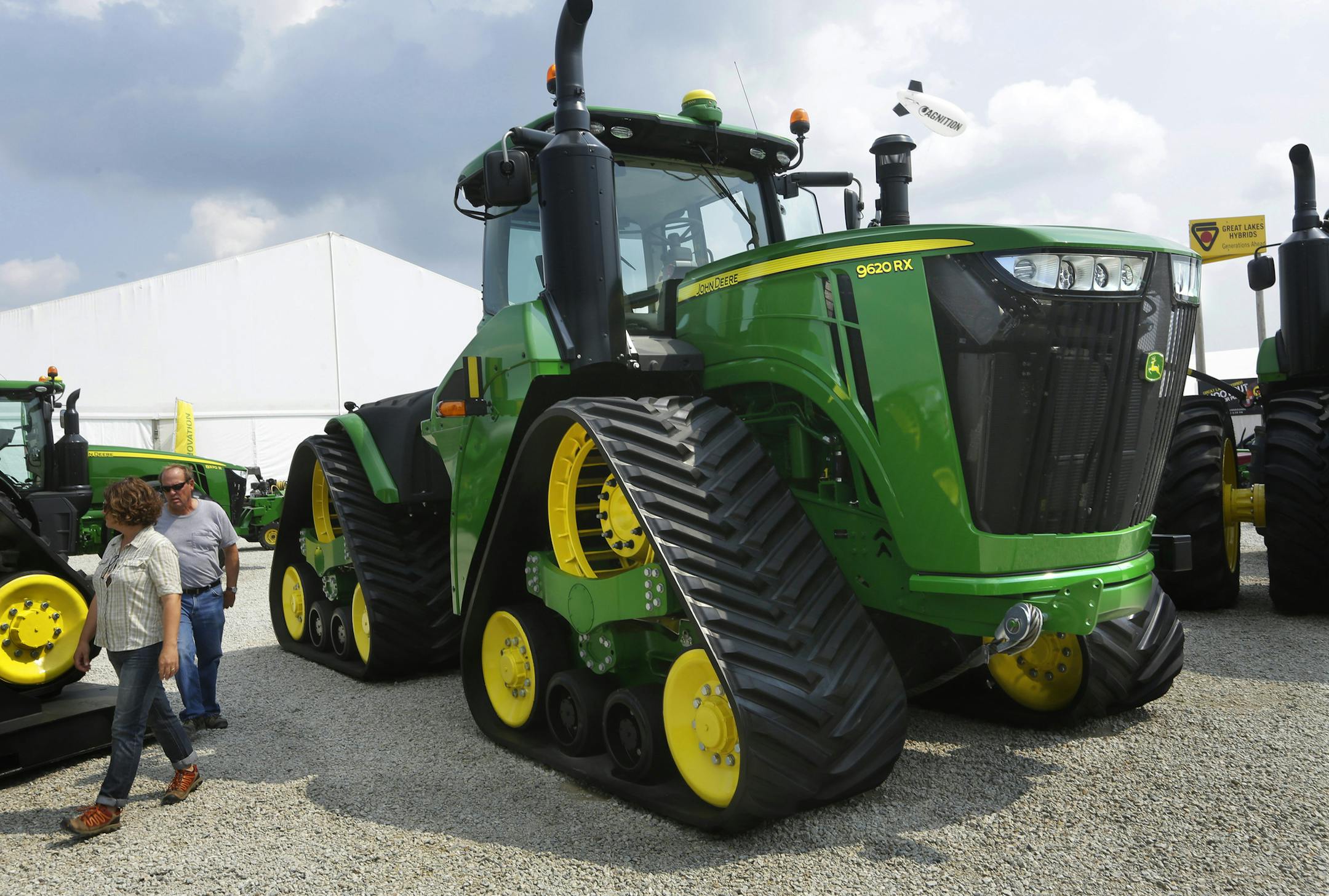
Not in the market for a new tractor? Deere & Co. would like to sell you all the equipment to make your older one smart.
With slumping crop prices, the Moline, Ill.-based company is seeking to combat slowing sales by selling farmers bolt-on products — modems, navigation devices, sensors and software. In the process, it's joined the race for a "precision farming" market that could be worth $240 billion by 2050, according to Goldman Sachs.
Deere's AutoTrac system includes an auto-steering kit and a monitor that lets farmers set the most accurate course in fields for planting, applying fertilizer and pest control. It's just one component of the company's venture into the world of agriculture technology that promises growers less waste and reduced input costs as they deal with declining incomes.
"It's an important topic for Deere, the industry and investors," Larry De Maria, an analyst at William Blair & Co. in New York, said. "Bigger and faster is no longer the mantra. It's about productivity and efficiency."
What's notable about Deere's technology offerings is that the company is taking an agnostic approach as to whether new devices are added to tractors made by competitors. On its website, the company touts that the AutoTrac Universal 200 package is available in a variety of colors — not just Deere's iconic green and yellow. That approach underscores how much the company's fortunes are tied to the financial health of farmers.
Prices for corn, the biggest U.S. crop, are on pace for a fourth straight annual decline and reached a seven-year low of $3.1475 a bushel in Chicago last month. Futures traded at $3.34 late last week.
In this environment, many growers aren't willing to purchase new tractors that can cost around $360,000 and are either squeezing production out of existing equipment or turning to auctions for used tractors and combines that cost half as much. The slump for crop prices means analysts expect Deere's profit for its fiscal year that ends next month will fall to the lowest since 2009.
Deere is moving toward a "holistic" strategy of selling parts that can be used on any machine already working fields, said Ronald Zink, the company's director of onboard applications.



