

PANAMA CITY – On Feb. 4, 1889, the French Compagnie Universelle du Canal Interocéanique de Panama was declared bankrupt, marking the first catastrophic failure to build the Panama Canal.
On the same date this year (the centenary year of its completion in 1914), talks collapsed on how to finish the canal's expansion. Seafarers, a superstitious bunch, will not interpret this as a good omen.
After weeks of negotiations between the Panama Canal Authority (PCA) and a consortium led by Sacyr, a Spanish builder, and its Italian counterpart, Salini Impregilo, the two sides have failed to reach agreement on who pays for $1.6 billion of cost overruns on their $3.2 billion portion of the project to widen the waterway. The consortium, GUPC, said the endeavor was on "the brink of failure."
The PCA's head, Jorge Quijano, said the consortium had dropped tools the morning after the talks dissolved with the project only 70 percent completed. His team will now decide whether to hire new builders to complete the work, which may cost another $1.5 billion. "We will finish this job in 2015 with or without GUPC," he said, though he acknowledged there might be tough legal battles ahead.
The kernel of the dispute is a $785 million advance payment the PCA made to the consortium. Quijano said GUPC had asked for a moratorium on repayment until 2018. The PCA, which has already granted a year's extra time, was prepared to extend it only until 2015. The row has pitted two forceful personalities against each other. Though coverage of the consortium has focused on Sacyr of Spain, it is Pietro Salini, the Italian businessman whose company last year bought control of Impregilo, who is said to be calling the shots.
Last month he accused Quijano of inexperience on such big projects. He also implied that an Italian subcontractor, Cimolai, would not deliver a set of massive lock gates if GUPC loses the contract, setting the expansion back by three years. Quijano told the Economist that sounded like "extortion."
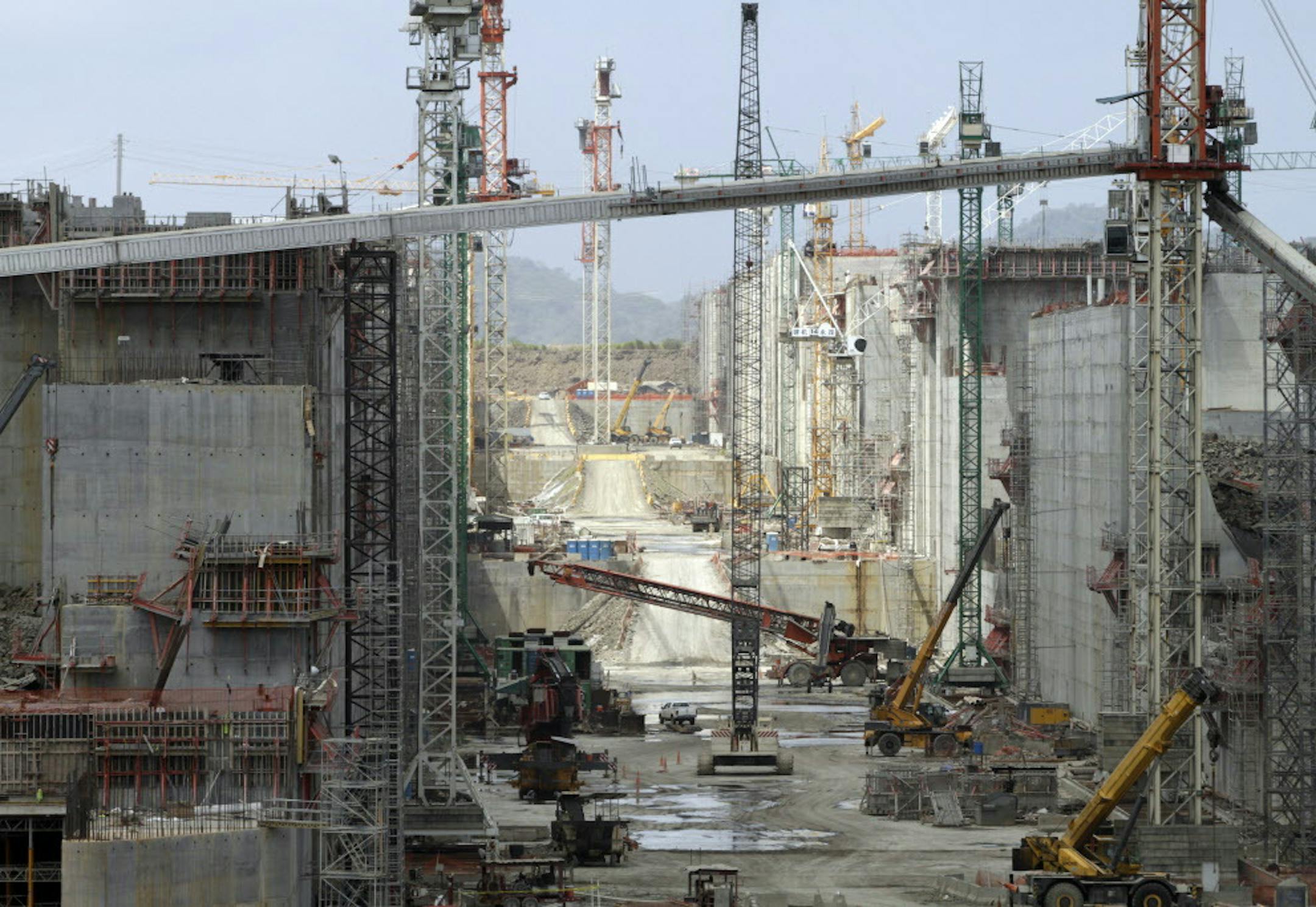
The dispute has already cost precious time. It started in the early part of the dry season, the only four months when conditions are right for mixing concrete. During a visit on Jan. 31 to a canyon-like expansion site on the Pacific coast, the concrete mixers were already inactive. There were few workers. It was a forlorn sight compared with a mural at the PCA's headquarters that shows the original canal swarming with laborers 100 years ago.
On the same day, Quijano hosted the U.S. ambassador to Panama at the expansion site, which he said underscored the importance of its completion to the United States, the canal's biggest user. The head of Miami's port was in Panama the same week. Miami has $2 billion in port improvements underway that were originally timed to coincide with the opening of the expanded canal this year or next.



