

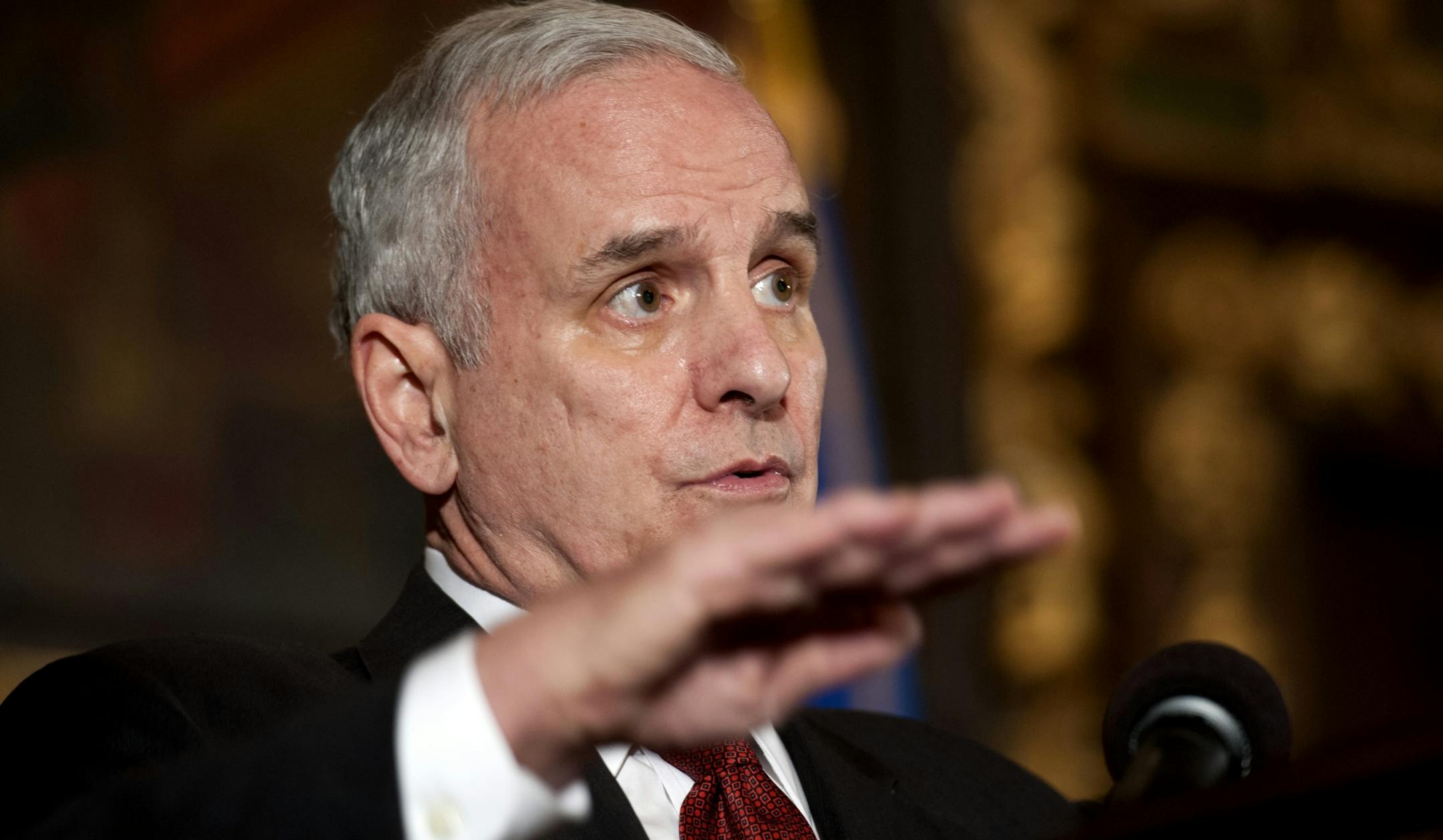
Gov. Mark Dayton's office on Friday waded into the red-hot center of the debate over his broad tax proposal, attempting to clarify the rules on when Minnesota businesses would pay the state sales tax.
Service businesses — from law firms to accountants to advertising agencies — have strongly protested Dayton's plan to have them pay state taxes for their dealings with other companies, especially the prospect of sales involving clients outside Minnesota. Some law firms have even threatened to leave the state.
But on Friday, Dayton spokesman Bob Hume and Department of Revenue Commissioner Myron Frans challenged that criticism directly, telling reporters that a "business-to-business" sales tax would not apply to goods or services sold beyond Minnesota.
"The rewriting of the code around such a very, very large comprehensive tax reform was always going to be complicated," Hume said. "There's been no change between what we're saying today and what we said almost four weeks ago, but putting that into bill form takes this time. It's the way the process is set up."
Dayton's budget — meant to wipe out a $1.1 billion projected budget deficit, give $1.1 billion to schools and transfer $1.4 billion in property tax rebates to homeowners — would raise $2.2 billion in new revenue by taxing sales between companies, plus another $1.1 billion by raising income taxes for the wealthiest Minnesotans.
If approved, Minnesota would join only three other states — Hawaii, South Dakota and New Mexico — that have broad sales taxes on professional services. The proposal has drawn the criticism of a broad cross-section of service firms, even though it also lowers the corporate tax rate from 9.8 percent to 8.4 percent.
Other businesses who already pay the tax — from restaurants to tree trimmers — have expressed support for the plan because it would lower the sales tax rate and eliminate exemptions that appear arbitrary.
To try to make peace with business executives who oppose the plan, the governor's office issued a 16-page clarification on the proposal, before the likely introduction of the bill at the statehouse next week. The governor's team provided a detailed list of exemptions, which includes the sale of farm machinery and some construction labor.
Under the proposal, Minnesota's sales tax rate would fall from seventh-highest in the nation to 27th, according to the governor's plan.


