

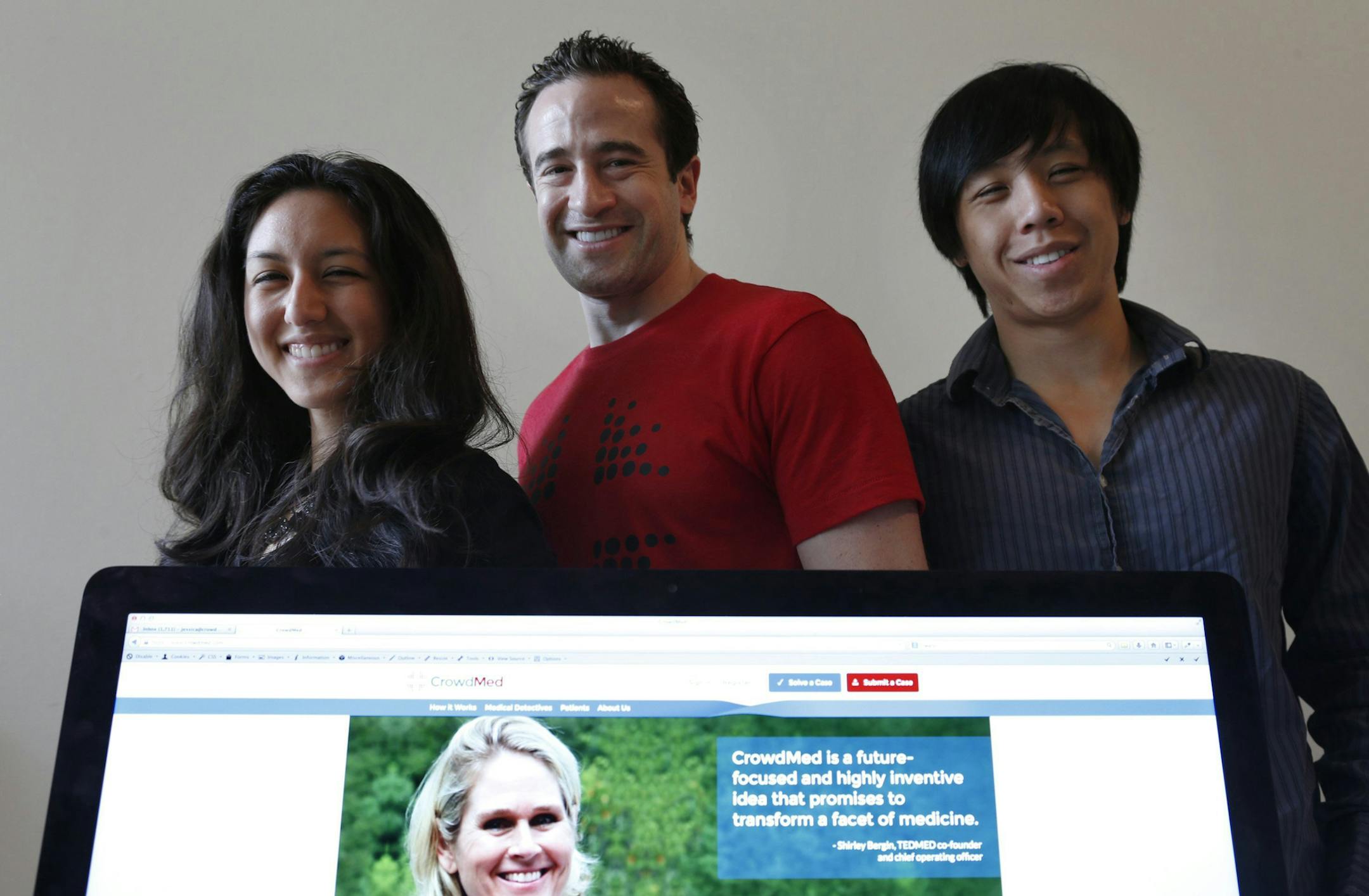
If your doctor can't determine what's ailing you, can the collective wisdom of crowds?
What Wikipedia has done for knowledge, a San Francisco company called CrowdMed is betting it can do for medicine. Send your symptoms and a nominal fee to CrowdMed.com, and dozens of medical professionals, students and average Joes will "crowdsource" — that is, share their knowledge and expertise — to help diagnose what's wrong with you.
The company isn't out to replace your family doctor, but instead take advantage of the reach of social media to tap into an age-old medical practice: seeking second opinions. Or, in this case, hundreds of them.
"We're essentially trying to match up the patient with a group of detectives who can help solve their case," said CrowdMed CEO Jared Heyman, whose company is backed by $2.4 million in venture capital funding. "And the more diverse backgrounds they have, the better our chances."
The concept, however, is not without its critics. Some physicians say the business model raises a number of serious concerns — from the credibility of those offering advice to the security of medical information that patients upload onto the website.
Still, some doctors are open to the idea. "It may be of value for difficult diagnoses," said Dr. Michael Hogarth, professor of pathology and laboratory medicine at the University of California, Davis, Health System. And CrowdMed's greatest potential, he said, may be its ability to provide a way to double check a physician's work.
At the UC-Berkeley/UC-San Francisco Joint Medical Program, Dr. Amin Azzam, director of the "problem-based learning" curriculum, wants to use CrowdMed "to push the boundaries of how we train medical students."
Instead of teaching first- and second-year students with "pretend patients," as is done now, Azzam is proposing adding CrowdMed's cases to the curriculum. "They might even be more motivated to learn because it's a real patient," he said.



