
Court of Appeals: Defamation lawsuit by Twin Cities dentist over negative Google review can proceed

The customer who filed the review attempted to get the case dismissed under Minnesota’s Uniform Public Expression Protection Act, but the court ruled her post was not a matter of public concern.

The Minnesota Star Tribune
September 16, 2025 at 12:10AM
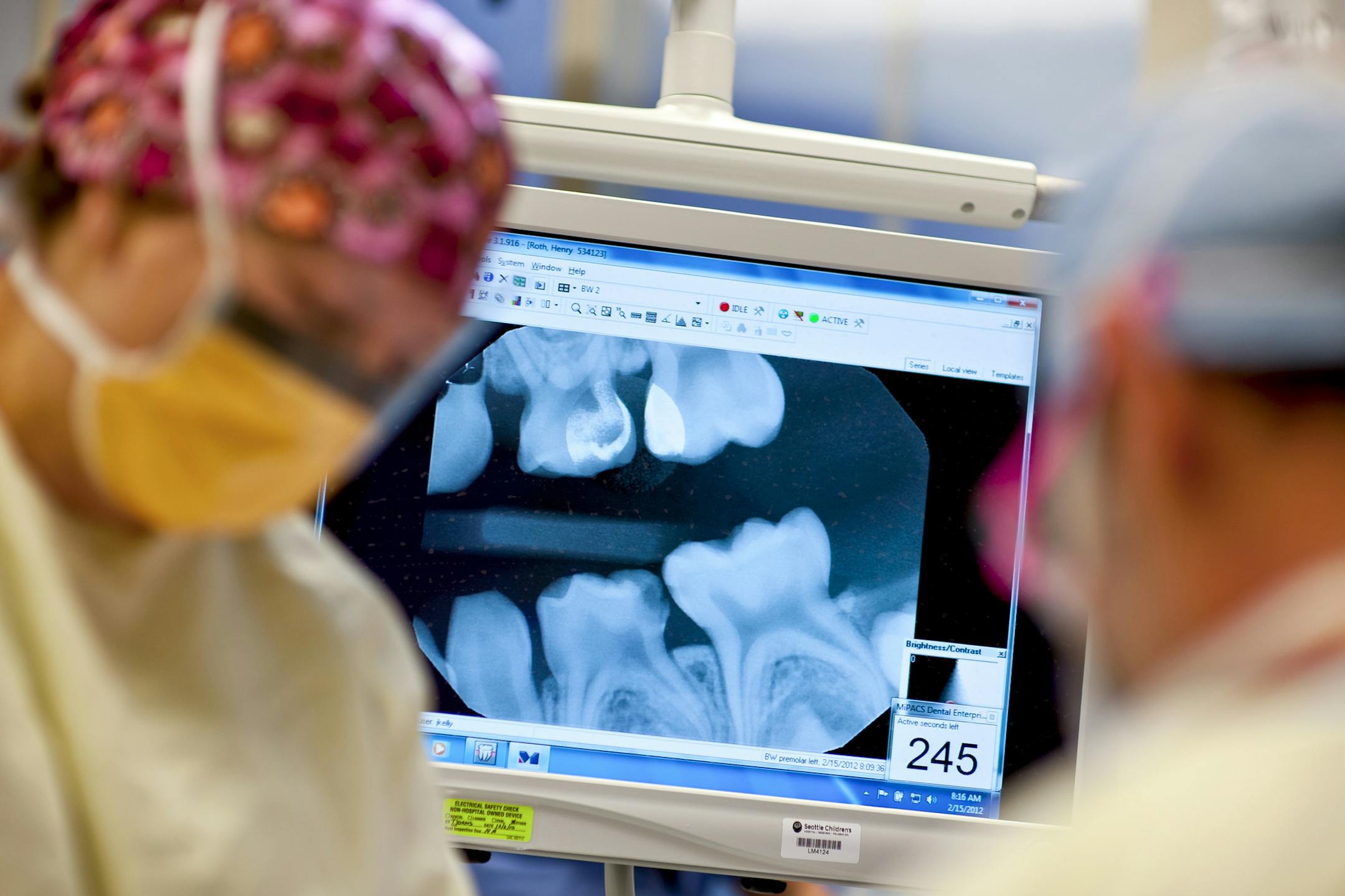
FILE -- An x-ray is displayed on a monitor during a dental procedure in Seattle on Feb. 5, 2012. Dentist offices are, in the eyes of some economists, the perfect barometer for gauging the country's recovery from the shock of the coronavirus pandemic. (Stuart Isett/The New York Times) ORG XMIT: XNYT29
The Minnesota Court of Appeals ruled Monday that a woman’s negative Google review of a Twin Cities dentist did not amount to protected free speech under state law and she can be sued for defamation. (Stuart Isett/The New York Times)

The Minnesota Court of Appeals ruled Monday that a woman’s negative Google review of a Twin Cities dentist did not amount to protected free speech under state law and she can be sued for defamation.

J&D Dental and its CEO, Dr. Jennifer Herbert, sued Liya Hou last year after Hou posted several negative reviews of the Minneapolis dentist.

Before the postings, Hou, of St. Cloud, had two fillings and a crown done at J&D Dental. Afterward, she started to feel discomfort and went to another dentist who said the work needed to be redone. J&D Dental questioned her version of events and sought more information about the damage. During this time, Hou engaged J&D Dental in conversation over what could be done to remedy the situation.

J&D Dental ultimately offered to refund Hou’s insurance company for the work, as long as she released all claims of liability against the dentist. Hou responded that she wanted $2,000 paid to her personally on top of $1,279 for the insurance money. She said if she wasn’t paid she would start taking action, including posting on social media about her experience.

The situation wasn’t resolved.

Hou made several posts on Google, Yelp and other public websites about her experience, accusing the dentist of damaging three of her teeth that led to “more serious dental issues.” She also wrote that Herbert had a “dismissive attitude.” J&D Dental sent a letter demanding Hou take the posts down. Instead, she edited her review and added that the dentist had threatened to take legal action.

J&D Dental, which has a 4.9-out-of-five-stars rating with 681 customer reviews on Google, filed a lawsuit in Hennepin County District Court over defamation, contending Hou’s posts were untrue and unsupported and included that Hou had a history of posting negative online reviews.
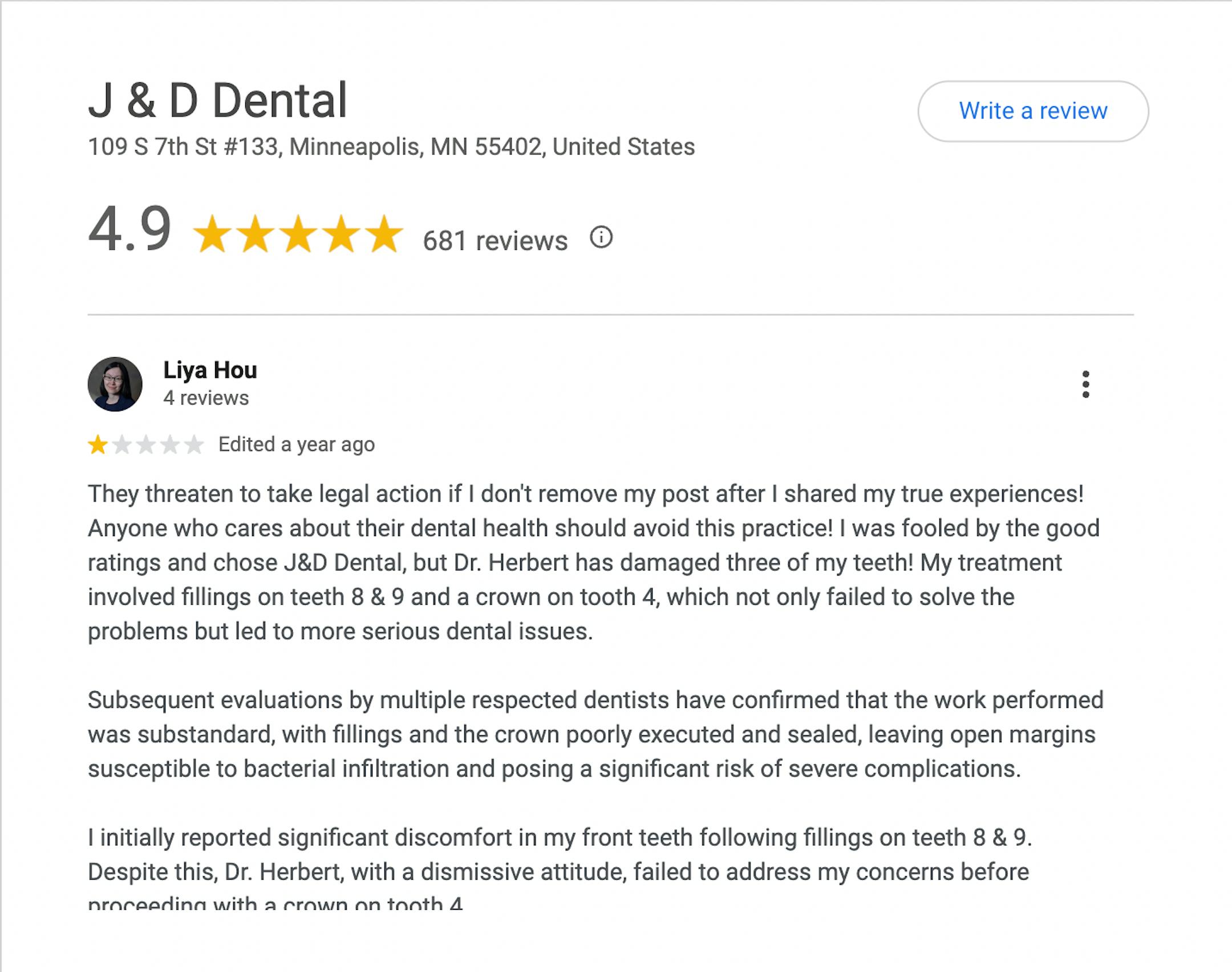
The Google review of J&D Dental posted by Liya Hou.

Hou motioned for the lawsuit to be dismissed under Minnesota’s Uniform Public Expression Protection Act (UPEPA), which allows for expedited relief from frivolous lawsuits over free speech that is of the public concern. Hou argued that her posts were “related to a matter of substantial public interest and concern.”

Judge Karen Janisch denied the motion to dismiss the lawsuit, ruling that Hou’s posts were not of public concern and there was no evidence that online review platforms like Google or Yelp provide a “forum for discussion of problems or widespread issues in relation to dentistry.”

Hou appealed.

UPEPA is starting to find its way into the courts as lawyers engage with how the new Minnesota law is interpreted. The Court of Appeals used its precedential opinion to consider how online reviews relate to free speech in Minnesota. The court determined that whether or not a negative post is of public concern has to be contextual, taking into account everything about the post.

While the District Court argued that Hou’s posts did not engage a public discussion on the problems of dentistry, she argued that it’s clear a public posting about a company is meant to spread awareness and “assist others in making health-related decisions.” Her attorneys pointed to a 2023 state Supreme Court decision where a woman accused a Minneapolis dance instructor of sexual assault on a Facebook post. In a split decision, the Supreme Court ruled that post was protected as free speech because it was part of the MeToo movement and a matter of public concern. A jury later found the woman did not defame the instructor because her statements were true.

The Court of Appeals ruled that while Hou’s post shared “some similarities” with the Supreme Court case, the comparison was limited because Hou’s posts were mostly about her personal grievance and experience and not engaging conversation with a broader community or about a social movement.

The court did agree that online reviews can be a proper place for free speech that would be protected under UPEPA, but Hou’s post failed to reach the threshold of public concern and “UPEPA does not apply.”

Attorneys Jennifer Robbins and Chris Madel are both clients of J&D Dental, and Robbins said they are representing the dentist pro bono because they found the review to be a targeted attack against Herbert by a “cyber extortionist.”

“We know [Herbert], she’s terrific and she doesn’t deserve to be threatened and bullied in this way,” Robbins said. She added that legitimate criticisms of businesses that were true concerns of the public should be protected for online reviews, but this case didn’t rise to that level, and the accusations were “frankly, false.”

Attorney Bruce Jones, who represented Hou, said he had no comment on the court of appeals opinion and hadn’t spoken with his client yet.

The lawsuit will now return to Hennepin County for further proceedings.

about the writer

about the writer

Jeff Day

Reporter

Jeff Day is a Hennepin County courts reporter. He previously worked as a sports reporter and editor.

See Moreicon