

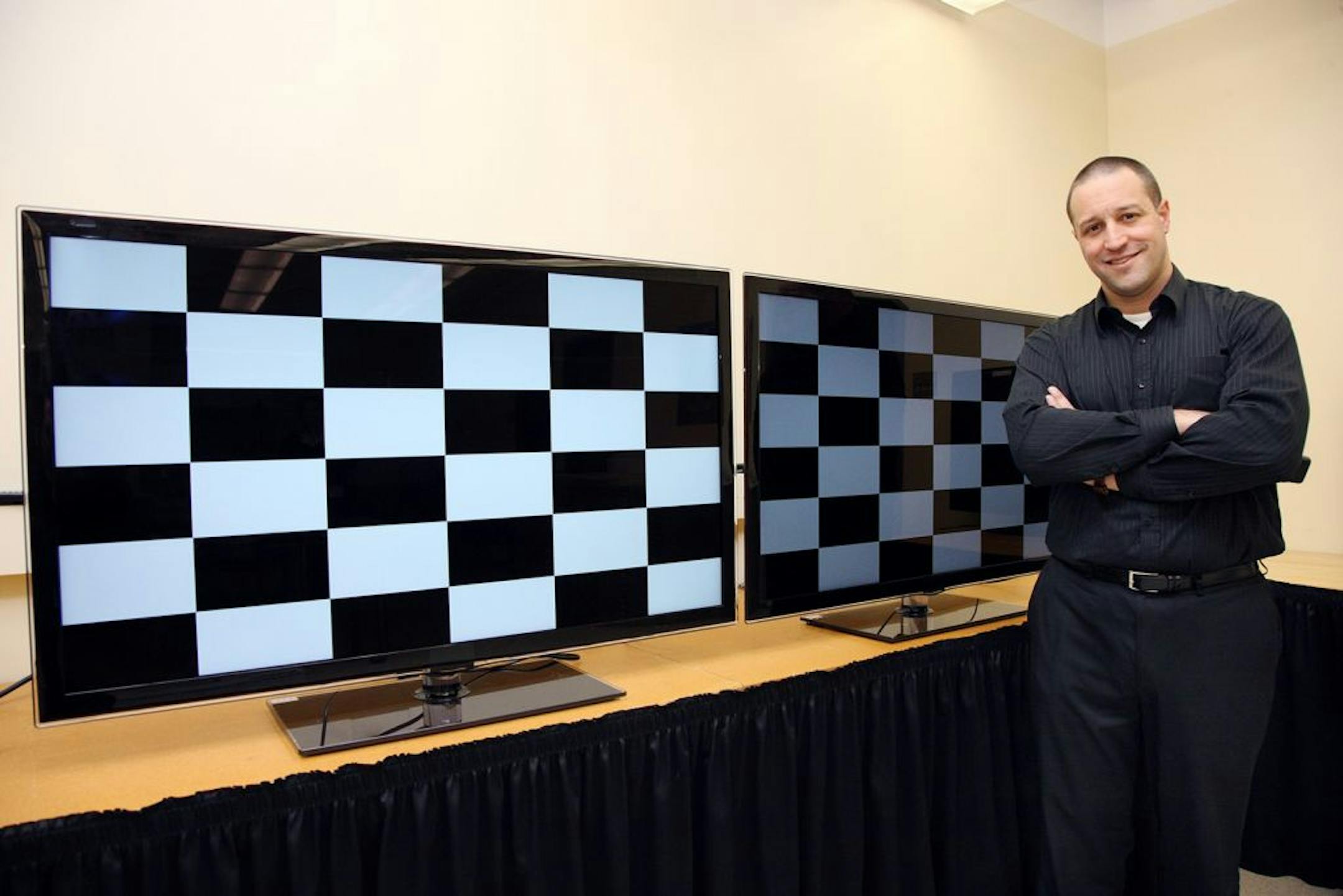
Unlike many buyers, Jeff Fritsche of Eden Prairie thought about his living room layout when considering a flat-screen TV. "I want to see the screen from the side just as well as I see it from the front," he said.
Unfortunately, the quality of the picture from a side view is declining, according to a study commissioned by 3M that documents a decline in LCD TV wide-angle luminance, a combination of picture brightness and side viewing. Manufacturers are cutting corners by eliminating filters that improve viewing from the side, said Dave Lamb, a 3M physicist who works on light technology in LCD screens.
While many consumers view their TVs straight on and may not be as affected by side viewing, nearly half of consumers watch TV from a wide axis, according to the 3M study conducted by CBS Vision. And LCD is the dominant technology, with about 82 percent of the worldwide market, according to NPD DisplaySearch.
That's a lot of necks craning to see.
At this year's Consumer Electronics Show in Las Vegas that begins Tuesday, 3M, which makes the filters, hopes to encourage manufacturers to include them in all TVs. "It varies by make, model and manufacturer," said Lamb. "We found that in two identical LCD TVs by the same maker, one might have the filter and another won't." As a result, 3M is recommending a new measurement standard for wide-angle viewing, which must meet viewers' needs while adhering to EnergyStar energy-saving benchmarks.
The filters cost the manufacturer about $10, said Lamb, but the filters get eliminated sometimes as makers squeeze in new features such as 3-D, 240Hz for crisper images and Wi-Fi while trying to keep costs down.
The filters offer a definite advantage for very little cost, said Don Lindich, whose Sound Advice column runs in the Star Tribune. By using the filters, consumers are less likely to maximize the brightness to make side viewing easier, thereby using less energy.
The decline in side viewing quality only affects LCD TVs and LCD/LED TVs, not plasma screens, said Lamb.


