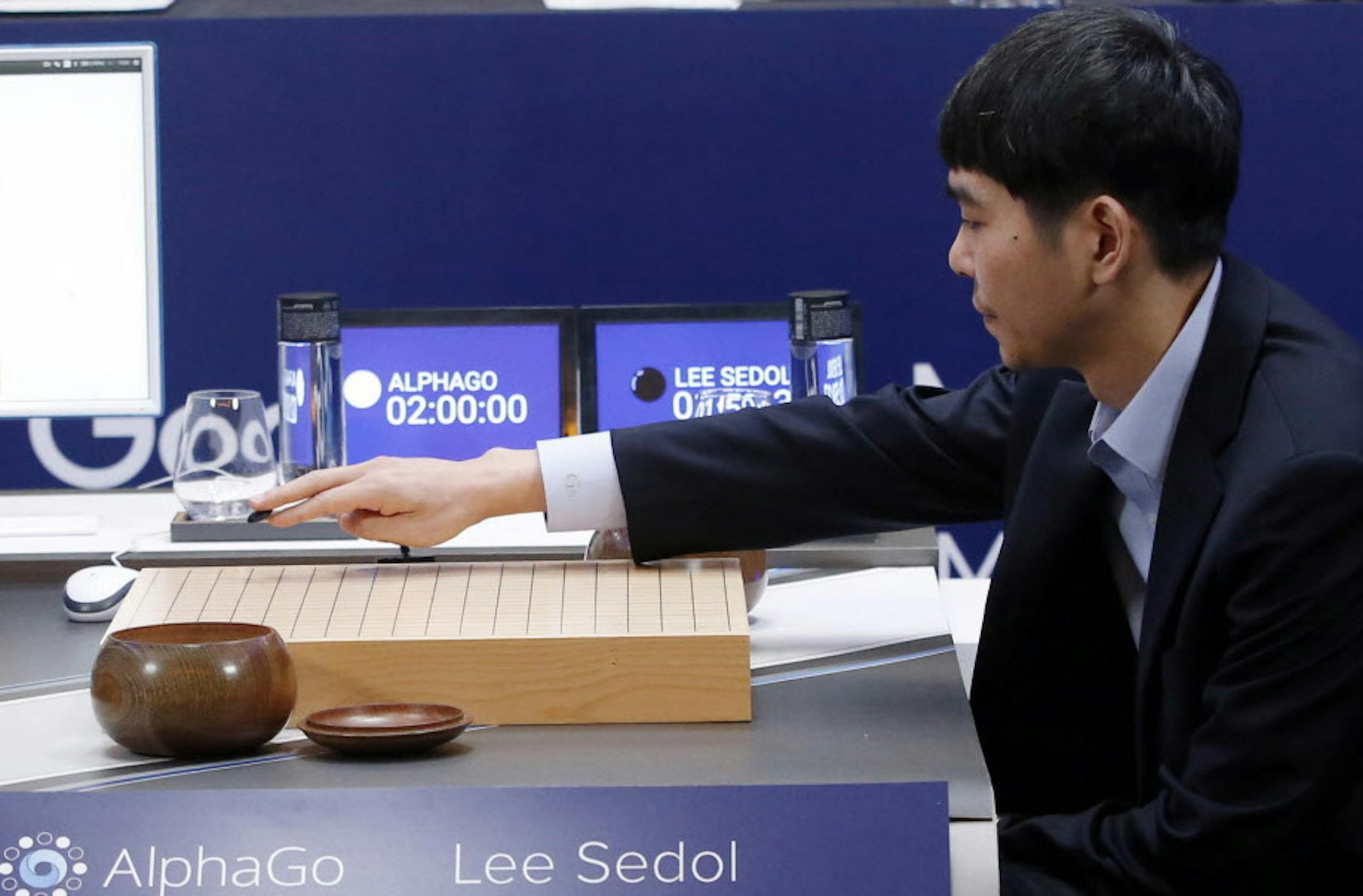
Put away your worries about how all the major presidential contenders have abandoned a bipartisan consensus on trade, or whether any serious financial instrument will ever again earn serious interest. In Seoul, a genuine tragedy for the human race has taken place.
AlphaGo won. The computer, developed by artificial-intelligence researchers at Google, swept the first three games in its five-game match with Lee Sedol, the world's best player of the game Go. Lee won the fourth and, on Tuesday, lost the fifth.
It wasn't supposed to be like this. Sure, the best computers have been crushing world chess champions for more than a decade. But Go — Go was supposed to be unsolvable. Or at least not solvable so soon. AlphaGo might have beaten the European champ last fall, but he was ranked something like 229th in the world. No big deal.
Go was safe, we thought, because Go was different. It's not just calculation. It's intuition. It's an aesthetic. It's a feeling for structure. It's a calm appreciation of space and shape and direction. In short, it's art.
I was introduced to Go as a college freshman, and very soon those of us who were serious about the game — mostly math and science nerds — looked down our noses at mere chess players. In the 1990s, we had a good laugh when computers began to trounce chess champions. Go, we were sure, was safe for decades to come. The number of legal positions in Go dwarfs the number of legal positions in chess by many orders of magnitude. Brute force would never solve Go.
The transcendent difficulty of Go has long contributed to its allure. In the West in particular, the game has carried an aura of inaccessibility that adds to its mystery. "Not one in a hundred European residents in Japan," complained a British observer in 1906, "has had the patience needed to learn and appreciate the merits of 'Go,' or to enjoy playing the game." Writing in the Pall Mall Magazine, he went on to praise Go for what it might teach about discipline and strategy.
Alas, he went on, the game was too difficult for most Westerners. The only ones who might play it well were those who possessed "the brain-faculty of persistent memory in the midst of distracting dangers." The "great merit" of Go, he wrote, was "its combining the opposite qualities of simplicity and complexity." He added: "You will lose if you do not perceive your opponent's real objective as clearly as you must bear your own in mind while concealing it."
This last point, of course, is common to games of skill, but somehow in Go seems more so. It's often called the most perfect game of strategy ever invented. (OK, devotees of Hex will disagree.) Most important, Go was supposed to be the game least likely to be broken by the machines.