

Thomas Eric Duncan, America's first Ebola fatality, went to a Dallas hospital twice in the days before he died.
The first time he arrived under his own power. The second time, when he was much sicker and more contagious, an ambulance took him in. He ended up exposing three people who rode in the ambulance with him to the virus.
Experts say that this second route, via Emergency Medical Service transport, is how future Ebola patients in the United States are likely to get to a hospital — and in the process, they will expose first responders and other patients to contagion risk. EMS organizations are already adapting, and they're getting support from private companies that make software for first-responders, including Edina's Open Inc.
Open is one of several companies nationally that sell mobile computer systems used to evaluate and record patient health information in the field, before arrival at hospitals. Open rolled out updates to its SafetyPAD system in October that allows the system to detect telltale signs of infectious disease risk and automatically send reports to supervisors, government officials, and public health agencies.
SafetyPAD's first foray into infectious disease monitoring came in 2006 with the arrival of the H1N1 flu virus, and it was expanded to include surveillance for such viral diseases as SARS and MERS. But the news of Ebola in the United States changed everything.
"When the gentleman in Dallas was diagnosed, we saw an exponential growth in our customers having a high level of concern," said Mike Vukovich, Open's founder.
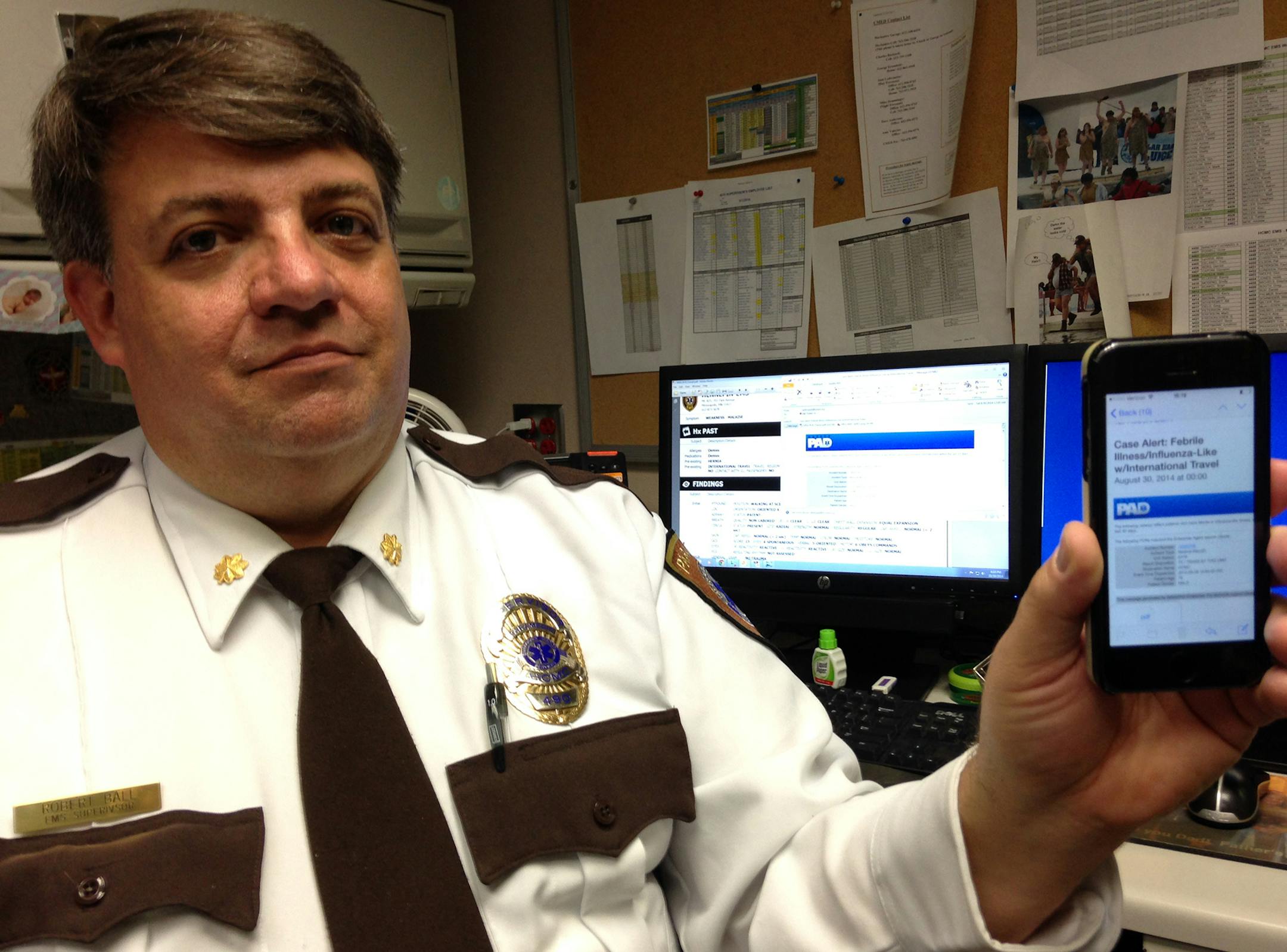
SafetyPAD is a program that runs on a rugged tablet computer carried in an ambulance or fire truck. It prompts paramedics to ask specific questions to patients in the field, documents the answers and then analyzes the responses to see if follow-up questions are needed. Alerts for potential cases are automatically e-mailed out.
For Ebola, the system looks for key symptoms like high fever, vomiting, coughing blood or unexplained bruising. If those are present, the system will prompt the paramedic to ask whether the patient has traveled internationally in the past 30 days. If yes, what countries did the patient visit? Did the patient visit a hospital there? Did they encounter other feverish people?



