

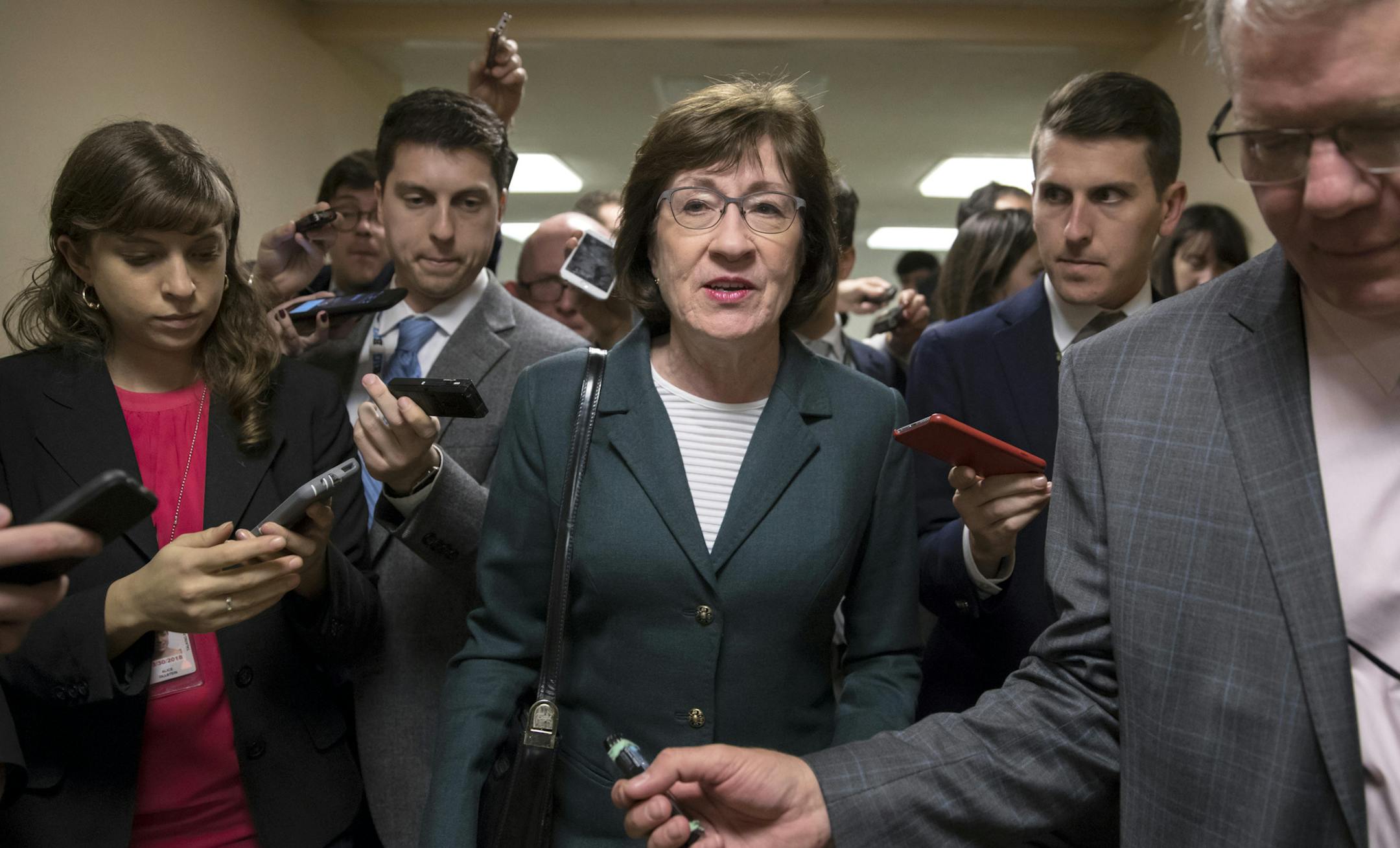
Of all the votes for the Senate GOP tax bill, those of Sens. Susan Collins, R-Maine, John McCain, R-Ariz., and Lisa Murkowski, R-Alaska, were perhaps the most puzzling. These lawmakers killed an Obamacare repeal bill last summer because it was hastily drafted and poorly designed. Yet they each just endorsed a tax bill that contains a hastily drafted and poorly designed repeal of a key piece of Obamacare, the law's "individual mandate" requiring all Americans to carry health care coverage.
When pressed Sunday, Collins insisted that repealing the mandate would not damage health care markets, in large part because she received assurances from congressional leaders and the White House that two bipartisan fix-Obamacare bills would come up next. But Collins is wrong in her certainty that these bills, if passed, would fill the gap that repealing the individual mandate would leave.
The Obamacare system guarantees that insurers cannot turn away sick and old people. To keep costs down, this, in turn, requires that young and healthy people do not refuse to buy insurance until they need care. The individual mandate is meant to spur everyone to join the insurance pool.
Striking the mandate endangers insurance markets because fewer young and healthy people would buy into the system. Insurers would raise premiums to offset this effect, driving more people out of the market and potentially leading to even higher premiums over time. The scale of the potential damage is a matter of hot debate. But the prospect of more uncertainty and further-weakened health care markets might scare more insurers out of the Obamacare system. If Republicans are set on repealing this important element of Obamacare, they should at least have ready a replacement policy designed to achieve similar effects, spurring the young and healthy to buy insurance and balance out the pool.
Instead, they have a bill that Sens. Lamar Alexander, R-Tenn., and Patty Murray, D-Wash., negotiated that would restore for two years subsidy payments to insurers participating in Obamacare, payments that were halted at Republican insistence. Restoring these payments could lower premiums for insurance buyers in some states. But in many places, regulators have found ways to effectively restrain premiums in the absence of the federal payments, so temporarily restoring them would in fact not help as many people as one might have imagined. Also in the bill are some permanent regulatory reforms, but their effects are still a matter of uncertain speculation.
Collins also pointed to a proposal she hashed out with Sen. Bill Nelson, D-Fla., which would provide money to help insurers pay for very-high-cost patients. With the federal government bearing more risk, insurers could lower premiums and attract more customers. Unfortunately, the bill would not devote enough money to this "reinsurance" program, and the funding would dry up after two years.
To be clear, each of these bills is worth passing on its own merits. But trading them for the permanent loss of the individual mandate is a bad exchange. If the reinsurance plan were larger and perpetual, Collins would have a better argument. If Republicans had spent months examining the effectiveness of the mandate, waited for a new assessment from the Congressional Budget Office and drafted a stand-alone bill that included replacement policies, they would have more credibility in making such a large and risky change in the Obamacare system. But this is not what happened.
FROM AN EDITORIAL IN THE WASHINGTON POST


