

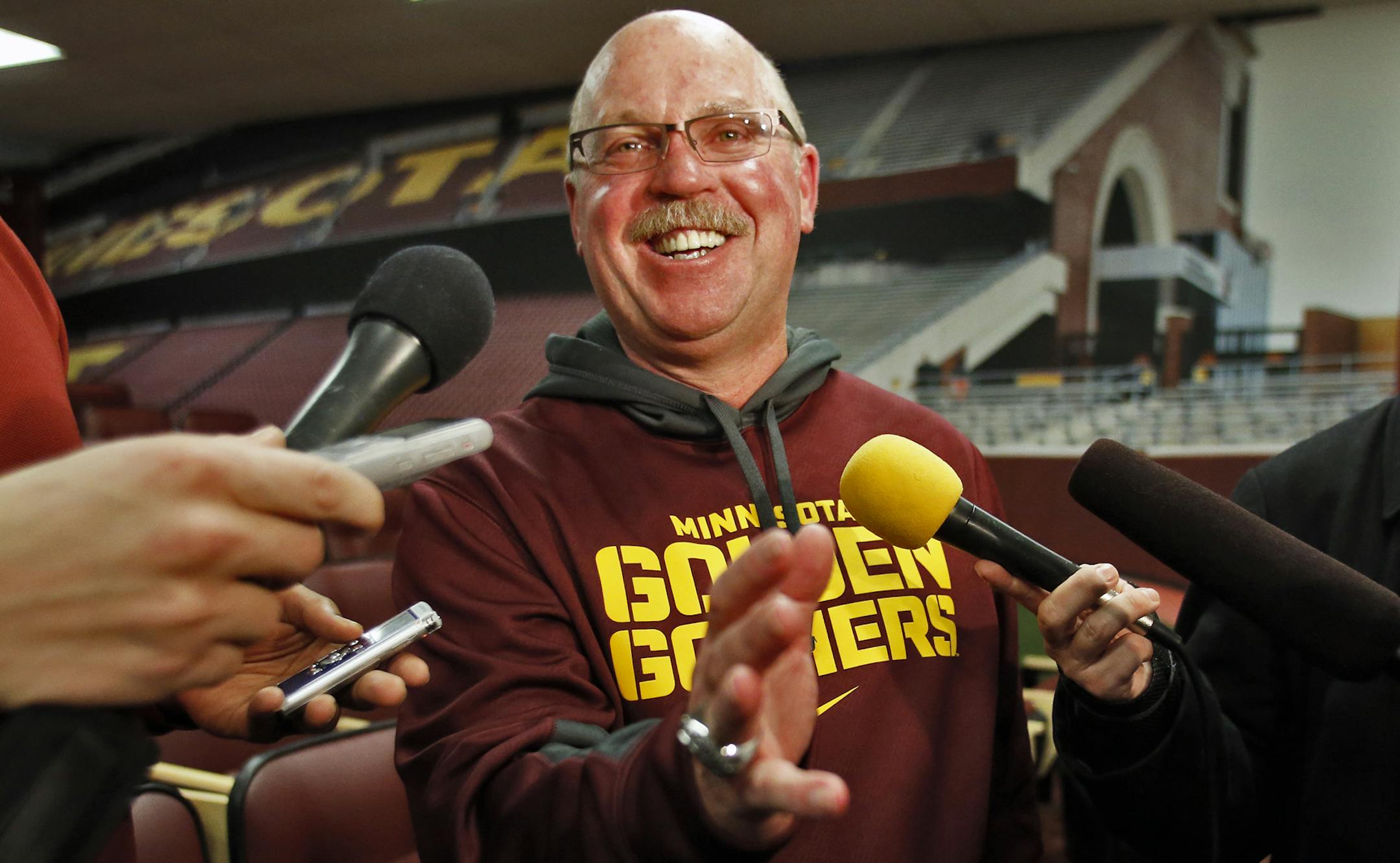
"Have we gone insane?" is what a Minnesota cattle farmer probably not much interested in March Madness asked. His question was a reaction to the news that Jerry Kill, the University of Minnesota football coach, had his $1.2 million salary increased to $2.1 million, plus perks, for guiding the Gophers to eight wins and five losses during the 2013 season. Maybe winning isn't everything. It certainly isn't for everyone.
No doubt Coach Kill is a nice enough guy and competent enough at what he does. And he didn't complain about the salary bump he received. Ohio State's Urban Meyer makes $4.6 million, plus perks, and he's in the same league.
It's hard to imagine anyone in his or her right mind seriously believing that the NCAA Division I big-money sports — football, basketball, hockey — have anything but a tendril connection to a university's higher-education missions. There are several fine student-athletes who get excellent grades while working very hard at their sports. The graduation rate for athletes and nonathletes is comparable, though the amount of money it takes to get a student-athlete a degree is hidden in a murk of red ink. But it seems obvious that the hazards of football seem well out of line with what health educators teach, and that at the D-1 level students need to learn how to keep their classes from interfering with their serious sports jobs.
Student-athletes must suspect they're part of an entertainment industry. Coach Kill was honest enough to fess up to it, and he left the impression that as a newcomer to the industry his new salary represents his fair market value.
But some of the people responsible for overseeing the numbers at D-1 higher-educational institutions maybe need some refresher courses in elementary arithmetic. Only 23 of the 228 NCAA D-1 sports programs generated enough income to cover expenses in 2012, and 16 of the 23 winners received subsidies by way of student fees and university and state funds. The other 205 were losers, as were the donors and taxpayers who picked up the tab. Losing seasons are a financial trend for most NCAA schools.
Meanwhile, the NCAA as an organization quietly showed a profit of $71 million for 2012. Meanwhile, rather noisily, state governments try to figure out how to pay their bills.
It's time to turn these big-time sports teams into what they really are: Businesses. Because I'm addicted to thrift, I think they should get off an unsustainable welfare system. Privatize them.
I'm not a spoilsport. I know that millions love to cheer for the logos and colors on the laundry they love. Big-time sports are major rituals that stimulate a deep need for community identity. As a kid in Michigan, I grew up loving the Spartans and Wolverines, and I got my graduate degrees as a Buckeye at Ohio State. When I married a Nebraska woman, I learned to love Cornhuskers, and because I pay taxes in Wisconsin, I have a Badger in me, and because my daughter is a student at the University of Iowa, I'm a Hawkeye, too. As a Minnesotan, I'm a devout Gopher, for reasons I can't fully explain. I want everyone to win.


