
Christmas trees are no get-rich-quick crop

Farmers must wait years for a tree to grow, and bad weather can wreak havoc on crops and sales.

December 21, 2013 at 11:28PM
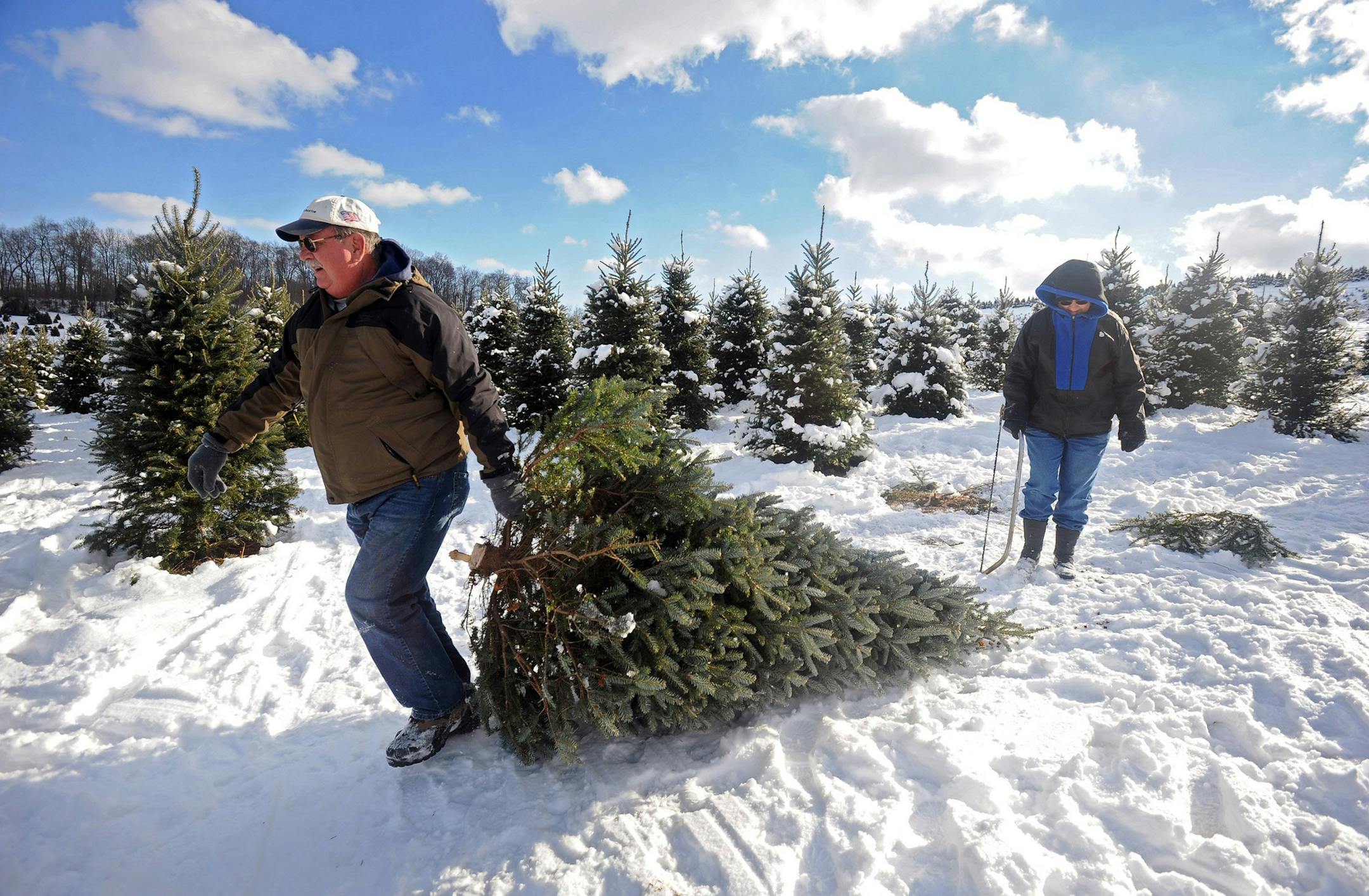
Mike and Flo Bukosky drag the tree they selected at Jarrettsville Nurseries in Street, MD, on Dec. 12, 2013. (Kenneth K. Lam/Baltimore Sun/MCT) ORG XMIT: 1146726
Mike and Flo Bukosky found a Christmas tree at a nursery in Street, Md. (The Minnesota Star Tribune)

By Jamie Smith Hopkins Baltimore Sun

The moment Fred and Kimberly Clark have waited for since planting firs, pines and other evergreens eight years ago finally arrived this month.

Their first Christmas tree sales.

All farming is delayed gratification, but the delay is particularly long for Christmas tree growers. The Clarks, who run two back-yard farms in Calvert County, Md., have done a lot of planting and shearing since 2005 in hopes of an eventual payoff.

It's not as easy as it looked to Fred Clark years ago when he stopped by a Christmas tree farm and watched a farmer accept customers' cash.

"I thought, 'I can sit on the back of my truck and collect money, too,' " joked Clark, 49, whose day job is as a ductwork contractor. "It turned out to be a little more work than that."

The number of Christmas tree farms has fallen in recent years and could continue to shrink. Some newcomers buy farms from retiring growers. And some — like the Clarks' Evergreen Knoll Christmas Tree Farm in Huntingtown, Md. — occasionally start up.

The risk of a truly awful year always hovers. Sometimes it hits.

Last year, superstorm Sandy walloped Pinetum Christmas Trees in Maryland, where Cindy Stacy and her husband, Marshall, have farmed for 43 years. They lost thousands of trees to high winds and heavy snow — trees that became 200 tractor-trailer loads of mulch.

"We only get one paycheck a year because we're tree farmers, so last year was sad," Cindy Stacy said. "We lost 70 percent of our income."

They didn't have insurance. Insure a tree at the start of its life, and you'll pay many times its retail value by the time you're ready to cut, Marshall Stacy said.

But the Stacys, now semiretired and collecting Social Security, survived and this season was much better.

When the Stacys bought their 370-acre property in 1970, it was already a tree farm — albeit a bankrupt one. The Clarks, by contrast, started from scratch on grassy back yards.

All told, they have about a half-acre of trees growing behind their previous home, which they now rent out. About the same number of trees grow behind their current home, a nearby property with more room for expansion because it's just under 10 acres.

Every year the Clarks plant 200 trees. They have 800 to 1,000 growing now, after heavy losses in the early years.

Kimberly Clark, 42, a federal worker, said interacting with the customers appeals to her more than the farming part. But she can see her husband likes the labor.

"That was kind of his route of getting out and I guess de-stressing in a lot of ways," she said. "If he had his choice and you could make a living farming nowadays, that's probably what he would do."

about the writer

about the writer

More from Business

See More
card image
Elizabeth Flores

Blood supplies often run short because fewer people donate over the holidays, leaving some hospitals with less than two-day supplies on hand.

card image
