

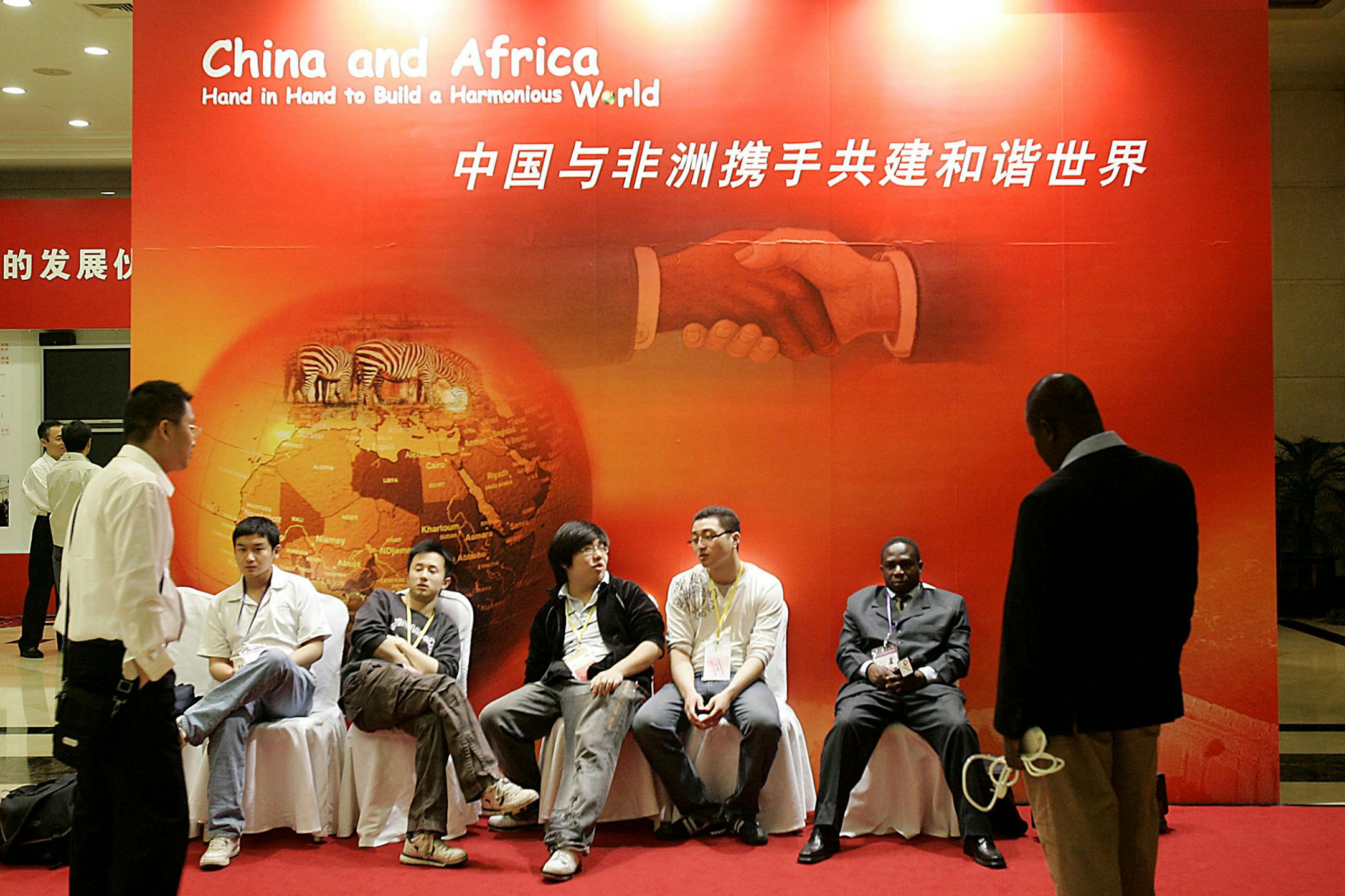
On the western edge of Lake Victoria in Uganda, 100 miles south of Kampala and an hour or more drive up a progressively narrower dirt track, is the site of what was meant to be one of the biggest Chinese commercial investments in Africa.
A rust-flecked sign marks the entrance to "Sseesamirembe City," part of the "Lake Victoria Free Trade Zone." It does not mark much. Teenage boys wheel bicycles laden with water containers past mud huts and scrubby banana fields. A few houses and half-built structures are the only evidence that there has been any development at all.
In 2008, the Lake Victoria Free Trade Zone was announced to the world as a transformative investment. Footage from CCTV, the Chinese state broadcaster, shows a meeting between Ugandan and Chinese officials in Beijing to confirm the deal. The investment, a partnership between a large Chinese firm and Ugandan investors, was to cover 200 square miles of land. They proposed building a "solar-powered" airport, manufacturing facilities and a distribution hub, as well as homes and agribusiness, all adding up to a new "eco-city." Some $1.5 billion would be invested in one of the least-developed parts of Uganda. It was suggested that thousands of Chinese farmers might settle the land and grow crops for export to China.
Of all these bold promises, none came to fruition.
As China's involvement in Africa deepens, and Western policymakers worry about whether they can compete with a flood of Chinese cash, the failed project is evidence of the mixed success of China's scramble for Africa. It is true that new railways and roads funded by China's Export-Import Bank, and its investment in copper mines and oil rigs in places such as Zambia and Angola, are changing the face of the continent. But there is growing evidence that some Chinese firms that leap into Africa are struggling with the same problems Africa has long given Western investors.
Reliable figures on the levels of Chinese investment in Africa are hard to come by. But those published by the Chinese Ministry of Commerce suggest the net annual flow of Chinese direct investment into Africa increased eightfold between 2005 and 2014, to $3.2 billion.
The total stock of Chinese investments grew twentyfold, to $32 billion. Direct comparisons to Western figures are harder still, but that makes China one of Africa's biggest investors. In addition, Chinese aid has increased, as have development loans made through the Export-Import Bank, which finances infrastructure projects built by Chinese firms.
However, according to Deborah Brautigam, a professor at the School of Advanced International Studies in Washington, much of the hype about Chinese firms buying up vast amounts of industry in Africa is overblown. Chinese FDI to Africa constitutes less than 3 percent of all Chinese foreign investment: Vastly more goes to other regions, especially Asia. Growth has slowed in recent years. And, as Brautigam shows in a new book investigating agricultural projects, many heavily reported Chinese projects do not amount to much.


