
Opinion | Once hyped as Duluth’s ‘next Sundance,’ the Catalyst Institute has moved on to ... Albania

The Catalyst Story Institute came to Duluth from Vermont. And now it has left town amid mounting red ink.

September 12, 2025 at 8:30PM
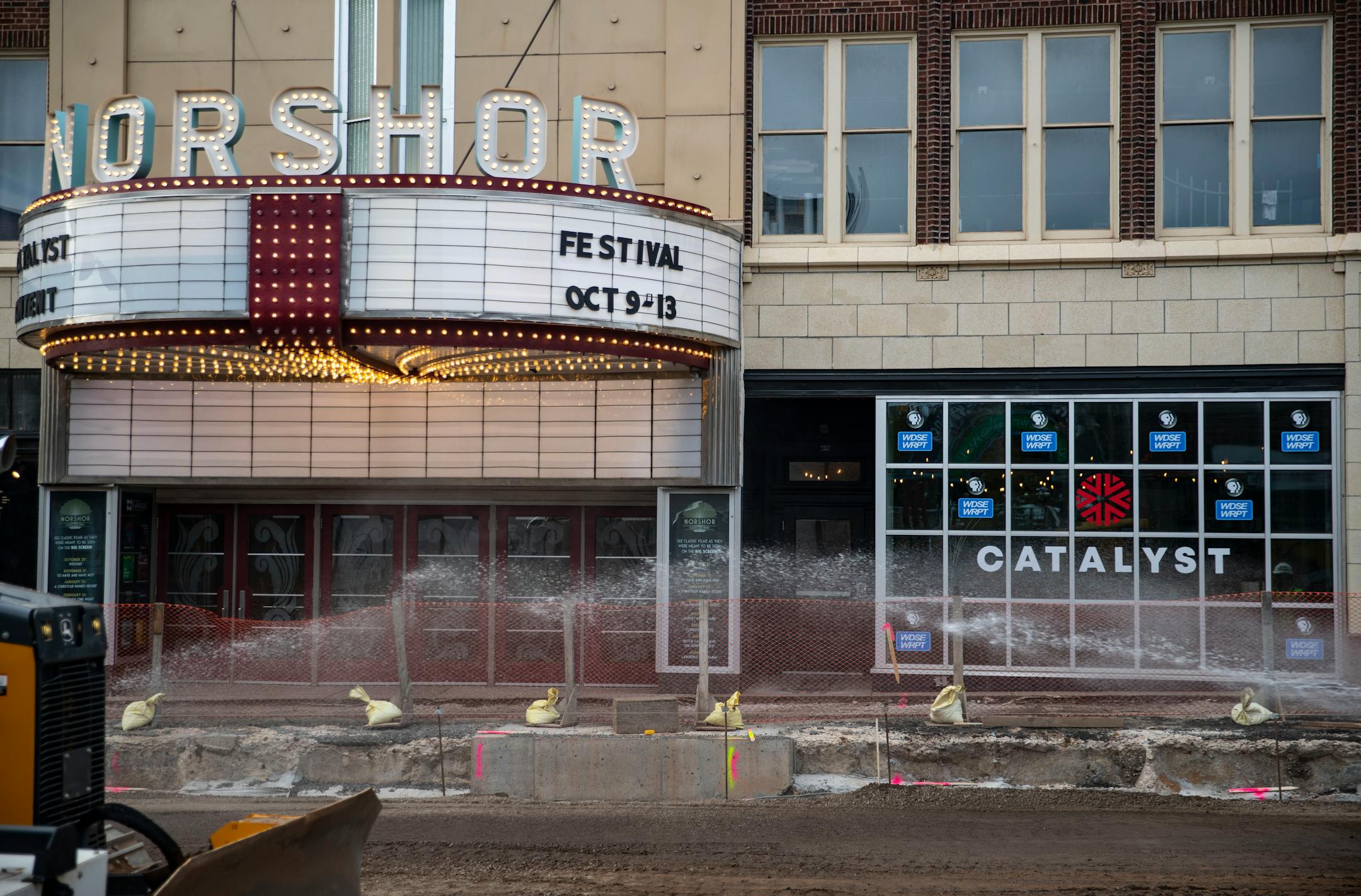
Advertisements for the Catalyst Film Festival were plastered on the outside of the NorShore theater in downtown Duluth in 2019. (Alex Kormann/The Minnesota Star Tribune)

Opinion editor’s note: Strib Voices publishes a mix of guest commentaries online and in print each day. To contribute, click here.

•••

Remember seven years ago when a guy from Vermont came to Duluth, hyping the city as the perfect place to match aspiring TV producers with visiting Hollywood execs? He also touted Duluth as a prime location to shoot big-budget movies.

“Could it be the next Sundance?” a Star Tribune article asked, echoed by TV anchors gushing over the “$1.5 million” that the Independent Television Festival (shortly after renamed Catalyst Content Festival) would pump into the city’s economy.

But today, would-be show-runners hoping Catalyst can introduce them to industry rainmakers might instead send their ideas to Rosemount. Or Lake Placid, N.Y. Or — this isn’t a joke — Albania.

Just not Duluth. After years of stoking dreams and dipping into the public till, the Catalyst Story Institute has moved on. It arrived in Minnesota in 2018 already $274,250 in the red, a debt that has since more than doubled to nearly three-quarters of a million dollars, according to its latest available IRS filings.

I hate saying I told you so, but somebody has to say it. And I have been since Catalyst’s arrival, though the story goes back further.

This isn’t the festival’s first move. Begun in Los Angeles in 2006, it relocated to Dover, Vermont, then to nearby Manchester, Vermont, before finding Duluth.

Now, the mailing address on the nonprofit’s most recent IRS filing is in Rosemount, the home of a former staffer who told me she forwards the mail to Albania. Its website also lists a 2026 festival in Lake Placid and a training site in New Orleans. But its main center of operations these days is now apparently Tirana, Albania.

“We’re thrilled to announce that Catalyst is expanding its international reach with a new hub in Albania!” Catalyst said in a Facebook post at the end of last year.

The man running the show is Philip Gilpin, Jr., a Boston College physics grad who worked in accounting at HBO for a decade before retreating to his parents’ bed and breakfast in Dover. That’s where he persuaded the festival’s founder to move it from L.A. and turn it over to him.

The concept was simple: Connect aspiring series creators to Hollywood executives who could bring their ideas to fruition. But while attendees paid their own way, execs expected theirs gratis — and junkets to Vermont weren’t cheap. After granting initial requests, Dover cut a subsequent ask of $50,000 to $35,000, and Gilpin packed up for slightly larger Manchester.

To be clear, the idea wasn’t to have it in a different city each year, like a professional association’s annual convention. With each move, Gilpin declared he’d found the endeavor’s new home. The payoff to the host town, he said, would come through food and lodging money spent by attendees, and eventually by landing a big studio production.

Two festivals later, Manchester balked, too. That’s when Gilpin found Duluth.

“We want to be a part of a place that is investing in itself, and sees the arts as an economic driver, a cultural driver, for decades to come,” he told MPR News at the time of his move to Duluth.

It was then that I introduced myself to Gilpin, after he gave a talk at a welcome party where he said that Manchester (he never mentioned Dover) didn’t appreciate the return it could potentially get by investing in his enterprise.

Coincidentally, I had produced an independent TV show — in Vermont, no less, even shooting part of it in Manchester — that aired on PBS stations and even picked up an Emmy. But if I expected we’d share yarns about iconic Manchester landmarks like the Equinox Hotel, he only mumbled something like “That’s nice” and turned away.

If he wasn’t interested in swapping stories, I certainly got more curious about his. By the time I reached my car, I’d pulled up the IRS filings on my phone and saw the $274,250 debt.

That didn’t stop Duluthians from opening their checkbooks. That first year, the city kicked in $50,000. St. Louis County and others also anted up. But nobody — nobody — said anything publicly about his finances. Frustrated, I decided to report it myself and invited Gilpin on my Wisconsin Public Radio show in 2019.

To his credit, he came. And he deflected.

“If somebody who is living in Wisconsin or Minnesota has a dream of telling stories [and] heard the way that you edited together that piece,” he said of my initial report, they might think “there’s something nefarious going on and it could dampen that person’s enthusiasm.”

As for the debt, he said it was standard “debt financing” — a strategy to grow the festival by luring more execs to it. The IRS filings, he claimed, weren’t an accurate portrayal because they only showed year-end balances, and as of July 2019, the 2018 deficit had been wiped clean.

“There’s over seven-figure assets on our current balance sheet,” Gilpin said.

Maybe there was — between filings. But the next year’s return showed $406,636 in the red. His explanation was a major sponsorship agreement had fallen through, which he was prohibited from talking about.

I eventually moved on from the story, except to check Catalyst’s yearly IRS filings. The debt consistently rose: from $415,908 in 2021, to $629,984 in 2022, to $714,893 in 2023, the last year publicly available.

By that time, Gilpin was receiving more attention for pushing Duluth and the state as filmmaking locations, successfully lobbying the Legislature to pass a Minnesota film production credit bill. His efforts did encourage some local moviemaking, though few projects exceeded the $1 million minimum budget required for the credit to kick in.

Meanwhile, the Catalyst Festival combined in 2022 with the Duluth-Superior Film Festival, Minnesota WebFest and the EDU Film Festival to run jointly as the “North Star Story Summit,” held in October in Duluth for a few years.

But not this year. Minnesota WebFest is now slated for the metro area with the Twin Cities Film Festival next month; the student-oriented EDU Festival was held in the Twin Cities last May, and searches for the Duluth-Superior Film Festival yielded broken links.

The next Catalyst festival listed on its website is Lake Placid in 2026. But its most prominent enterprise these days is promoting filmmaking in the Balkans, where Gilpin now lives, according to his Facebook profile.

“Hollywood Comes to Albania: Global Film Industry Scouts Country for Productions,” blares Euronews Albania, calling Catalyst’s partnership “a key milestone.”

So is Duluth history?

I reached out to Gilpin this week for comment on Catalyst’s current indebtedness and whether or not it would hold future programs in Duluth. He responded with a statement on behalf of the organization.

“Catalyst’s vision for Duluth was, and continues to be, as a creative hub for independent filmmakers and storytellers,” the statement read. Claiming successes in creating jobs, incentive programs and new revenue, it added: “We were able to deliver on all of these, and we are proud that our efforts benefited the community.”

And the debt?

“We believed so much in Duluth’s potential as a flourishing hub for filmmakers that we put ourselves in debt, including our CEO liquidating his personal life savings, to make it happen.”

But that wasn’t appreciated, the statement continued. Despite the money, jobs and opportunities that Catalyst brought to locals, “most did not reciprocate that support to any sustainable level.” In particular, the denial of a Duluth City Council grant “made it impossible to create a 2025 festival event at the quality level that everyone expects.”

According to Duluth City Councilor Roz Randorf, that denial was not based on the quality of programming by Catalyst or other arts groups, but a change in the way the city allocates funds out of its tourism tax. With the 2025 budget, the city now favors infrastructural projects that enhance tourism over direct grants to individual organizations.

“A lot of folks who were getting tourism tax dollars are no longer getting it,” Randorf said, adding that the city still supports local filmmaking projects with grants to the Upper Midwest Film Office under the state’s film incentive program.

Nonetheless, Catalyst does wish Duluth well, the statement said, adding that it hasn’t given up on its core mission “of making the storytelling arts more accessible to all artists around the world.”

As in: Today Albania, tomorrow …?

Robin Washington is a producer-host for Wisconsin Public Radio and a former editor-in-chief of the Duluth News Tribune. He lives in Duluth and St. Paul and can be reached at robin@robinwashington.com.

about the writer

about the writer

Robin Washington

More from Commentaries

See More
card image
Leila Navidi/The Minnesota Star Tribune

In government leadership, young people need to be ready to accept the torch, but previous generations can’t slow down their leg, or delay the pass.

card image
card image